Kirjojen hintavertailu. Mukana 12 016 292 kirjaa ja 12 kauppaa.

Kirjahaku

Etsi kirjoja tekijän nimen, kirjan nimen tai ISBN:n perusteella.

8 kirjaa tekijältä James R. Farr

Authority and Sexuality in Early Modern Burgundy (1550-1730)

Authority and Sexuality in Early Modern Burgundy (1550-1730)

James R. Farr

Oxford University Press Inc
1995
sidottu
A sociocultural analysis of the relationships among law, religion, and sexual morality in Burgundy during the Catholic Reformation, this book is divided into two, interrelated parts: the world of prescription and the world of practice. The first part examines the construction of authority, focusing primarily upon Burgundy's dominant elite legal community. The second part of the book examines the deployment of authority, and its appropriation by French men and women. The new moral order focused on sexuality and the imposition of this order involved a legal contest over the disposition of bodies, both male and female, be they priests, courting couples, victims of seduction or rape, or prostitutes. James Farr's book offers an unusually fertile approach to study the link between sexuality and criminality.

Who Was William Hickey?

Who Was William Hickey?

James R. Farr

Routledge
2019
sidottu
This book analyzes an example of life-writing, an autobiography that was written in the early nineteenth century and will appeal to readers of many disciplines who are interested in understanding the interconnectedness of memory, textual narrative, and ideas of selfhood. Moreover, this book reasserts the importance of the individual in history. It explains how personal narratives reveal the individual as a purposeful social actor pursuing particular objectives, but framed by cultural and social contexts, in this case by eighteenth-century London and Imperial India. The author of this autobiography, William Hickey, projects a sense of self formed by a combination of an interiorized self-consciousness (an awareness of himself as an autonomous individual, although not one prone to deep self-reflection) and a socially-turned self-fashioning. Like so many autobiographers of his time, Hickey’s self is realized through the production of a narrative, his self fixed and defined through the act of writing. As he wrote his memoirs, Hickey was engaged in purposeful textual representation to satisfy his perceived sense of place in that culture (above all, as a gentleman) while tacitly reflecting the constraints of that culture imposed upon the form and content of the text.
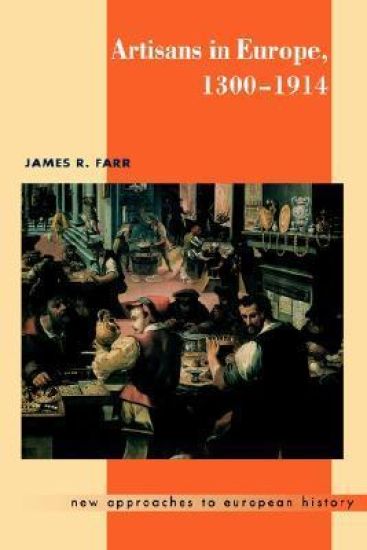
Artisans in Europe, 1300–1914

Artisans in Europe, 1300–1914

James R. Farr

Cambridge University Press
2000
sidottu
This book is a survey of the history of work in general and of European urban artisans in particular, from the late middle ages to the era of industrialization. Unlike traditional histories of work and craftsmen, this book offers a multi-faceted understanding of artisan experience situated in the artisans’ culture. It treats economic and institutional topics, but also devotes considerable attention to the changing ideologies of work, the role of government regulation in the world of work, the social history of craftspeople, the artisan in rebellion against the various authorities in his world, and the ceremonial and leisure life of artisans. Women, masters, journeymen, apprentices, and non-guild workers all receive substantial treatment. The book concludes with a chapter on the nineteenth century, examining the transformation of artisan culture, exploring how and why the early modern craftsman became the industrial wage-worker, mechanic or shopkeeper of the modern age.
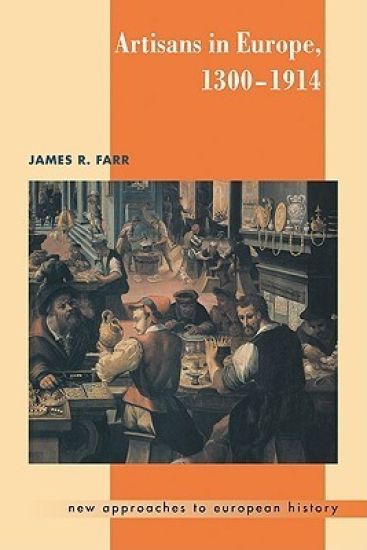
Artisans in Europe, 1300–1914

Artisans in Europe, 1300–1914

James R. Farr

Cambridge University Press
2000
pokkari
This book is a survey of the history of work in general and of European urban artisans in particular, from the late middle ages to the era of industrialization. Unlike traditional histories of work and craftsmen, this book offers a multi-faceted understanding of artisan experience situated in the artisans’ culture. It treats economic and institutional topics, but also devotes considerable attention to the changing ideologies of work, the role of government regulation in the world of work, the social history of craftspeople, the artisan in rebellion against the various authorities in his world, and the ceremonial and leisure life of artisans. Women, masters, journeymen, apprentices, and non-guild workers all receive substantial treatment. The book concludes with a chapter on the nineteenth century, examining the transformation of artisan culture, exploring how and why the early modern craftsman became the industrial wage-worker, mechanic or shopkeeper of the modern age.
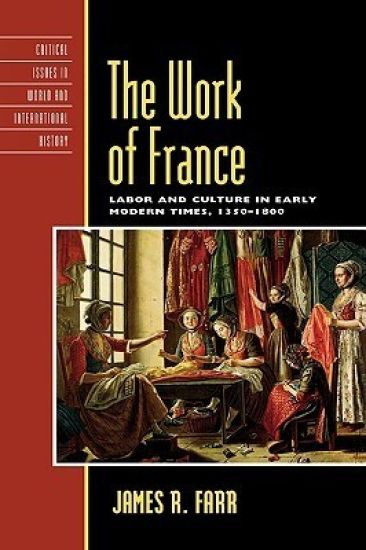
The Work of France

The Work of France

James R. Farr

Rowman Littlefield Publishers
2008
sidottu
This clearly written and deeply informed book explores the nature and meaning of work in early modern France. Distinguished historian James R. Farr considers the relationship between material life—specifically the work activities of both men and women—and the culture in which these activities were embedded. This culture, he argues, helped shape the nature of work, invested it with meaning, and fashioned the identities of people across the social spectrum. Farr vividly traces the daily lives of peasants, common laborers, domestic servants, prostitutes, street vendors, craftsmen and -women, merchants, men of the law, medical practitioners, and government officials. Work was recognized and valued as a means to earn a living, but it held a greater significance as a cultural marker of honor, identity, and status. Constants and continuities in work activities and their cultural aspects shared space with changes that were so profound and sweeping that France would be forever transformed. The author focuses on three salient, interconnected, and at times conflicting developments: the extension and integration of the market economy, the growth of the state's functions and governing apparatus, and the intensification of social hierarchy. Presenting a unified and compelling argument about the role of labor in society, Farr addresses a complex set of questions and succeeds masterfully at answering them. With its stylish writing and clear themes, this book will find a broad audience among students and scholars of early modern Europe, French history, economics, gender studies, anthropology, and labor studies.
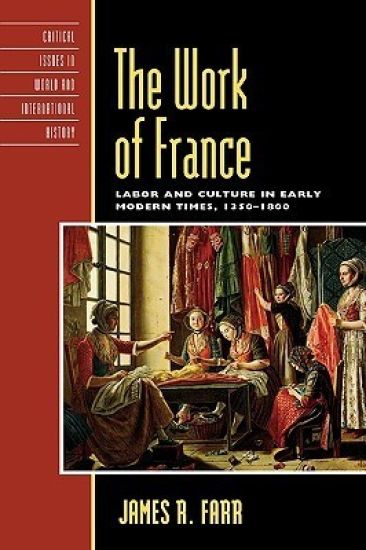
The Work of France

The Work of France

James R. Farr

Rowman Littlefield Publishers
2008
nidottu
This clearly written and deeply informed book explores the nature and meaning of work in early modern France. Distinguished historian James R. Farr considers the relationship between material life—specifically the work activities of both men and women—and the culture in which these activities were embedded. This culture, he argues, helped shape the nature of work, invested it with meaning, and fashioned the identities of people across the social spectrum. Farr vividly traces the daily lives of peasants, common laborers, domestic servants, prostitutes, street vendors, craftsmen and -women, merchants, men of the law, medical practitioners, and government officials. Work was recognized and valued as a means to earn a living, but it held a greater significance as a cultural marker of honor, identity, and status. Constants and continuities in work activities and their cultural aspects shared space with changes that were so profound and sweeping that France would be forever transformed. The author focuses on three salient, interconnected, and at times conflicting developments: the extension and integration of the market economy, the growth of the state's functions and governing apparatus, and the intensification of social hierarchy. Presenting a unified and compelling argument about the role of labor in society, Farr addresses a complex set of questions and succeeds masterfully at answering them. With its stylish writing and clear themes, this book will find a broad audience among students and scholars of early modern Europe, French history, economics, gender studies, anthropology, and labor studies.
A Tale of Two Murders

A Tale of Two Murders

James R. Farr

Duke University Press
2005
sidottu
As scandalous as any modern-day celebrity murder trial, the “Giroux affair” was a maelstrom of intrigue, encompassing daggers, poison, adultery, archenemies, servants, royalty, and legal proceedings that reached the pinnacle of seventeenth-century French society. In 1638 Philippe Giroux, a judge in the highest royal court of Burgundy, allegedly murdered his equally powerful cousin, Pierre Baillet, and Baillet’s valet, Philibert Neugot. The murders were all the more shocking because they were surrounded by accusations (particularly that Giroux had been carrying on a passionate affair with Baillet’s wife), conspiracy theories (including allegations that Giroux tried to poison his mother-in-law), and unexplained deaths (Giroux’s wife and her physician died under suspicious circumstances). The trial lasted from 1639 until 1643 and came to involve many of the most distinguished and influential men in France, among them the prince of CondÉ, Henri II Bourbon; the prime minister, Cardinal Richelieu; and King Louis XIII.James R. Farr reveals the Giroux affair not only as a riveting murder mystery but also as an illuminating point of entry into the dynamics of power, justice, and law in seventeenth-century France. Drawing on the voluminous trial records, Farr uses Giroux’s experience in the court system to trace the mechanisms of power-both the formal power vested by law in judicial officials and the informal power exerted by the nobility through patron-client relationships. He does not take a position on Giroux’s guilt or innocence. Instead, he allows readers to draw their own conclusions about who did what to whom on that ill-fated evening in 1638.
A Tale of Two Murders

A Tale of Two Murders

James R. Farr

Duke University Press
2005
pokkari
As scandalous as any modern-day celebrity murder trial, the “Giroux affair” was a maelstrom of intrigue, encompassing daggers, poison, adultery, archenemies, servants, royalty, and legal proceedings that reached the pinnacle of seventeenth-century French society. In 1638 Philippe Giroux, a judge in the highest royal court of Burgundy, allegedly murdered his equally powerful cousin, Pierre Baillet, and Baillet’s valet, Philibert Neugot. The murders were all the more shocking because they were surrounded by accusations (particularly that Giroux had been carrying on a passionate affair with Baillet’s wife), conspiracy theories (including allegations that Giroux tried to poison his mother-in-law), and unexplained deaths (Giroux’s wife and her physician died under suspicious circumstances). The trial lasted from 1639 until 1643 and came to involve many of the most distinguished and influential men in France, among them the prince of CondÉ, Henri II Bourbon; the prime minister, Cardinal Richelieu; and King Louis XIII.James R. Farr reveals the Giroux affair not only as a riveting murder mystery but also as an illuminating point of entry into the dynamics of power, justice, and law in seventeenth-century France. Drawing on the voluminous trial records, Farr uses Giroux’s experience in the court system to trace the mechanisms of power-both the formal power vested by law in judicial officials and the informal power exerted by the nobility through patron-client relationships. He does not take a position on Giroux’s guilt or innocence. Instead, he allows readers to draw their own conclusions about who did what to whom on that ill-fated evening in 1638.