Kirjojen hintavertailu. Mukana 12 390 323 kirjaa ja 12 kauppaa.

Kirjahaku

Etsi kirjoja tekijän nimen, kirjan nimen tai ISBN:n perusteella.

2 kirjaa tekijältä James R. Fichter

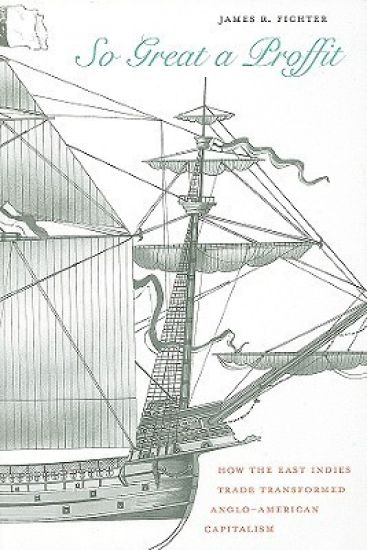
So Great a Proffit

So Great a Proffit

James R. Fichter

Harvard University Press
2010
sidottu
In a work of sweep and ambition, James Fichter explores how American trade proved pivotal to the evolution of capitalism in the United States and helped to shape the course of the British Empire.Before the American Revolution, colonial merchants were part of a trading network that spanned the globe. After 1783, U.S. merchants began trading in the East Indies independently, creating a new class of investor-capitalists and the first generation of American millionaires. Such wealth was startling in a country where, a generation earlier, the most prosperous Americans had been Southern planters. This mercantile elite brought its experience and affluence to other sectors of the economy, helping to concentrate capital and create wealth, and paving the way for the modern business corporation.Conducted on free trade principles, American trade in Asia was so extensive that it undermined the monopoly of the British East India Company and forced Britain to open its own free trade to Asia. The United States and the British Empire thus converged around shared, Anglo-American free-trade ideals and financial capitalism in Asia. American traders also provided a vital link to the Atlantic world for Dutch Java and French Mauritius, and were at the vanguard of Western contact with Polynesia and the Pacific Northwest.Based on an impressive array of sources from Europe, Asia, Africa, and the United States, this pathbreaking book revolutionizes our understanding of the early American economy in a global context and the relationship between the young nation and its former colonial master.
Tea

Tea

James R. Fichter

CORNELL UNIVERSITY PRESS
2023
sidottu
In Tea, James R. Fichter reveals that despite the so-called Boston Tea Party in 1773, two large shipments of tea from the East India Company survived and were ultimately drunk in North America. Their survival shaped the politics of the years ahead, impeded efforts to reimburse the company for the tea lost in Boston Harbor, and hinted at the enduring potency of consumerism in revolutionary politics. Tea protests were widespread in 1774, but so were tea advertisements and tea sales, Fichter argues. The protests were noisy and sometimes misleading performances, not clear signs that tea consumption was unpopular. Revolutionaries vilified tea in their propaganda and prohibited the importation and consumption of tea and British goods. Yet merchant ledgers reveal these goods were still widely sold and consumed in 1775. Colonists supported Patriots more than they abided by non-consumption. When Congress ended its prohibition against tea in 1776, it reasoned that the ban was too widely violated to enforce. War was a more effective means than boycott for resisting Parliament, after all, and as rebel arms advanced, Patriots seized tea and other goods Britons left behind. By 1776, protesters sought tea and, objecting to its high price, redistributed rather than destroyed it. Yet as Fichter demonstrates in Tea, by then the commodity was not a symbol of the British state, but of American consumerism.