Kirjojen hintavertailu. Mukana 11 705 692 kirjaa ja 12 kauppaa.

Kirjahaku

Etsi kirjoja tekijän nimen, kirjan nimen tai ISBN:n perusteella.

3 kirjaa tekijältä James R. Thompson

Empirical Model Building

Empirical Model Building

James R. Thompson

John Wiley Sons Inc
2011
sidottu
Praise for the First Edition "This...novel and highly stimulating book, which emphasizes solving real problems...should be widely read. It will have a positive and lasting effect on the teaching of modeling and statistics in general." - Short Book Reviews This new edition features developments and real-world examples that showcase essential empirical modeling techniques Successful empirical model building is founded on the relationship between data and approximate representations of the real systems that generated that data. As a result, it is essential for researchers who construct these models to possess the special skills and techniques for producing results that are insightful, reliable, and useful. Empirical Model Building: Data, Models, and Reality, Second Edition presents a hands-on approach to the basic principles of empirical model building through a shrewd mixture of differential equations, computer-intensive methods, and data. The book outlines both classical and new approaches and incorporates numerous real-world statistical problems that illustrate modeling approaches that are applicable to a broad range of audiences, including applied statisticians and practicing engineers and scientists. The book continues to review models of growth and decay, systems where competition and interaction add to the complextiy of the model while discussing both classical and non-classical data analysis methods. This Second Edition now features further coverage of momentum based investing practices and resampling techniques, showcasing their importance and expediency in the real world. The author provides applications of empirical modeling, such as computer modeling of the AIDS epidemic to explain why North America has most of the AIDS cases in the First World and data-based strategies that allow individual investors to build their own investment portfolios. Throughout the book, computer-based analysis is emphasized and newly added and updated exercises allow readers to test their comprehension of the presented material. Empirical Model Building, Second Edition is a suitable book for modeling courses at the upper-undergraduate and graduate levels. It is also an excellent reference for applied statisticians and researchers who carry out quantitative modeling in their everyday work.
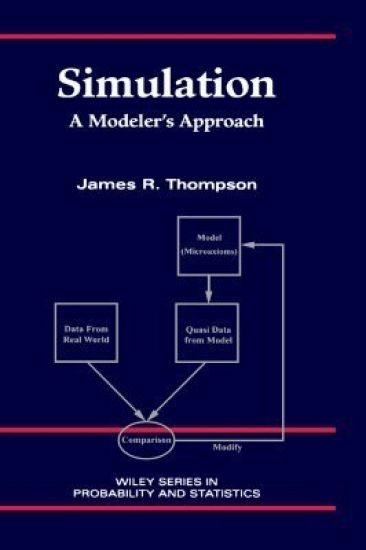
Simulation

Simulation

James R. Thompson

John Wiley Sons Inc
1999
sidottu
A unique, integrated treatment of computer modeling and simulation "The future of science belongs to those willing to make the shift to simulation-based modeling," predicts Rice Professor James Thompson, a leading modeler and computational statistician widely known for his original ideas and engaging style. He discusses methods, available to anyone with a fast desktop computer, for integrating simulation into the modeling process in order to create meaningful models of real phenomena. Drawing from a wealth of experience, he gives examples from trading markets, oncology, epidemiology, statistical process control, physics, public policy, combat, real-world optimization, Bayesian analyses, and population dynamics. Dr. Thompson believes that, so far from liberating us from the necessity of modeling, the fast computer enables us to engage in realistic models of processes in , for example, economics, which have not been possible earlier because simple stochastic models in the forward temporal direction generally become quite unmanageably complex when one is looking for such things as likelihoods. Thompson shows how simulation may be used to bypass the necessity of obtaining likelihood functions or moment-generating functions as a precursor to parameter estimation. Simulation: A Modeler’s Approach is a provocative and practical guide for professionals in applied statistics as well as engineers, scientists, computer scientists, financial analysts, and anyone with an interest in the synergy between data, models, and the digital computer.
Planning for the Success of Students with IEPs
The difficulties that students with individual education plans (IEPs) encounter in general education classrooms are rarely impossible to overcome. What is required to help them succeed is figuring out the individualised supports they need, whether that involves accessing technology, receiving assistance from a peer or adult, or curricular and assignment adaptations. In this comprehensive handbook, James R. Thompson synthesises the work of a team of experts to provide a roadmap for that problem-solving process. The Systematic Supports Planning Process is structured around three central questions that lead to identifying different types of support: "What to teach?"—curricular adaptations"How to teach?"—instructional supports"How to promote participation?—participation supports Packed with easy-to-follow guidelines, as well as implementation tools and examples, this book is a one-stop reference for planning, delivering, monitoring and evaluating the supports that students with IEPs require.