Kirjojen hintavertailu. Mukana 12 390 323 kirjaa ja 12 kauppaa.

Kirjahaku

Etsi kirjoja tekijän nimen, kirjan nimen tai ISBN:n perusteella.

6 kirjaa tekijältä James Rich

Apple

Apple

James Rich

Hardie Grant Books (UK)
2019
sidottu
Who doesn't love apples? Grown, harvested and eaten for centuries, apples play an important role in everyday life and are enjoyed in a huge variety of ways.Author James Rich hails from apple country in Somerset, England, where his family own a cider farm. Apples, it could be said, are in his blood, this is a collection of over 90 of his best-loved recipes. Try your hand at a summery Crunchy apple, cherry and kale salad, a comforting Slow-roasted pork belly and pickled apple, and an Ultimate apple crumble, all washed down with a Cider and thyme cocktail. James uses whole apples as well as cider, apple juice, cider brandy and cider vinegar to add depth to his dishes.Apples can be delicate and complementary, floral and simple or they can be bold, sharp and stand out from the crowd. Set to the backdrop of his family’s stunning apple, Apple is a celebration of this humble fruit.
Orchard

Orchard

James Rich

Hardie Grant Books (UK)
2022
sidottu
In Orchard cook and writer James Rich explores the huge variety of food that can be found in the English countryside; whether that is in the ancient orchards and hedgerows abundant with ingredients or the humble veg patch or kitchen garden verdant with home-grown staples. Celebrating fruit, including pears, plums, cherries, strawberries, gooseberries, elderflower, blackberries as well and quinces, medlars and apples, James offers more than 60 delightful recipes – both sweet and savoury – that are inspired by some of the most famous and delicious home-grown produce from England’s ancient gardens. From Slow-Roasted Pulled Harissa Lamb with Apricot & Chilli Jam or Chicken and Cherry Tray Bake for a special occasion feast, to a simple Apple, Plum and Walnut Cobbler or Chocolate Cobnut Tart for a warming autumnal pudding, James draws inspiration from seasonal produce that will gently encourage you to explore and cook from your own kitchen gardens. With a focus on core fruits, vegetables and nuts that are grown in orchards and among hedgerows, but which are also easily accessible for people everywhere, as well as a note on foraging and the kitchen pantry, Orchard is a treasure trove of edible gems that you will return to cook from, time and time again.
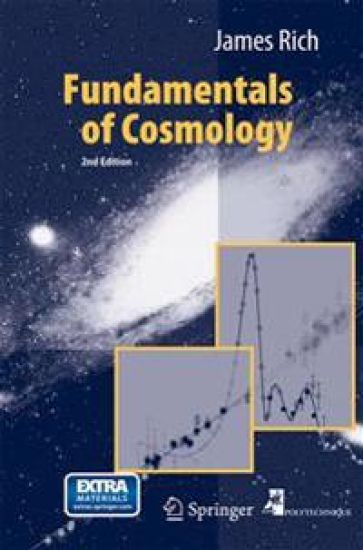
Fundamentals of Cosmology

Fundamentals of Cosmology

James Rich

Springer-Verlag Berlin and Heidelberg GmbH Co. K
2010
sidottu
Thisisthesecondeditionofabookonthephenomenological foundations ofmodern cosmology. The ?rst edition was surprisingly well timed. In the preceding 3 years, advances in astronomy had laid the foundations of the dark-energy/dark-matter c- mological model. In 1998, observations of type Ia supernova by the Supernova C- mology Project and High Z team suggested that the expansion of the universe is accelerating. In 2000, Boomerang and Maxima observed clearly the ?rst acoustic peak in the anisotropy spectrum of the cosmic microwave background. The position of the peak strongly suggested that the density of the universe was near critical. These two observations reconciled popular in?ationary models with the heretofore embarrassing insistence by astronomers that the clumping of galaxies required that the mass density of the universe be only about 25% of the critical density. The sup- nova data told us that the rest was dark energy in the form of an effective vacuum energy or cosmological constant. The so-called LambdaCDM model became the standard model. Eight years later, the observational data has improved tremendously as a c- parison of the ?gures in the two editions will demonstrate. Surprisingly, all this incredible data has failed to ?nd any clear failure of the?CDM model. Among the observational advances, the most obvious comes from the WMAP satellitewho,alongtheground-basedexperimentslikeACBAR,yieldedtheexquisite series of peaks in the CMB temperature anisotropy spectrum shown in Fig. 7.11.
Fundamentals of Cosmology

Fundamentals of Cosmology

James Rich

Springer-Verlag Berlin and Heidelberg GmbH Co. K
2014
nidottu
Thisisthesecondeditionofabookonthephenomenological foundations ofmodern cosmology. The ?rst edition was surprisingly well timed. In the preceding 3 years, advances in astronomy had laid the foundations of the dark-energy/dark-matter c- mological model. In 1998, observations of type Ia supernova by the Supernova C- mology Project and High Z team suggested that the expansion of the universe is accelerating. In 2000, Boomerang and Maxima observed clearly the ?rst acoustic peak in the anisotropy spectrum of the cosmic microwave background. The position of the peak strongly suggested that the density of the universe was near critical. These two observations reconciled popular in?ationary models with the heretofore embarrassing insistence by astronomers that the clumping of galaxies required that the mass density of the universe be only about 25% of the critical density. The sup- nova data told us that the rest was dark energy in the form of an effective vacuum energy or cosmological constant. The so-called LambdaCDM model became the standard model. Eight years later, the observational data has improved tremendously as a c- parison of the ?gures in the two editions will demonstrate. Surprisingly, all this incredible data has failed to ?nd any clear failure of the?CDM model. Among the observational advances, the most obvious comes from the WMAP satellitewho,alongtheground-basedexperimentslikeACBAR,yieldedtheexquisite series of peaks in the CMB temperature anisotropy spectrum shown in Fig. 7.11.
Fundamentals in Nuclear Physics

Fundamentals in Nuclear Physics

Jean-Louis Basdevant; James Rich; Michael Spiro

Springer-Verlag New York Inc.
2005
sidottu
Nuclear physics began one century ago during the “miraculous decade” - tween 1895 and 1905 when the foundations of practically all modern physics were established. The period started with two unexpected spino?s of the Crooke’s vacuum tube: Roentgen’s X-rays (1895) and Thomson’s electron (1897), the ?rst elementary particle to be discovered. Lorentz and Zeemann developed the the theory of the electron and the in?uence of magnetism on radiation. Quantum phenomenology began in December, 1900 with the - pearance of Planck’s constant followed by Einstein’s 1905 proposal of what is now called the photon. In 1905, Einstein also published the theories of relativity and of Brownian motion, the ultimate triumph of Boltzman’s s- tistical theory, a year before his tragic death. For nuclear physics, the critical discovery was that of radioactivity by Becquerel in 1896. By analyzing the history of science, one can be convinced that there is some rationale in the fact that all of these discoveries came nearly sim- taneously, after the scienti?cally triumphant 19th century. The exception is radioactivity, an unexpected baby whose discovery could have happened s- eral decades earlier. Talentedscientists,theCuries,Rutherford,andmanyothers,tookthe- servationofradioactivityandconstructedtheideasthatarethesubjectofthis book. Of course, the discovery of radioactivity and nuclear physics is of much broader importance. It lead directly to quantum mechanics via Rutherford’s planetary atomic model and Bohr’s interpretation of the hydrogen spectrum. This in turn led to atomic physics, solid state physics, and material science.
Fundamentals in Nuclear Physics

Fundamentals in Nuclear Physics

Jean-Louis Basdevant; James Rich; Michael Spiro

Springer-Verlag New York Inc.
2010
nidottu
Nuclear physics began one century ago during the “miraculous decade” - tween 1895 and 1905 when the foundations of practically all modern physics were established. The period started with two unexpected spino?s of the Crooke’s vacuum tube: Roentgen’s X-rays (1895) and Thomson’s electron (1897), the ?rst elementary particle to be discovered. Lorentz and Zeemann developed the the theory of the electron and the in?uence of magnetism on radiation. Quantum phenomenology began in December, 1900 with the - pearance of Planck’s constant followed by Einstein’s 1905 proposal of what is now called the photon. In 1905, Einstein also published the theories of relativity and of Brownian motion, the ultimate triumph of Boltzman’s s- tistical theory, a year before his tragic death. For nuclear physics, the critical discovery was that of radioactivity by Becquerel in 1896. By analyzing the history of science, one can be convinced that there is some rationale in the fact that all of these discoveries came nearly sim- taneously, after the scienti?cally triumphant 19th century. The exception is radioactivity, an unexpected baby whose discovery could have happened s- eral decades earlier. Talentedscientists,theCuries,Rutherford,andmanyothers,tookthe- servationofradioactivityandconstructedtheideasthatarethesubjectofthis book. Of course, the discovery of radioactivity and nuclear physics is of much broader importance. It lead directly to quantum mechanics via Rutherford’s planetary atomic model and Bohr’s interpretation of the hydrogen spectrum. This in turn led to atomic physics, solid state physics, and material science.