Kirjojen hintavertailu. Mukana 11 244 527 kirjaa ja 12 kauppaa.

Kirjahaku

Etsi kirjoja tekijän nimen, kirjan nimen tai ISBN:n perusteella.

13 kirjaa tekijältä James Romm

Herodotus

Herodotus

James Romm

Yale University Press
1999
pokkari
Herodotus, widely known as the father of history, was also described by Aristotle as a mythologos, or "tale-teller." In this stylish and insightful book, intended for both general readers and students, James Romm argues that the author of the Histories was both a historian—in the original sense of "one who inquires"—and a master storyteller.Although most ancient historians wrote only about events they themselves had lived through, Herodotus explored an era well before his own time—from the rise of the Persian Empire to the Persian invasions of Greece in 490 and 480 B.C., the heroic fight of the Greeks against the invaders, and the final Greek victory. Working without the aid of written sources, Herodotus traveled widely and wove into his chronology descriptions of people and countries he visited and anecdotes that shed light on their lives and customs. Romm discusses the historical background of Herodotus`s life and work, his moralistic approach to history, his insatiable fascination with people and places, his literary powers, and the question of the historical "truth" behind the stories he relates. He gives general readers a fresh appreciation of the Histories as a work encompassing fiction and nonfiction, myth and history, and poetry and prose. Herodotus becomes not simply a source of historical data but a masterful and artistic author who created a radically new literary genre.Hermes BooksJohn Herington, Founding Editor
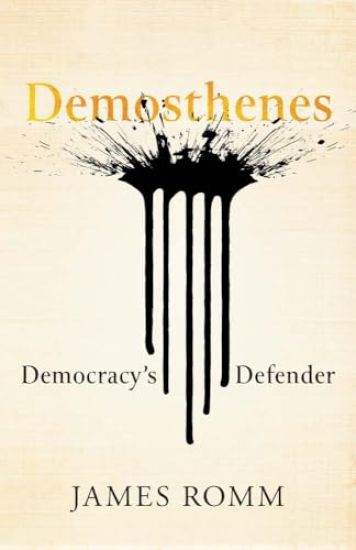
Demosthenes

Demosthenes

James Romm

YALE UNIVERSITY PRESS
2025
sidottu
The tragic story of ancient Greece’s last democratic leader and his doomed fight to save Athens from Macedonian domination In the spring of 340 BCE, news arrived that Philip of Macedon had seized a town in central Greece, a base from which he could march on Athens. In the fierce debates about how to respond to the rising threat in the North, Demosthenes, the greatest orator of his day, goaded the Athenian Assembly into confronting Philip on the field of battle. Though that effort failed and Athens fell into the grip of Alexander the Great, Philip’s son and successor, Demosthenes had established himself as one of history’s most eloquent defenders of democracy. In this thrilling biography of the man who led the charge for Greek freedom, James Romm follows Demosthenes from his early career as a legal speech writer through his rise in politics, his fall from grace in a corruption scandal, and his desperate flight to the island of Calauria—where he took his own life rather than submit to Macedonian forces. As he brings to life the bare-knuckle, insult-filled verbal brawls of Athenian orators, Romm not only explores the mind of the man who took on the challenge of saving Greek freedom but also shows how democracies can be destroyed by infighting and internal division.
Demetrius

Demetrius

James Romm

YALE UNIVERSITY PRESS
2023
pokkari
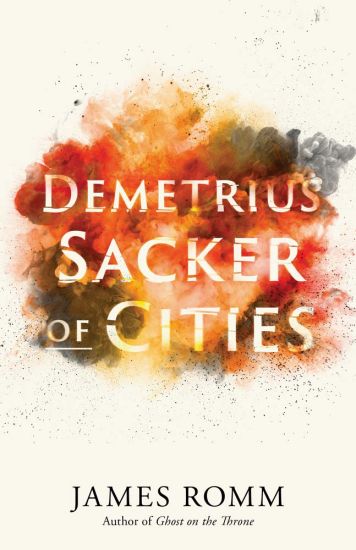
A portrait of one of the ancient world’s first political celebrities, who veered from failure to success and back again “This colorful biography of Demetrius . . . explores his rich inner life and reveals an ancient world of violence and intrigue.”—New York Times Book Review The life of Demetrius (337–283 BCE) serves as a through-line to the forty years following the death of Alexander the Great (323–282 BCE), a time of unparalleled turbulence and instability in the ancient world. With no monarch able to take Alexander’s place, his empire fragmented into five pieces. Capitalizing on good looks, youth, and sexual prowess, Demetrius sought to weld those pieces together and recover the dream of a single world state, with a new Alexander—himself—at its head. He succeeded temporarily, but in crucial, colossal engagements—a massive invasion of Egypt, a siege of Rhodes that went on for a full year, and the Battle of Ipsus—he came up just short. He ended his career in a rash invasion of Asia and became the target of a desperate manhunt, only to be captured and destroyed by his own son-in-law. James Romm tells the story of Demetrius the Besieger’s rise and spectacular fall but also explores his vibrant inner life and family relationships to depict a real, complex, and recognizable figure.
Ghost on the Throne: Ghost on the Throne: The Death of Alexander the Great and the Bloody Fight for His Empire
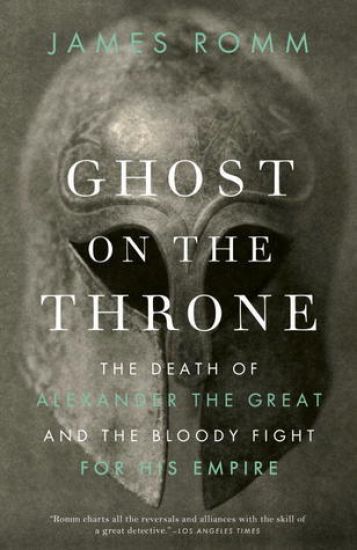
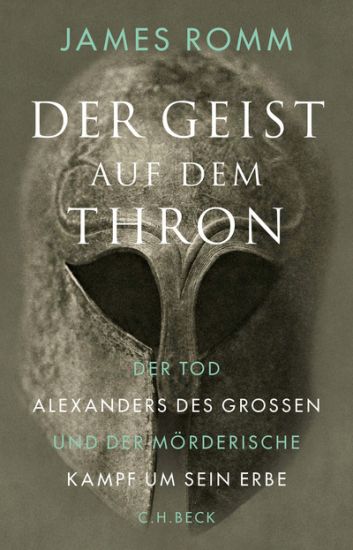
When Alexander the Great died at the age of thirty-two, his empire stretched from the Adriatic Sea in the west all the way to modern-day India in the east. In an unusual compromise, his two heirs--a mentally damaged half brother, Philip III, and an infant son, Alexander IV, born after his death--were jointly granted the kingship. But six of Alexander's Macedonian generals, spurred by their own thirst for power and the legend that Alexander bequeathed his rule "to the strongest," fought to gain supremacy. Perhaps their most fascinating and conniving adversary was Alexander's former Greek secretary, Eumenes, now a general himself, who would be the determining factor in the precarious fortunes of the royal family. James Romm, professor of classics at Bard College, brings to life the cutthroat competition and the struggle for control of the Greek world's greatest empire.
Dying Every Day

Dying Every Day

James Romm

Vintage Books
2014
pokkari
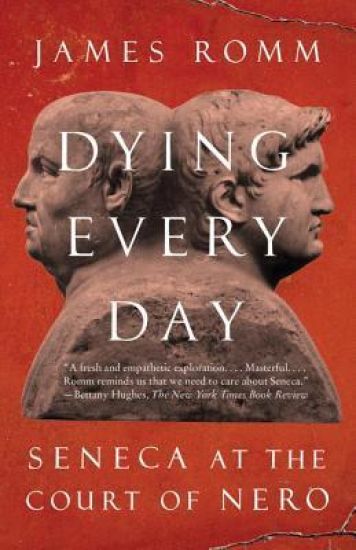
From acclaimed classical historian, author of Ghost on the Throne a high-stakes drama full of murder, madness, tyranny, perversion, with the sweep of history on the grand scale. At the center, the tumultuous life of Seneca, ancient Rome's preeminent writer and philosopher, beginning with banishment in his fifties and subsequent appointment as tutor to twelve-year-old Nero, future emperor of Rome. Controlling them both, Nero's mother, Julia Agrippina the Younger, Roman empress, great-granddaughter of the Emperor Augustus, sister of the Emperor Caligula, niece and fourth wife of Emperor Claudius. James Romm seamlessly weaves together the life and written words, the moral struggles, political intrigue, and bloody vengeance that enmeshed Seneca the Younger in the twisted imperial family and the perverse, paranoid regime of Emperor Nero, despot and madman. Romm writes that Seneca watched over Nero as teacher, moral guide, and surrogate father, and, at seventeen, when Nero abruptly ascended to become emperor of Rome, Seneca, a man never avid for political power became, with Nero, the ruler of the Roman Empire. We see how Seneca was able to control his young student, how, under Seneca's influence, Nero ruled with intelligence and moderation, banned capital punishment, reduced taxes, gave slaves the right to file complaints against their owners, pardoned prisoners arrested for sedition. But with time, as Nero grew vain and disillusioned, Seneca was unable to hold sway over the emperor, and between Nero's mother, Agrippina--thought to have poisoned her second husband, and her third, who was her uncle (Claudius), and rumored to have entered into an incestuous relationship with her son--and Nero's father, described by Suetonius as a murderer and cheat charged with treason, adultery, and incest, how long could the young Nero have been contained? Dying Every Day is a portrait of Seneca's moral struggle in the midst of madness and excess. In his treatises, Seneca preached a rigorous ethical creed, exalting heroes who defied danger to do what was right or embrace a noble death. As Nero's adviser, Seneca was presented with a more complex set of choices, as the only man capable of summoning the better aspect of Nero's nature, yet, remaining at Nero's side and colluding in the evil regime he created. Dying Every Day is the first book to tell the compelling and nightmarish story of the philosopher-poet who was almost a king, tied to a tyrant--as Seneca, the paragon of reason, watched his student spiral into madness and whose descent saw five family murders, the Fire of Rome, and a savage purge that destroyed the supreme minds of the Senate's golden age.
Theophrastus' Characters

Theophrastus' Characters

James Romm

Callaway Editions,U.S.
2018
sidottu
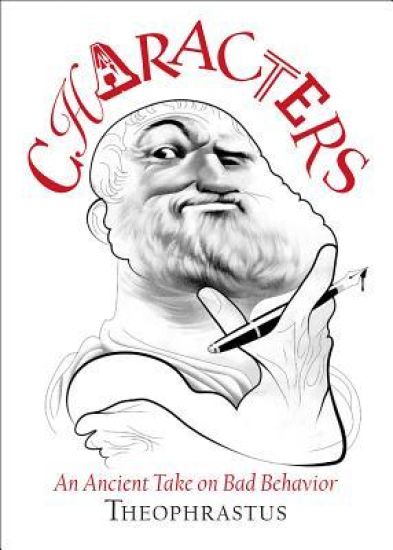
The more things change, the more they stay the same: Theophrastus' Characters, a classical Greek text newly translated for a modern audience, is a joyful festival of fault-finding. Theophrastus' Characters is a joyous festival of fault-finding: a collection of thirty closely observed personality portraits, defining the full spectrum of human flaws, failings, and follies. With piquant details of speech and behavior taken straight off the streets of ancient Athens, Theophrastus gives us sketches of the mean, vile, and annoying that are comically distorted yet vividly real.
Plato and the Tyrant

Plato and the Tyrant

James Romm

WW NORTON CO
2025
sidottu
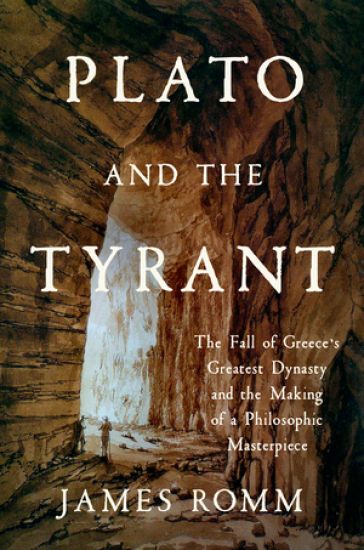
Many people know something of Plato’s works, yet few are familiar with his life outside of his writings. In Plato and the Tyrant, acclaimed classicist James Romm uses a little-known set of Plato’s personal letters to introduce the man behind the ethereal image and to explore the formation of his most famous work, Republic. In the second half of his life, an already famous Plato involved himself in the affairs of the two Dionysii, a father and son who ruled Syracuse, at that time the greatest power in the Greek world. Plato’s interventions in the violent contest between Dionysius the Younger and his brother-in-law, Dion—with whom Plato may have had a long love affair—were the backdrop and perhaps the motivation for his masterwork. In a thrilling narrative, Romm captures how Plato’s experiment in enlightened autocracy spiralled into catastrophe and gives us a new account of the origins of Western political philosophy.
The Landmark Arrian

The Landmark Arrian

James Romm

Presidio Press
2012
nidottu
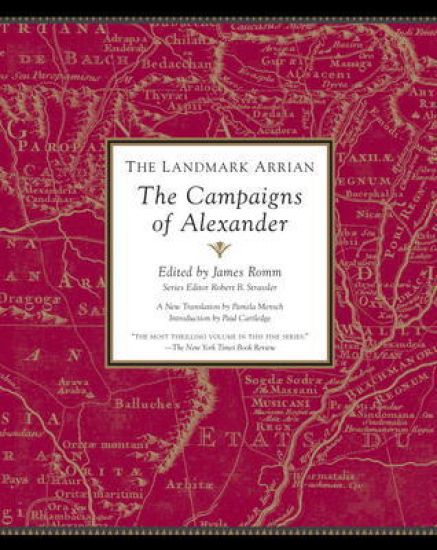
During twelve years of continuous campaigns, Alexander conquered an empire that stretched from the shores of the Adriatic to the edge of modern India. Arrian's history of those conquests, the most reliable and detailed account to emerge from the ancient world, is a work that will fascinate readers interested in classical studies, the history of warfare, and the origins of East-West tensions that still simmer today in Iraq, Iran, and Afghanistan. Drawing on Ptolemy's memoirs and other sources that have not survived antiquity, Arrian's portrait of Alexander is unmatched for its accuracy and immediacy. Having served as a high Roman official with command of an army, Arrian had a unique perspective on Alexander, imbued with a level of understanding that only firsthand military experience can provide.In the richly illustrated and annotated style of the Landmark series, The Campaigns of Alexander, which features an engaging and eloquent new translation by Pamela Mensch, brings together some of the pre-eminent classics scholars at work today to create what is certain to be the definitive edition of this essential work of history.About the AuthorJames Romm is Professor of Classics at Bard College. He has received fellowships from the Guggenheim Foundation and the National Endowment for the Humanities. His books include The Edges of the Earth in Ancient Thought and the forthcoming Ghost on the Throne: The Death of Alexander the Great and the War for Crown and Empire.
The Sacred Band

The Sacred Band

James Romm

SIMON SCHUSTER
2022
pokkari
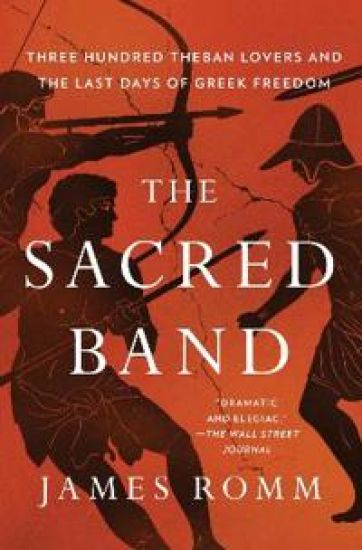
From classicist James Romm comes a “striking…fascinating” (Booklist) deep dive into the last decades of ancient Greek freedom leading up to Alexander the Great’s destruction of Thebes—and the saga of the greatest military corps of the time, the Theban Sacred Band, a unit composed of 150 pairs of male lovers.The story of the Sacred Band, an elite 300-man corps recruited from pairs of lovers, highlights a chaotic era of ancient Greek history, four decades marked by battles, ideological disputes, and the rise of vicious strongmen. At stake was freedom, democracy, and the fate of Thebes, at this time the leading power of the Greek world. The tale begins in 379 BC, with a group of Theban patriots sneaking into occupied Thebes. Disguised in women’s clothing, they cut down the agents of Sparta, the state that had cowed much of Greece with its military might. To counter the Spartans, this group of patriots would form the Sacred Band, a corps whose history plays out against a backdrop of Theban democracy, of desperate power struggles between leading city-states, and the new prominence of eros, sexual love, in Greek public life. After four decades without a defeat, the Sacred Band was annihilated by the forces of Philip II of Macedon and his son Alexander in the Battle of Chaeronea—extinguishing Greek liberty for two thousand years. Buried on the battlefield where they fell, they were rediscovered in 1880—some skeletons still in pairs, with arms linked together. From violent combat in city streets to massive clashes on open ground, from ruthless tyrants to bold women who held their era in thrall, The Sacred Band recounts “in fluent, accessible prose” (The Wall Street Journal) the twists and turns of a crucial historical moment: the end of the treasured freedom of ancient Greece.
Since You're Mortal . . .: Life Lessons from the Lost Greek Plays
"The truly happy man ought to stay at home." "Hunger, and lack of coin, put a stop to love." "Hades, alone of the gods, does not enjoy bribes." These quotes--and hundreds of others from the great Greek dramatists, including Sophocles, Aeschylus, and Menander--were preserved in the fifth century AD, when a man named Stobaeus compiled an anthology to inspire and instruct his son. The quotes were pithy packets of wisdom expressed in eloquent verse and selected with a father's discerning eye: some prompt "aha" moments, others offer wit or dark humor, still others give moral insight. In Since You're Mortal . . ., James Romm is the first to translate fragments saved by Stobaeus as poetry for modern English-language readers. Vividly rendered and beautifully presented, this volume serves as an ages-old but timeless guide to living a thoughtful, virtuous life.
Plato and the Tyrant

Plato and the Tyrant

James Romm

WW NORTON CO
2026
nidottu
“[E]xcellent . . . a deft and engaging work of history, philosophy and biography . . . a kind of intellectual thriller.” —Becca Rothfeld, Washington Post From an eminent historian and classicist, an incisive portrait of the philosopher Plato, showing how the ideas in his masterwork, Republic, were tested by violent events in the most powerful Greek city of the era.