Kirjojen hintavertailu. Mukana 11 717 486 kirjaa ja 12 kauppaa.

Kirjahaku

Etsi kirjoja tekijän nimen, kirjan nimen tai ISBN:n perusteella.

17 kirjaa tekijältä James T. Bennett

Stifling Political Competition

Stifling Political Competition

James T. Bennett

Springer-Verlag New York Inc.
2008
sidottu
Stifling Political Competition examines the history and array of laws, regulations, subsidies and programs that benefit the two major parties and discourage even the possibility of a serious challenge to the Democrat-Republican duopoly. The analysis synthesizes political science, economics and American history to demonstrate how the two-party system is the artificial creation of a network of laws, restrictions and subsidies that favor the Democrats and Republicans and cripple potential challenges. The American Founders, as it has been generally forgotten, distrusted political parties. Nowhere in the U.S. Constitution are parties mentioned, much less given legal protection or privilege. This provocative book traces how by the end of the Civil War the Republicans and Democrats had guaranteed their dominance and subsequently influenced a range of policies developed to protect the duopoly. For example, Bennett examines how the Federal Election Campaign Act of 1971 (as amended in 1974 and 1976), which was sold to the public as a nonpartisan act of good government reformism actually reinforced the dominance of the two parties. While focused primarily on the American experience, the book does consider the prevalence of two-party systems around the world (especially in emerging democracies) and the widespread contempt with which they are often viewed. The concluding chapter considers the potential of truly radical reform toward opening the field to vigorous, lively, contentious third-party candidacies that might finally offer alienated voters a choice, not an echo.

The Politics of American Feminism

The Politics of American Feminism

James T. Bennett

University Press of America
2007
nidottu
This work assesses, with scholarly scrupulousness and irreverent wit, the ways in which the American male is being blamed, castigated, slandered, emasculated, and just plain harassed for a multitude of crimes and sins because of a single trait: "maleness." From cradle to grave, public policy and the teachings of the groves of the academe are increasingly shaped by an anti-male bias. Chapters examine the ways in which American men and maleness are punished in childhood; in school; in history texts; in language; in the wallet; in religion; and even in recreation. Although the book's tone is often light, the subject is a serious one that the mainstream media often avoids. The Politics of American Feminism debunks dated myths, defends individual liberty against feminist assaults, offers an impious take on the narrow focus of the women's movement, and has as a central premise that not only are men essential to the health of the nation and the survival of the species, but they also have a few salutary qualities as well.
Homeland Security Scams

Homeland Security Scams

James T. Bennett

Transaction Publishers
2006
sidottu
A direct consequence of the War on Terror launched after the attacks of September 11, 2001 is an awareness of the need for homeland security. This war is being used to justify a huge expansion of government powers and spending, but funds allocated for homeland security are often for programs far removed from anything that might be termed "defense" or "security." In Homeland Security Scams, James T. Bennett shows that this government spending is doing very little to make us safer, but a great deal to make us poorer, less free, and more dependent on the federal government.Regardless of the color of the "security alert" issued by the Homeland Security czar, the spending light is always green as pork barrel dollars are showered on programs of dubious worth. Lobbyists lobby for homeland security grants and contracts; corporations and state and local governments are becoming ever more dependent on federal subsidies; the vested interest in prolonging and intensifying the concern about homeland security increases; and lobbyists press for ever more money. As Bennett makes clear, with government money comes government control. Law enforcement and emergency response agencies at all levels of government are being effectively "nationalized." Police power is being concentrated, and the Department of Homeland Security (DHS) envisions a "surveillance" state that the East German State Police under Communism would have envied.In this hard-hitting critique, Bennett argues that all the spending and surveillance will not win the War on Terror or preserve us from natural disasters. The foe cannot be beaten (we're having trouble even finding the enemy), cannot surrender, and still has awesome powers to lay waste to American cities and citizens. He argues that we should view terrorism as just one of many other serious threats to individuals and to nations. More sternly, he warns that the War on Terror is also a War on Privacy and a War on Liberty.
Corporate Welfare

Corporate Welfare

James T. Bennett

TAYLOR FRANCIS LTD
2024
nidottu
From the time of Alexander Hamilton's "Report on Manufactures" through the Great Depression, American towns and cities sought to lure footloose companies by offering lavish benefits. These ranged from taxpayer-financed factories, to tax exemptions, to outright gifts of money. This kind of government aid, known as "corporate welfare," is still around today. After establishing its historical foundations, James T. Bennett reveals four modern manifestations.His first case is the epochal debate over government subsidy of a supersonic transport aircraft. The second case has its origins in Southern factory relocation programs of the 1930s—the practice of state and local governments granting companies taxpayer financed incentives. The third is the taking of private property for the enrichment of business interests. The fourth—export subsidies—has its genesis in the New Deal but matured with the growth of the Export-Import Bank, which subsidizes international business exchanges of America's largest corporate entities.Bennett examines the prospects for a successful anti-corporate welfare coalition of libertarians, free market conservatives, Greens, and populists. The potential for a coalition is out there, he argues. Whether a canny politician can assemble and maintain it long enough to mount a taxpayer counterattack upon corporate welfare is an intriguing question.
Homeland Security Scams

Homeland Security Scams

James T. Bennett

Routledge
2017
nidottu
A direct consequence of the War on Terror launched after the attacks of September 11, 2001 is an awareness of the need for homeland security. This war is being used to justify a huge expansion of government powers and spending, but funds allocated for homeland security are often for programs far removed from anything that might be termed "defense" or "security." In Homeland Security Scams, James T. Bennett shows that this government spending is doing very little to make us safer, but a great deal to make us poorer, less free, and more dependent on the federal government.Regardless of the color of the "security alert" issued by the Homeland Security czar, the spending light is always green as pork barrel dollars are showered on programs of dubious worth. Lobbyists lobby for homeland security grants and contracts; corporations and state and local governments are becoming ever more dependent on federal subsidies; the vested interest in prolonging and intensifying the concern about homeland security increases; and lobbyists press for ever more money. As Bennett makes clear, with government money comes government control. Law enforcement and emergency response agencies at all levels of government are being effectively "nationalized." Police power is being concentrated, and the Department of Homeland Security (DHS) envisions a "surveillance" state that the East German State Police under Communism would have envied.In this hard-hitting critique, Bennett argues that all the spending and surveillance will not win the War on Terror or preserve us from natural disasters. The foe cannot be beaten (we're having trouble even finding the enemy), cannot surrender, and still has awesome powers to lay waste to American cities and citizens. He argues that we should view terrorism as just one of many other serious threats to individuals and to nations. More sternly, he warns that the War on Terror is also a War on Privacy and a War on Liberty.
Corporate Welfare

Corporate Welfare

James T. Bennett

AldineTransaction
2015
sidottu
From the time of Alexander Hamilton's "Report on Manufactures" through the Great Depression, American towns and cities sought to lure footloose companies by offering lavish benefits. These ranged from taxpayer-financed factories, to tax exemptions, to outright gifts of money. This kind of government aid, known as "corporate welfare," is still around today. After establishing its historical foundations, James T. Bennett reveals four modern manifestations.His first case is the epochal debate over government subsidy of a supersonic transport aircraft. The second case has its origins in Southern factory relocation programs of the 1930s—the practice of state and local governments granting companies taxpayer financed incentives. The third is the taking of private property for the enrichment of business interests. The fourth—export subsidies—has its genesis in the New Deal but matured with the growth of the Export-Import Bank, which subsidizes international business exchanges of America's largest corporate entities.Bennett examines the prospects for a successful anti-corporate welfare coalition of libertarians, free market conservatives, Greens, and populists. The potential for a coalition is out there, he argues. Whether a canny politician can assemble and maintain it long enough to mount a taxpayer counterattack upon corporate welfare is an intriguing question.
Subsidizing Culture

Subsidizing Culture

James T. Bennett

AldineTransaction
1991
sidottu
In the American mind, state subsidization of writers and artists was long associated with monarchies and, in later years, socialist states. The support these regimes gave to intellectuals was understood to come with a cost, yet, beginning with the New Deal's Federal Writers', Art, and Theater Projects, a new policy consensus asserted that by offering financial support to the arts, the federal government was affirming their importance to the nation.Subsidizing Culture examines the development of and controversies surrounding federal programs that directly benefit writers, artists, and intellectuals. James T. Bennett examines four cases of such support: the New Deal's Federal Writers', Art, and Theater Projects; the vigorous promotion, in the post-World War II and early Cold War eras, of abstract expressionism and other forms of modern art by the US government; the National Endowment for the Arts (NEA), which has fortified its position as the preeminent arts bureaucracy; and the National Endowment for the Humanities, the NEA's less embattled twin, which funnels monies to scholars.Bennett concentrates on the creation of and the debate over these government programs, and he gives special attention to the critics, who are usually ignored. He reminds us that the chorus of anti-subsidy voices over the years has included such disparate figures as writers William Faulkner and John Updike; artists John Sloan and Wheeler Williams; and social critics Jacques Barzun and H.L. Mencken.
Paid Patriotism?

Paid Patriotism?

James T. Bennett

AldineTransaction
2017
sidottu
What does a nation owe its military veterans? Gratitude, esteem, land grants, medical care, pensions, higher education? Or is serving in the armed forces of one’s country an obligation to be undertaken without any expectation of compensation? If veterans are to receive government aid, should a distinction be made between those who served in wartime or faced enemy fire and those who saw neither war nor combat?These questions have been answered in varying ways by the American people and their elected representatives since the Revolutionary War. Paid Patriotism? explores the genesis and growth of soldiers’ pensions throughout the nineteenth century, the Bonus experiment after the First World War, the passage and consequences of the GI Bill of Rights, the growth of the nation’s system of veterans’ hospitals, the evolution of veterans’ programs during the Cold War and Vietnam, the post-9/11 GI Bill, and contemporary scandals and reform efforts within the veterans’ bureaucracy, from its promotion to a cabinet department to wrongdoing in the Veterans Health Administration.James T. Bennett examines the complex and politically charged history and heated present-day debate of what the late columnist William Safire called the “most sacred cow” in Washington: the veterans’ bureaucracy. In the end, the United States and its citizens owe veterans a debt. But how has and how should that debt be honored—and at what cost?
Paid Patriotism?

Paid Patriotism?

James T. Bennett

AldineTransaction
2017
nidottu
What does a nation owe its military veterans? Gratitude, esteem, land grants, medical care, pensions, higher education? Or is serving in the armed forces of one’s country an obligation to be undertaken without any expectation of compensation? If veterans are to receive government aid, should a distinction be made between those who served in wartime or faced enemy fire and those who saw neither war nor combat?These questions have been answered in varying ways by the American people and their elected representatives since the Revolutionary War. Paid Patriotism? explores the genesis and growth of soldiers’ pensions throughout the nineteenth century, the Bonus experiment after the First World War, the passage and consequences of the GI Bill of Rights, the growth of the nation’s system of veterans’ hospitals, the evolution of veterans’ programs during the Cold War and Vietnam, the post-9/11 GI Bill, and contemporary scandals and reform efforts within the veterans’ bureaucracy, from its promotion to a cabinet department to wrongdoing in the Veterans Health Administration.James T. Bennett examines the complex and politically charged history and heated present-day debate of what the late columnist William Safire called the “most sacred cow” in Washington: the veterans’ bureaucracy. In the end, the United States and its citizens owe veterans a debt. But how has and how should that debt be honored—and at what cost?
Stifling Political Competition

Stifling Political Competition

James T. Bennett

Springer-Verlag New York Inc.
2010
nidottu
Stifling Political Competition examines the history and array of laws, regulations, subsidies and programs that benefit the two major parties and discourage even the possibility of a serious challenge to the Democrat-Republican duopoly. The analysis synthesizes political science, economics and American history to demonstrate how the two-party system is the artificial creation of a network of laws, restrictions and subsidies that favor the Democrats and Republicans and cripple potential challenges. The American Founders, as it has been generally forgotten, distrusted political parties. Nowhere in the U.S. Constitution are parties mentioned, much less given legal protection or privilege. This provocative book traces how by the end of the Civil War the Republicans and Democrats had guaranteed their dominance and subsequently influenced a range of policies developed to protect the duopoly. For example, Bennett examines how the Federal Election Campaign Act of 1971 (as amended in 1974 and 1976), which was sold to the public as a nonpartisan act of good government reformism actually reinforced the dominance of the two parties. While focused primarily on the American experience, the book does consider the prevalence of two-party systems around the world (especially in emerging democracies) and the widespread contempt with which they are often viewed. The concluding chapter considers the potential of truly radical reform toward opening the field to vigorous, lively, contentious third-party candidacies that might finally offer alienated voters a choice, not an echo.
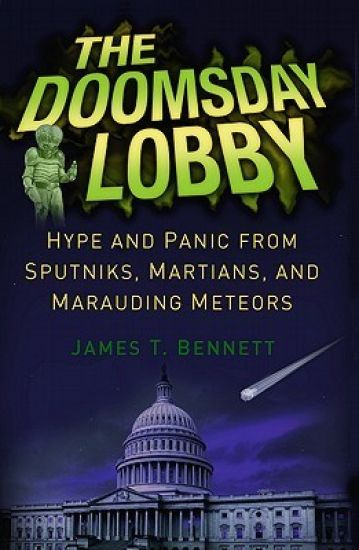
The Doomsday Lobby

The Doomsday Lobby

James T. Bennett

Springer-Verlag New York Inc.
2010
nidottu
Federal patronage of science was never contemplated by the framers of the Constitution, but they did seek to “promote the Progress of Science and useful Art” by granting inventors patent rights. However, direct subvention to scientists and scientific organizations was not considered appropriate activity of the central government. In the 19th Century, American science was funded almost entirely through private investors. Since WWII, however, the federal government has become the primary patron of American science. From the race-to-space in the 1950s to current furor over global warming, Bennett traces the subtle and not-so-subtle ways in which government has co-opted scientific research and reinforced a culture in which challengers to proscribed wisdom are frozen out. Citing original documents and media reports, Bennett offers a compelling, entertaining, and thought-provoking perspective on political influence on scientific research and its implications for a democratic society. "During the Nineteenth Century, almost entirely on private funding, American science grew from practically nothing to world class. Now, however, over fifty percent of American science is funded by the federal government. Dr. Bennett traces the path, "crisis" after "crisis," by which American science became practically an arm of the federal government. His tale is a cautionary one, warning against future "crisis mongers" who would extend the government's already majority control of American science even further. His warning is a timely one, and it should be heeded." Joseph P. Martino, author of Science Funding: Politics and Porkbarrel "Bennett's latest book offers a challenging interpretation of the rise of the American federal science establishment since World War II. Focusing primarily on the growth of the space program, Bennett argues that crisis, real or imagined, is the source of state power and state funding for science. The Doomsday Lobbyoffers what no doubt will be viewed as a controversial contribution to the history of American science policy, and more broadly to an understanding of the role of the state in society." James D. Savage, Professor of Politics, University of Virginia, and author of Funding Science in America
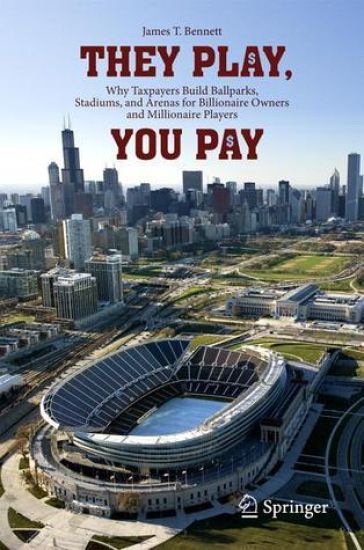
They Play, You Pay

They Play, You Pay

James T. Bennett

Springer-Verlag New York Inc.
2012
nidottu
They Play, You Pay is a detailed, sometimes irreverent look at a political conundrum: despite evidence that publicly funded ballparks, stadiums, and arenas do not generate net economic growth, governments keep on taxing sales, restaurant patrons, renters of automobiles, and hotel visitors in order to build ever more elaborate cathedrals of professional sport—often in order to satisfy an owner who has threatened to move his team to greener, more subsidy-happy, pastures. This book is a sweeping survey of the literature in the field, the history of such subsidies, the politics of stadium construction and franchise movement, and the prospects for a re-priva­ti­zation of ballpark and stadium financing. It ties together disparate strands in a fascinating story, examining the often colorful cases through which governments became involved in sports. These range from the well-known to the obscure—from Yankee Stadium and the Astrodome to the Brooklyn Dodgers’ move to Los Angeles (to a privately built ballpark constructed upon land that had been seized via eminent domain from a mostly Mexican-American population) to such arrant giveaways as Cowboys Stadium. It examines alternatives that might lessen the pressure for public subsidies, whether the Green Bay Packers model (in which the team’s owners are local stockholders) or via league expan­sions. It also takes a look at little-known, yet significant, episodes such as President Theodore Roosevelt’s intervention in the collegiate football crisis of 1905—a move that indirectly put the federal government on the side of such basic rule changes as the legalization of the forward pass. They Play, You Play is a fresh look at a political and economic puzzle: how it came to be that Joe and Jane Sixpack in the Bronx and Dallas subsidize the Steinbrenners and Jerry Joneses of professional sport.
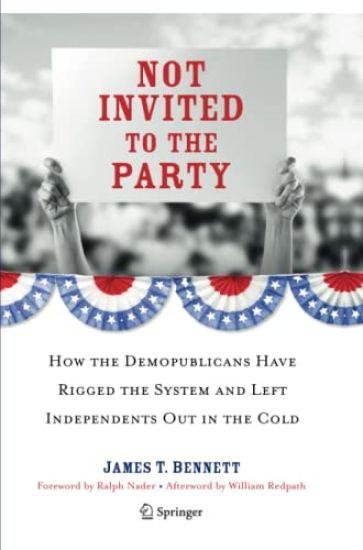
Not Invited to the Party

Not Invited to the Party

James T. Bennett

Copernicus Books
2014
nidottu
Not Invited to the Party demonstrates how the dominant political parties--the Democrats and Republicans--have co-opted the system to their advantage. James Bennett examines the history and array of laws, regulations, subsidies and programs that benefit the two major parties and discourage even the possibility of a serious challenge to the Democrat-Republican duopoly. The American Founders, as it has been generally forgotten, distrusted political parties. Nowhere in the U.S. Constitution are parties mentioned, much less given legal protection or privilege. This provocative book traces how by the end of the Civil War the Republicans and Democrats had guaranteed their dominance and subsequently influenced a range of policies developed to protect the duopoly. For example, Bennett examines how the Federal Election Campaign Act of 1971 (as amended in 1974 and 1976), which was sold to the public as a nonpartisan act of good government reformism actually reinforced the dominance of the two parties. While focused primarily on the American experience, the book also considers the prevalence of two-party systems around the world (especially in emerging democracies) and the widespread contempt with which they are often viewed. Featuring incisive commentary on the 2008 election, and a foreword by third-party iconoclast, Ralph Nader, the book considers the potential of truly radical reform toward opening the field to vigorous, lively, contentious independent candidacies that might finally offer alienated voters a choice, not an echo.
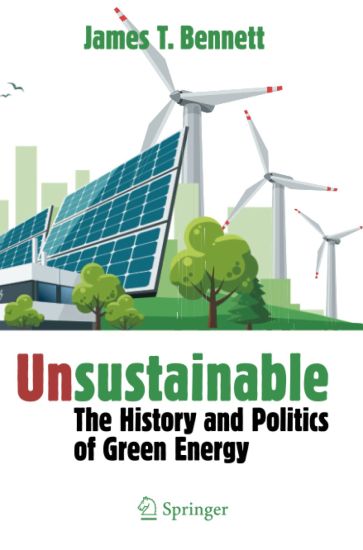
Unsustainable

Unsustainable

James T. Bennett

Springer Nature Switzerland AG
2021
nidottu
This book examines the history, politics, and economics of alternative energy. Since the energy crisis of the 1970s, governments around the world have subsidized and otherwise incentivized alternative forms of energy to reduce dependence on fossil fuels. This search has taken on added urgency in the twenty-first century, as the specter of climate change has engendered ambitious state-level renewable portfolio standards, enhanced federal incentives, and inspired “100% renewable” electrical generation targets in such states as Vermont and Hawaii. To save the planet from destruction, wind, solar, and other renewable energy alternatives must replace fossil fuels. But how did we get here and what is the cost? After an in-depth study of the Carter administration's synthetic fuels program, the focus shifts to the two most prominent, perhaps most promising, and certainly most promoted—and government subsidized—“green” and “renewable” energies today: wind and solar. Because wind has made the most headway and drawn the most controversy, it receives the most attention. Although the primary focus is on the American experience with renewable energy, the policies and politics of renewables in Scotland, Wales, Denmark, Spain, and other European nations are also discussed. Issues considered in the book include the nature and efficacy of renewable subsidies; the employment of federal and state tax codes to encourage renewables; the lobbies and interest groups that campaign for government support of renewables; and the fierce battles over the siting of renewable facilities. Unlike other works on this subject, the book probes in depth the nature of the opposition to wind and solar, both in the matter of siting and in their worthiness as recipients of substantial government assistance.
The History and Politics of Public Radio

The History and Politics of Public Radio

James T. Bennett

Springer Nature Switzerland AG
2021
sidottu
This book presents an absorbing study of how educational radio, which originated to broadcast weather forecasts to farmers, has become what the Pew Center calls the most trusted source of news for American liberals and a regular in the rogue's gallery of election-year conservative targets.The Nielsen Company reported in late 2019 that 272 million Americans listen to "traditional radio" each week, a number exceeding those who watch television, use a smartphone, or access the Internet. Yet almost from the start, radio has also been flayed as a noise box of inanity, a transmitter of low-brow entertainment, an instrument of cultural degradation promoting vapid popular music, and a medium whose ultimate purpose is to convince listeners to purchase the goods and services incessantly hawked by the advertisers who underwrite the programs and allegedly dictate content. At the same time, an alternative conception of radio existed as a vehicle for education and for cultural and intellectual(and even political) enlightenment. Most proponents of this perspective disdained advertising revenue and sought subsidies from foundations, wealthy patrons, or varying levels of government.The long, winding road of educational radio led eventually to the creation of National Public Radio (NPR), a fixture on the left of the dial that can be seen as either the consummation or corruption of the educational radio movement. Prized by many liberals, especially affluent whites, and disparaged by many conservatives, NPR has become a potent symbol of the political polarization and cultural chasm that now characterizes the American conversation.
The History and Politics of Public Radio

The History and Politics of Public Radio

James T. Bennett

Springer Nature Switzerland AG
2022
nidottu
This book presents an absorbing study of how educational radio, which originated to broadcast weather forecasts to farmers, has become what the Pew Center calls the most trusted source of news for American liberals and a regular in the rogue's gallery of election-year conservative targets.The Nielsen Company reported in late 2019 that 272 million Americans listen to "traditional radio" each week, a number exceeding those who watch television, use a smartphone, or access the Internet. Yet almost from the start, radio has also been flayed as a noise box of inanity, a transmitter of low-brow entertainment, an instrument of cultural degradation promoting vapid popular music, and a medium whose ultimate purpose is to convince listeners to purchase the goods and services incessantly hawked by the advertisers who underwrite the programs and allegedly dictate content. At the same time, an alternative conception of radio existed as a vehicle for education and for cultural and intellectual(and even political) enlightenment. Most proponents of this perspective disdained advertising revenue and sought subsidies from foundations, wealthy patrons, or varying levels of government.The long, winding road of educational radio led eventually to the creation of National Public Radio (NPR), a fixture on the left of the dial that can be seen as either the consummation or corruption of the educational radio movement. Prized by many liberals, especially affluent whites, and disparaged by many conservatives, NPR has become a potent symbol of the political polarization and cultural chasm that now characterizes the American conversation.
Subsidizing Culture

Subsidizing Culture

James T. Bennett

AldineTransaction
2009
nidottu
In the American mind, state subsidization of writers and artists was long associated with monarchies and, in later years, socialist states. The support these regimes gave to intellectuals was understood to come with a cost, yet, beginning with the New Deal's Federal Writers', Art, and Theater Projects, a new policy consensus asserted that by offering financial support to the arts, the federal government was affirming their importance to the nation. Subsidizing Culture examines the development of and controversies surrounding federal programs that directly benefit writers, artists, and intellectuals. James T. Bennett examines four cases of such support: the New Deal's Federal Writers', Art, and Theater Projects; the vigorous promotion, in the post-World War II and early Cold War eras, of abstract expressionism and other forms of modern art by the US government; the National Endowment for the Arts (NEA), which has fortified its position as the preeminent arts bureaucracy; and the National Endowment for the Humanities, the NEA's less embattled twin, which funnels monies to scholars. Bennett concentrates on the creation of and the debate over these government programs, and he gives special attention to the critics, who are usually ignored. He reminds us that the chorus of anti-subsidy voices over the years has included such disparate figures as writers William Faulkner and John Updike; artists John Sloan and Wheeler Williams; and social critics Jacques Barzun and H.L. Mencken.