Kirjojen hintavertailu. Mukana 11 342 296 kirjaa ja 12 kauppaa.

Kirjahaku

Etsi kirjoja tekijän nimen, kirjan nimen tai ISBN:n perusteella.

5 kirjaa tekijältä James T. Cushing

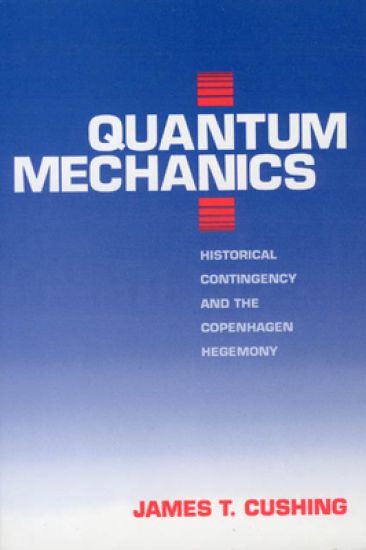
Quantum Mechanics

Quantum Mechanics

James T. Cushing

University of Chicago Press
1994
sidottu
Why does one theory "succeed" while another, possibly clearer interpretation, fails? By exploring two observationally equivalent, yet conceptually incompatible, views of quantum mechanics, James T. Cushing shows how historical contingency can be crucial to determining a theory's construction and its position among competing views. Since the late 1920s, the theory formulated by Niels Bohr and his colleagues at Copenhagen has been the dominant interpretation of quantum mechanics. Yet an alternative interpretation, rooted in the work of Louis de Broglie in the early 1920s and reformulated and extended by David Bohm in the 1950s, equally well explains the observational data. Through a detailed historical and sociological study of the physicists who developed different theories of quantum mechanics, the debates within and between opposing camps, and the receptions given to each theory, Cushing shows that despite the preeminence of the Copenhagen view, the Bohm interpretation cannot be ignored. Cushing contends that the Copenhagen interpretation became widely accepted not because it is a better explanation of subatomic phenomena than Bohm's, but because it happened to appear first. Focusing on the philosophical, social and cultural forces that shaped one of the most important developments in modern physics, this book examines the role that timing can play in the establishment of theory and explanation.
Quantum Mechanics

Quantum Mechanics

James T. Cushing

University of Chicago Press
1994
nidottu
Why does one theory "succeed" while another, possibly clearer interpretation, fails? By exploring two observationally equivalent, yet conceptually incompatible, views of quantum mechanics, James T. Cushing shows how historical contingency can be crucial to determining a theory's construction and its position among competing views. Since the late 1920s, the theory formulated by Niels Bohr and his colleagues at Copenhagen has been the dominant interpretation of quantum mechanics. Yet an alternative interpretation, rooted in the work of Louis de Broglie in the early 1920s and reformulated and extended by David Bohm in the 1950s, equally well explains the observational data. Through a detailed historical and sociological study of the physicists who developed different theories of quantum mechanics, the debates within and between opposing camps, and the receptions given to each theory, Cushing shows that despite the preeminence of the Copenhagen view, the Bohm interpretation cannot be ignored. Cushing contends that the Copenhagen interpretation became widely accepted not because it is a better explanation of subatomic phenomena than Bohm's, but because it happened to appear first. Focusing on the philosophical, social and cultural forces that shaped one of the most important developments in modern physics, this book examines the role that timing can play in the establishment of theory and explanation.
Theory Construction and Selection in Modern Physics

Theory Construction and Selection in Modern Physics

James T. Cushing

Cambridge University Press
2005
pokkari
One of the major philosophical problems in physical sciences is what criteria should determine how scientific theories are selected and justified in practice and whether, in describing observable physical phenomena, such theories are effectively constrained to be unique. This book studies the example of a particular theory, the S-matrix theory. The S-matrix program was initiated by Heisenberg to deal with difficulties encountered in quantum field theories in describing particular phenomena. Since then, each theory has at different times been favoured as the explanation of observed phenomena. Certainly the S-matrix theory was adequate, feasible and fertile. However, the quantum field theory interpretation is now widely accepted and the study of alternative theories is all but abandoned. By examining the philosophy which influenced the turns in this story, the author explains how an adequate and viable theory fell out of favour and concludes with a critique of different methodologies in the history of science. This book will be of value to both philosophers of science and physicists interested in the philosophical background to their field.
Theory Construction and Selection in Modern Physics

Theory Construction and Selection in Modern Physics

James T. Cushing

Cambridge University Press
1990
sidottu
One of the major philosophical problems in physical sciences is what criteria should determine how scientific theories are selected and justified in practice and whether, in describing observable physical phenomena, such theories are effectively constrained to be unique. This book studies the example of a particular theory, the S-matrix theory. The S-matrix program was initiated by Heisenberg to deal with difficulties encountered in quantum field theories in describing particular phenomena. Since then, each theory has at different times been favoured as the explanation of observed phenomena. Certainly the S-matrix theory was adequate, feasible and fertile. However, the quantum field theory interpretation is now widely accepted and the study of alternative theories is all but abandoned. By examining the philosophy which influenced the turns in this story, the author explains how an adequate and viable theory fell out of favour and concludes with a critique of different methodologies in the history of science. This book will be of value to both philosophers of science and physicists interested in the philosophical background to their field.
Philosophical Concepts in Physics

Philosophical Concepts in Physics

James T. Cushing

Cambridge University Press
1998
pokkari
This book examines a selection of philosophical issues in the context of specific episodes in the development of physical theories. Advances in science are presented against the historical and philosophical backgrounds in which they occurred. A major aim is to impress upon the reader the essential role that philosophical considerations have played in the actual practice of science. The book begins with some necessary introduction to the history of ancient and early modern science, with major emphasis being given to the two great watersheds of twentieth-century physics: relativity and, especially, quantum mechanics. At times the term ‘construction’ may seem more appropriate than ‘discovery’ for the way theories have developed and, especially in the later chapters, the question of the influence of historical, philosophical and even social factors on the very form and content of scientific theories is discussed.