Kirjojen hintavertailu. Mukana 11 244 527 kirjaa ja 12 kauppaa.

Kirjahaku

Etsi kirjoja tekijän nimen, kirjan nimen tai ISBN:n perusteella.

10 kirjaa tekijältä James W. Heisig

Jesus' Twin

Jesus' Twin

James W. Heisig

Crossroad Publishing Co ,U.S.
2015
nidottu
In Jesus' Twin, a scholar shares his personal reflections into the Gospel of Thomas offering a learned, accessible introduction as well as inspiring insights into these ancient texts that have long stirred curiosity and inquiry. James Heisig, who has read and studied the texts throughout his distinguished career as a scholar and teacher of religions, shows that the reasons for excluding the Gospel of Thomas from the Christian tradition are largely meaningless for us today. After more than half a century of concerted dialogue with other traditions, we are in a better position to recognize that not every alter Jesus is a Jesus alias. At the same time, attention to the spiritual demands being made on Christianity by our present age helps draw us more deeply into the text itself and control the tendency to immunize ourselves against its discomforts, whether through the distractions of scholarly disputation or the preoccupation with preserving orthodoxy.
Dialogues at One Inch Above the Ground

Dialogues at One Inch Above the Ground

James W. Heisig

Crossroad Publishing Co ,U.S.
2003
nidottu
James Heisig has spent his life traveling along many roads—living in Japan, Spain, England, and the United States, and listening to other religious traditions while remaining a Roman Catholic. In this book, Heisig draws from this worldly insight, and presents an invaluable dialogue between Christianity and Buddhism.
Remembering the Kana

Remembering the Kana

James W. Heisig

University of Hawai'i Press
2007
nidottu
Following on the phenomenal success of ""Remembering the Kanji"", the author has prepared a companion volume for learning the Hiragana and Katakana syllabaries of modern Japanese. In six short lessons of about twenty minutes, each of the two systems of ""kana"" writing are introduced in such a way that the absolute beginner can acquire fluency in writing in a fraction of the time normally devoted to the task. Using the same basic self-taught method devised for learning the kanji, and in collaboration with Helmut Morsbach and Kazue Kurebayashi, the author breaks the shapes of the two syllabaries into their component parts and draws on what he calls ""imaginative memory"" to aid the student in reassembling them into images that fix the sound of each particular kana to its writing. Now in its third edition, ""Remembering the Kana"" has helped tens of thousands of students of Japanese master the Hiragana and Katakana in a short amount of time...and have fun in the process.
Remembering the Kanji 1

Remembering the Kanji 1

James W. Heisig

University of Hawai'i Press
2011
nidottu
The aim of this book is to provide the student of Japanese with a simple method for correlating the writing and the meaning of Japanese characters in such a way as to make them both easy to remember. It is intended not only for the beginner, but also for the more advanced student looking for some relief from the constant frustration of forgetting how to write the kanji, or for a way to systematize what he or she already knows.The author begins with writing the kanji because—contrary to first impressions—it is in fact simpler than learning how to the pronounce them. By ordering the kanji according to their component parts or “primitive elements,” and then assigning each of these parts a distinct meaning with its own distinct image, the student is led to harness the powers of “imaginative memory” to learn the various combinations that make up the kanji. In addition, each kanji is given its own key word to represent the meaning, or one of the principal meanings, of that character. These key words provide the setting for a particular kanji’s “story,” whose protagonists are the primitive elements.In this way, one is able to complete in a few short months a task that would otherwise take years. Armed with the same skills as Chinese or Korean students, who know the meaning and writing of the kanji but not their Japanese pronunciations, one is then in a much better position to learn the readings (which are treated in a separate volume).Remembering the Kanji has helped tens of thousands of students advance towards literacy at their own pace, and to acquire a facility that traditional methods have long since given up on as all but impossible for those not raised with the kanji from childhood. The 6th edition has been updated to include the 196 new kanji approved by the government in 2010 as “general-use” kanji.
Remembering the Kanji 2

Remembering the Kanji 2

James W. Heisig

University of Hawai'i Press
2012
nidottu
Following the first volume of Remembering the Kanji, the present work provides students with helpful tools for learning the pronunciation of the kanji. Behind the notorious inconsistencies in the way the Japanese language has come to pronounce the characters it received from China lie several coherent patterns. Identifying these patterns and arranging them in logical order can reduce dramatically the amount of time spent in the brute memorization of sounds unrelated to written forms.Many of the “primitive elements,” or building blocks, used in the drawing of the characters also serve to indicate the “Chinese reading” that particular kanji use, chiefly in compound terms. By learning one of the kanji that uses such a “signal primitive,” one can learn the entire group at the same time. In this way, Remembering the Kanji 2 lays out the varieties of phonetic pattern and offers helpful hints for learning readings, that might otherwise appear completely random, in an efficient and rational way. Individual frames cross-reference the kanji to alternate readings and to the frame in volume 1 in which the meaning and writing of the kanji was first introduced.A parallel system of pronouncing the kanji, their “Japanese readings,” uses native Japanese words assigned to particular Chinese characters. Although these are more easily learned because of the association of the meaning to a single word, the author creates a kind of phonetic alphabet of single syllable words, each connected to a simple Japanese word, and shows how they can be combined to help memorize particularly troublesome vocabulary.The 4th edition has been updated to include the 196 new kanji approved by the government in 2010 as “general-use” kanji.
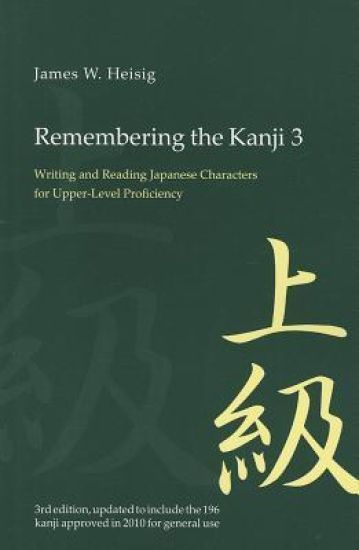
Remembering the Kanji 3

Remembering the Kanji 3

James W. Heisig

University of Hawai'i Press
2012
nidottu
Students who have learned to read and write the kanji taught in Japanese schools run into the same difficulty that Japan university students themselves face: the number of characters included in the approved list is not sufficient for advanced reading and writing. Although each academic specialisation requires supplementary kanji of its own, there is considerable overlap. With that in mind, this book employs the same methods as Volumes 1 and 2 of Remembering the Kanji to introduce additional characters useful for upper-level proficiency, bringing the total of all three volumes to 3,000 kanji. The 3rd edition has been updated to reflect the 196 new kanji approved by the government in 2010, all of which have been relocated in Volume 1. The selection of 800 new kanji is based on frequency lists and cross-checked against a number of standard Japanese kanji dictionaries. Separate parts of the book are devoted to learning the writing and reading of these characters. The writing requires only a handful of new “primitive elements.” A few are introduced as compound primitives (“measure words”) or as alternative forms for standard kanji. The majority of the kanji are organised according to the elements introduced in Volume 1. As in Volume 2, Chinese readings are arranged into groups for easy reference, enabling the student to take advantage of the readings assigned to “signal primitives” already learned. Seven indexes include hand-drawn samples of the new characters introduced and cumulative lists of the key word and primitive meaning, and of the Chinese and Japanese pronunciations, that appear in all 3 volumes of the series.
Nothingness and Desire

Nothingness and Desire

James W. Heisig

University of Hawai'i Press
2013
sidottu
The six lectures that make up this book were delivered in March 2011 at London University's School of Oriental and Asian Studies as the Jordan Lectures on Comparative Religion. They revolve around the intersection of two ideas, nothingness and desire, as they apply to a re-examination of the questions of self, God, morality, property, and the East-West philosophical divide.
Nothingness and Desire

Nothingness and Desire

James W. Heisig

University of Hawai'i Press
2013
nidottu
The six lectures that make up this book were delivered in March 2011 at London University's School of Oriental and Asian Studies as the Jordan Lectures on Comparative Religion. They revolve around the intersection of two ideas, nothingness and desire, as they apply to a re-examination of the questions of self, God, morality, property, and the East-West philosophical divide. Rather than attempt to harmonize East and West philosophies into a single chorus, Heisig undertakes what he calls a "philosophical antiphony." Through the simple call-and-response of a few representative voices, Heisig tries to join the choir on both sides of the antiphony to relate the questions at hand to larger problems that press on the human community. He argues that as problems like the technological devastation of the natural world, the shrinking of elected governance through the expanding powers of financial institutions, and the expropriation of alternate cultures of health and education spread freely through traditional civilizations across the world, religious and philosophical responses can no longer afford to remain territorial in outlook. Although the lectures often stress the importance of practice, their principal preoccupation is with seeing the things of life more clearly. Heisig explains: "By that I mean not just looking more closely at objects that come into my line of view from day to day, but seeing them as mirrors in which I can see myself reflected. Things do not just reveal parts of the world to me; they also tell me something of how I see what I see, and who it is that does the seeing. To listen to what things have to say to me, I need to break with the habit of thinking simply that it is I who mirror inside of myself the world outside and process what I have captured to make my way through life. Only when this habit has been broken will I be able to start seeing through the reflections, to scrape the tain off the mirror, as it were, so that it becomes a window to the things of life as they are, with only a pale reflection of myself left on the pane. Everything seen through the looking glass, myself included, becomes an image on which reality has stamped itself. This, I am persuaded, is the closest we can come to a ground for thinking reasonably and acting as true-to-life as we can."
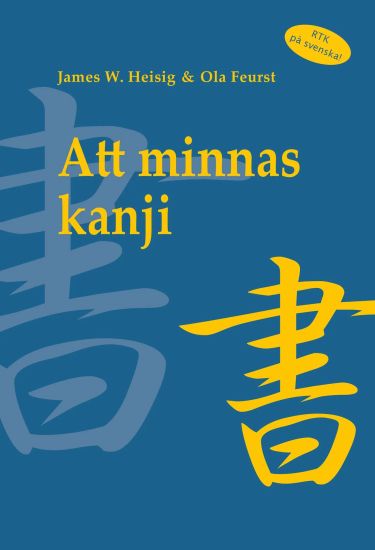
Att minnas kanji. Vol. 1, De japanska skrivtecknens skrivning och betydelse
RTK en Internationell succé - nu i svensk version. Syftet med denna bok är att erbjuda den som studerar japanska en enkel metod för att koordinera de japanska skrivtecknens skrivning och betydelse på ett sådant sätt att de båda blir lättare att minnas. Den är inte enbart inriktad på nybörjaren utan vänder sig också till den avancerade studenten som söker en lättnad från den eviga frustrationen av att glömma hur en viss kanji skall skrivas, eller som söker ett sätt att systematisera vad hon eller han redan kan. Författarens utgångspunkt är att – tvärt emot vad man först kan tycka – det är klart lättare att lära sig att skriva kanjitecken, jämfört med att lära sig att uttala dem. Genom att ordna kanjitecknen enligt deras ingående delkomponenter eller ”primitivelement” och sedan tilldela varje ingående del en distinkt betydelse tillsammans med sin egen distinkta bild, kan studenten utnyttja kraften i sitt ”föreställningsminne” för att lära sig de olika kombinationer som ger ett visst kanjitecken. Dessutom får varje kanji sitt eget nyckelord för att representera betydelsen eller en av de viktigaste betydelserna av den karaktären. Dessa nyckelord ger scenen för en viss kanjis ”berättelse”, vars huvudpersoner är de primitiva elementen. På detta sätt kan man på bara några få månader slutföra en uppgift som annars skulle ta år. Beväpnad med samma färdigheter som kinesiska eller koreanska studenter, som redan vet innebörden och skrivningen av kanjitecknen, men inte deras japanska uttal, är man då i en mycket bättre position för att lära sig utläsningen (som behandlas i en separat volym). Denna bok presenterar originalmetoden (RTK av Heisig) som har hjälpt tiotusentals studenter att nå läskunnighet i sin egen takt och att förvärva en förmåga i nivå med dem som vuxit upp med kanji sedan barndomen. Något som sedan länge bedömts vara omöjligt med traditionella metoder. Här behandlas 2 200 kanjitecken, inklusive samtliga 2 136 joyo kanji som godkänts av japanska utbildningsdepartementet som ”kanji för allmänt bruk”.James W. Heisig är professor emeritus i religionsfilosofi vid Nanzan Institute for Religion and Culture i Nagoya. Ola Feurst är ekonomie doktor (PhD) från Stockholms universitet.