Kirjojen hintavertailu. Mukana 12 016 292 kirjaa ja 12 kauppaa.

Kirjahaku

Etsi kirjoja tekijän nimen, kirjan nimen tai ISBN:n perusteella.

8 kirjaa tekijältä Jamie Peck

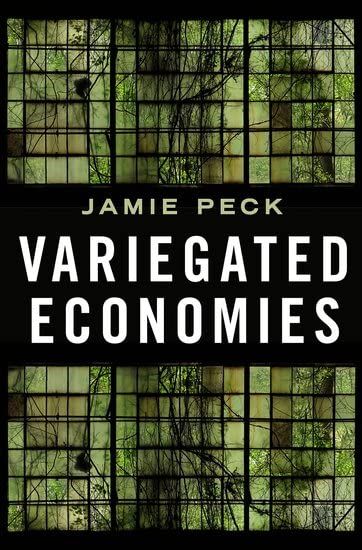
Variegated Economies

Variegated Economies

Jamie Peck

OXFORD UNIVERSITY PRESS INC
2023
sidottu
The culmination of more than two decades of work on the spatiality of economic forms, worlds, and lives, Variegated Economies tackles the question of how to approach, conceptualize, and analyze economies as geographically differentiated phenomena. Staged from the field of economic geography, the book seeks to build bridges to complementary developments in critical political economy and heterodox economic studies by way of a substantive theoretical and methodological program. Jamie Peck advances a series of arguments concerning the inherent-and highly consequential-spatiality of economic forms, worlds, and lives, engaging a range of issues from the diversity of capitalism(s) to the dynamics of late-stage neoliberalization, and from the problematic uneven geographical development to the challenges-cum-opportunities of conjunctural methodologies.
Variegated Economies

Variegated Economies

Jamie Peck

OXFORD UNIVERSITY PRESS INC
2023
nidottu
The culmination of more than two decades of work on the spatiality of economic forms, worlds, and lives, Variegated Economies tackles the question of how to approach, conceptualize, and analyze economies as geographically differentiated phenomena. Staged from the field of economic geography, the book seeks to build bridges to complementary developments in critical political economy and heterodox economic studies by way of a substantive theoretical and methodological program. Jamie Peck advances a series of arguments concerning the inherent-and highly consequential-spatiality of economic forms, worlds, and lives, engaging a range of issues from the diversity of capitalism(s) to the dynamics of late-stage neoliberalization, and from the problematic uneven geographical development to the challenges-cum-opportunities of conjunctural methodologies.
Offshore

Offshore

Jamie Peck

Oxford University Press
2017
sidottu
Offshore outsourcing-the movement of jobs to lower-wage countries-is one of the defining features of globalization. Routine blue-collar work has been going offshore for decades, but the digital revolution beginning in the 1990s extended this process to many parts of the service economy too. Politically controversial from the beginning, "offshoring" is conventionally seen as a threat to jobs, wages, and economic security in higher-income countries-having become synonymous with the dirty work of globalization. Even though the majority of corporations make some use of offshore outsourcing, fearful of negative publicity most now choose to manage these activities in a discreet manner. Partly as a result, the global sourcing business, now reckoned to be worth more $120 billion, largely operates under the radar, its ocean-spanning activities in low-cost labour arbitrage being poorly documented and poorly understood. Offshore is the first sustained investigation of the workings of the global sourcing industry, its business practices, its market dynamics, its technologies, and its politics. The book traces the complex transformation of the worlds of global sourcing, from its origins in the new international division of labour in the 1970s, through the rapid growth of back-office economies in India and the Philippines since the 1990s, to the development of "nearshore" markets in Latin America and Eastern Europe. Recently, this evolving process of geographical and organizational restructuring has included experiments in "backshoring" within low-cost, ex-urban locations in the United States and a wave of software-enabled automation, which threatens to remove labour from many back offices altogether. In these and other ways, the offshore revolution continues.
Offshore

Offshore

Jamie Peck

Oxford University Press
2019
nidottu
Offshore outsourcing- the movement of jobs to lower-wage countries- is one of the defining features of globalization. Routine blue-collar work has been going offshore for decades, but the digital revolution beginning in the 1990s extended this process to many parts of the service economy too. Politically controversial from the beginning, "offshoring" is conventionally seen as a threat to jobs, wages, and economic security in higher-income countries, having become synonymous with the dirty work of globalization. Even though the majority of corporations make some use of offshore outsourcing, fearful of negative publicity most now choose to manage these activities in a discreet manner. Partly as a result, the global sourcing business, reckoned to be worth more than $120 billion, largely operates under the radar, its ocean-spanning activities in low-cost labour arbitrage being poorly documented and poorly understood. Offshore is the first sustained investigation of the workings of the global sourcing industry, its business practices, its market dynamics, its technologies, and its politics. The book traces the complex transformation of the worlds of global sourcing, from its origins in the new international division of labour in the 1970s, through the rapid growth of back-office economies in India and the Philippines since the 1990s, to the development of "nearshore" markets in Latin America and Eastern Europe. Recently, this evolving process of geographical and organizational restructuring has included experiments in "backshoring" within low-cost, ex-urban locations in the United States and a wave of software-enabled automation, which threatens to remove labour from many back offices altogether. In these and other ways, the offshore revolution continues.
Constructions of Neoliberal Reason

Constructions of Neoliberal Reason

Jamie Peck

Oxford University Press
2010
sidottu
Amongst intellectuals and activists, neoliberalism has become a potent signifier for the kind of free-market thinking that has dominated politics for the past three decades. Forever associated with the conviction politics of Ronald Reagan and Margaret Thatcher, the free-market project has since become synonymous with the 'Washington consensus' on international development policy and the phenomenon of corporate globalization, where it has come to mean privatization, deregulation, and the opening up of new markets. But beyond its utility as a protest slogan or buzzword as shorthand for the political-economic Zeitgeist, what do we know about where neoliberalism came from and how it spread? Who are the neoliberals, and why do they studiously avoid the label? Constructions of Neoliberal Reason presents a radical critique of the free-market project, from its origins in the first half of the 20th Century through to the recent global economic crisis, from the utopian dreams of Friedrich von Hayek through the dogmatic theories of the Chicago School to the hope and hubris of Obamanomics. The book traces how neoliberalism went from crank science to common sense in the period between the Great Depression and the age of Obama. Constructions of Neoliberal Reason dramatizes the rise of neoliberalism and its uneven spread as an intellectual, political, and cultural project, combining genealogical analysis with situated case studies of formative moments throughout the world, like New York City's bankruptcy, Hurricane Katrina, and the Wall Street crisis of 2008. The book names and tracks some of neoliberalism's key protagonists, as well as some of the less visible bit-part players. It explores how this adaptive regime of market rule was produced and reproduced, its logics and limits, its faults and its fate.
Constructions of Neoliberal Reason

Constructions of Neoliberal Reason

Jamie Peck

Oxford University Press
2012
nidottu
Amongst intellectuals and activists, neoliberalism has become a potent signifier for the kind of free-market thinking that has dominated politics for the past three decades. Forever associated with the conviction politics of Ronald Reagan and Margaret Thatcher, the free-market project has since become synonymous with the 'Washington consensus' on international development policy and the phenomenon of corporate globalization, where it has come to mean privatization, deregulation, and the opening up of new markets. But beyond its utility as a protest slogan or buzzword as shorthand for the political-economic Zeitgeist, what do we know about where neoliberalism came from and how it spread? Who are the neoliberals, and why do they studiously avoid the label? Constructions of Neoliberal Reason presents a radical critique of the free-market project, from its origins in the first half of the 20th Century through to the recent global economic crisis, from the utopian dreams of Friedrich von Hayek through the dogmatic theories of the Chicago School to the hope and hubris of Obamanomics. The book traces how neoliberalism went from crank science to common sense in the period between the Great Depression and the age of Obama. Constructions of Neoliberal Reason dramatizes the rise of neoliberalism and its uneven spread as an intellectual, political, and cultural project, combining genealogical analysis with situated case studies of formative moments throughout the world, like New York City's bankruptcy, Hurricane Katrina, and the Wall Street crisis of 2008. The book names and tracks some of neoliberalism's key protagonists, as well as some of the less visible bit-part players. It explores how this adaptive regime of market rule was produced and reproduced, its logics and limits, its faults and its fate.
Work-Place

Work-Place

Jamie Peck

Guilford Publications
1996
nidottu
This text seeks to construct a conception of the labour market, which is sensitive to the variability in labour market experiences and processes, taking account of the tensions between the global economy and the local organization of labour markets. It considers a complex set of influential factors as educational, political and social factors, which contribute to the complexion of local labour markets.
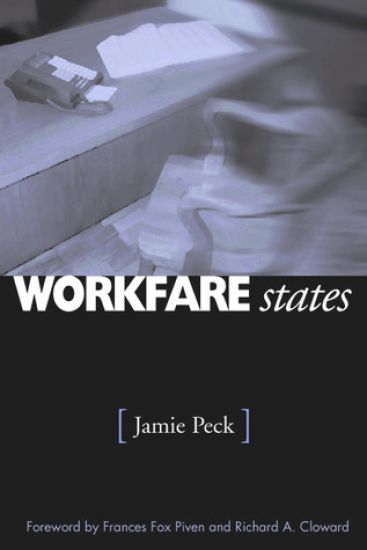
Workfare States

Workfare States

Jamie Peck

Guilford Publications
2001
nidottu
This book examines the political economy of workfare, the umbrella term for welfare-to-work initiatives that have been steadily gaining ground since candidate Bill Clinton's 1992 promise to end welfare as we know it. Peck traces the development, diffusion, and implementation of workfare policies in the United States, and their export to Canada and the United Kingdom. He explores how reforms have been shaped by labor markets and political conditions, how gender and race come into play, and how local programs fit into the broader context of neoliberal economics and globalization. The book cogently demonstrates that workfare rarely involves large-scale job creation, but is more concerned with deterring welfare claims and necessitating the acceptance of low-paying, unstable jobs. Integrating labor market theory, critical policy analysis, and extensive field research, Peck exposes the limitations of workfare policies and points toward more equitable alternatives.