Kirjojen hintavertailu. Mukana 11 699 587 kirjaa ja 12 kauppaa.

Kirjahaku

Etsi kirjoja tekijän nimen, kirjan nimen tai ISBN:n perusteella.

12 kirjaa tekijältä Jan Toporowski

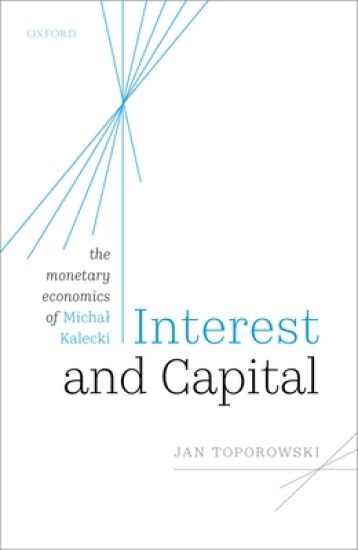
Interest and Capital

Interest and Capital

Jan Toporowski

Oxford University Press
2022
sidottu
Interest and Capital brings together Michal Kalecki's published fragments on monetary theory and policy to explore his distinctive approach to money and its circulation in the capitalist economy. Toporowski lays out Kalecki's critique of the international monetary arrangements proposed by Keynes and White at Bretton Woods, casting new light on the international monetary imbalances that have since disrupted the international economy. The greater importance of debt management revealed in Kalecki's monetary analysis makes it particularly relevant to the policy dilemmas of developing countries and governments facing high levels of debt in the wake of recent global crises. In Kalecki's theoretical approach, money has both an industrial and a financial circulation. Corporate finance takes its place at the centre of monetary considerations because it is the money of capitalists that is the autonomous determinant of expenditure in the economy. This theory has important implications for the rate of interest, which is not related to the rate of profit, nor to the kind of portfolio adjustments necessary to maintain portfolio equilibrium, but to the kind of financing that may prevail in any given phase of the business cycle.
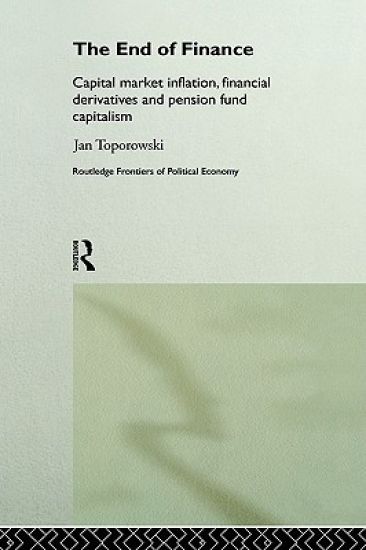
The End of Finance

The End of Finance

Jan Toporowski

Routledge
1999
sidottu
This volume develops an original critique of the belief that the present era of finance, where finance markets dominate contemporary capitalist economies, represents the best possible way of organising economic affairs. In fact, it is argued, the ensuing economic instability and inefficiency create the preconditions for the end of the dominance of finance. The End of Finance develops a theory of capital market inflation rooted in the work of Veblen, Kalecki, Keynes and Minsky, demonstrating how it disinclines productive activity on the part of firms, provides only short-term conditions that are propitious for privatisation and distorts monetary policy in the long-term. The author examines the role of pension fund schemes and financial derivatives in transmitting capital market inflation and provides a nuanced analysis of the contradictory role they play in the financial system. Capital market inflation is also examined in its historical context and compared with past inflations, in particular the South Sea and Mississippi Bubbles, which spawned the first financial derivatives, and the first privatisations. This broad historical vision allows us to see these forms of inflation as temporary and provisional in character.
Why the World Economy Needs a Financial Crash and Other Critical Essays on Finance and Financial Economics
The essays in this volume explain the key structural features of financial inflation that give rise to financial crisis. These features include excessive reliance on finance to maintain economic activity through rising asset prices. Reliance on asset inflation induces a preoccupation with property values and a new social divide between the asset-rich and the asset-poor that undermines the culture of the welfare state. When debt can no longer be supported by cash flow from asset markets, excess debt plunges economies into economic depression.
Why the World Economy Needs a Financial Crash and Other Critical Essays on Finance and Financial Economics
The essays in this volume explain the key structural features of financial inflation that give rise to financial crisis. These features include excessive reliance on finance to maintain economic activity through rising asset prices. Reliance on asset inflation induces a preoccupation with property values and a new social divide between the asset-rich and the asset-poor that undermines the culture of the welfare state. When debt can no longer be supported by cash flow from asset markets, excess debt plunges economies into economic depression.
The End of Finance

The End of Finance

Jan Toporowski

Routledge
2015
nidottu
This volume develops an original critique of the belief that the present era of finance, where finance markets dominate contemporary capitalist economies, represents the best possible way of organising economic affairs. In fact, it is argued, the ensuing economic instability and inefficiency create the preconditions for the end of the dominance of finance. The End of Finance develops a theory of capital market inflation rooted in the work of Veblen, Kalecki, Keynes and Minsky, demonstrating how it disinclines productive activity on the part of firms, provides only short-term conditions that are propitious for privatisation and distorts monetary policy in the long-term. The author examines the role of pension fund schemes and financial derivatives in transmitting capital market inflation and provides a nuanced analysis of the contradictory role they play in the financial system. Capital market inflation is also examined in its historical context and compared with past inflations, in particular the South Sea and Mississippi Bubbles, which spawned the first financial derivatives, and the first privatisations. This broad historical vision allows us to see these forms of inflation as temporary and provisional in character.
Credit and Crisis from Marx to Minsky

Credit and Crisis from Marx to Minsky

Jan Toporowski

Edward Elgar Publishing Ltd
2020
sidottu
This timely book studies the economic theories of credit cycles and disturbances in the 20th century, presenting a nuanced view of the role of finance in the economy after the financial crash of 2008. Focusing on the work of economists from Marx onwards, Jan Toporowski moves beyond conventional monetary theory to offer an insightful critical alternative to current financial macroeconomics. The book features an extended discussion of Marx's approach to credit and finance, new insights to Minsky's ideas and a reconsideration of the financial theories of Kalecki and Steindl. Economic researchers and postgraduate students seeking to extend their knowledge of critical approaches to finance will find this an invaluable read, as well as practitioners and policy makers who seek to understand financial instability and unstable markets. This will also be an insightful read for economic historians looking to understand the nuances of different key economic theories and their practical applications. This timely book studies the economic theories of credit cycles and disturbances in the 20th century, presenting a nuanced view of the role of finance in the economy after the financial crash of 2008.
Credit and Crisis from Marx to Minsky

Credit and Crisis from Marx to Minsky

Jan Toporowski

Edward Elgar Publishing Ltd
2021
nidottu
This timely book studies the economic theories of credit cycles and disturbances in the 20th century, presenting a nuanced view of the role of finance in the economy after the financial crash of 2008. Focusing on the work of economists from Marx onwards, Jan Toporowski moves beyond conventional monetary theory to offer an insightful critical alternative to current financial macroeconomics. The book features an extended discussion of Marx's approach to credit and finance, new insights to Minsky's ideas and a reconsideration of the financial theories of Kalecki and Steindl. Economic researchers and postgraduate students seeking to extend their knowledge of critical approaches to finance will find this an invaluable read, as well as practitioners and policy makers who seek to understand financial instability and unstable markets. This will also be an insightful read for economic historians looking to understand the nuances of different key economic theories and their practical applications. This timely book studies the economic theories of credit cycles and disturbances in the 20th century, presenting a nuanced view of the role of finance in the economy after the financial crash of 2008.
Theories of Financial Disturbance

Theories of Financial Disturbance

Jan Toporowski

Edward Elgar Publishing Ltd
2005
sidottu
Theories of Financial Disturbance examines how the operations of market-driven finance may initiate and transmit disturbances to the economy at large, by looking in detail at how various economists envisaged such disturbances occurring.This book is more than just a study in the history of economic thought - it illustrates how economic debate focuses upon financial disturbance at times of financial instability, and then conveniently discards critical views when such instability recedes. Jan Toporowski looks at the development of critical theories from the views of Adam Smith and Francois Quesnay, and their reflection in recent new Keynesian ideas of Joseph Stiglitz and Ben Bernanke, through credit cycles in Alfred Marshall and Ralph Hawtrey, to the financial theories of Thorstein Veblen and Irving Fisher. Also studied are the theories of John Kenneth Galbraith, Michal Kalecki, John Maynard Keynes, Charles Kindleberger, Rosa Luxemburg, Hyman P. Minsky, Robert Shiller and Josef Steindl. Not least among the original features of this book are a discussion of Quesnay's attitude towards interest, and a chapter devoted to the work of the Polish monetary economist Marek Breit, whose work inspired Kalecki.Jan Toporowski's fascinating work will find its audience in academics of finance and financial economics, bankers, financiers and policy makers concerned with financial stability as well as anyone looking for arguments on the imperfect functioning of finance.
Theories of Financial Disturbance

Theories of Financial Disturbance

Jan Toporowski

Edward Elgar Publishing Ltd
2006
nidottu
Theories of Financial Disturbance examines how the operations of market-driven finance may initiate and transmit disturbances to the economy at large, by looking in detail at how various economists envisaged such disturbances occurring.This book is more than just a study in the history of economic thought - it illustrates how economic debate focuses upon financial disturbance at times of financial instability, and then conveniently discards critical views when such instability recedes. Jan Toporowski looks at the development of critical theories from the views of Adam Smith and Francois Quesnay, and their reflection in recent new Keynesian ideas of Joseph Stiglitz and Ben Bernanke, through credit cycles in Alfred Marshall and Ralph Hawtrey, to the financial theories of Thorstein Veblen and Irving Fisher. Also studied are the theories of John Kenneth Galbraith, Michal Kalecki, John Maynard Keynes, Charles Kindleberger, Rosa Luxemburg, Hyman P. Minsky, Robert Shiller and Josef Steindl. Not least among the original features of this book are a discussion of Quesnay's attitude towards interest, and a chapter devoted to the work of the Polish monetary economist Marek Breit, whose work inspired Kalecki.Jan Toporowski's fascinating work will find its audience in academics of finance and financial economics, bankers, financiers and policy makers concerned with financial stability as well as anyone looking for arguments on the imperfect functioning of finance.
THE ECONOMICS OF FINANCIAL MARKETS AND THE 1987 CRASH

THE ECONOMICS OF FINANCIAL MARKETS AND THE 1987 CRASH

Jan Toporowski

Edward Elgar Publishing Ltd
1995
nidottu
The Economics of Financial Markets and the 1987 Crash is the first thorough and systematic account of the antecedents and economic consequences of the stock market crash of 1987 in the world’s major financial centres. In determining the causes of that crash, Jan Toporowski examines the way in which finance and capital markets operate and concludes that the crash was an economically insignificant event in the general inflation of capital markets. Dr Toporowski argues that rather than the crash itself, it was capital market inflation that eventually contributed to the economic slump of the 1990s. In so doing, he presents original theories on finance and capital markets, banking cycles, financial regulation and the economic consequences of deregulation. The book also features a critique of Keynes’s liquidity preference theory and an account of how Japanese financial institutions helped Wall Street and the London market after the crash.Written by an economist with an ‘insider’s’ view of finance and capital markets - the author was formerly Senior Economist with Standard Chartered Bank - this book presents a theoretical analysis which explains how financial markets actually work. The Economics of Financial Markets and the 1987 Crash will be welcomed by economists, financiers, the educated public and policymakers concerned with issues of financial instability and the financial roots of economic stagnation.
Michal Kalecki: An Intellectual Biography

Michal Kalecki: An Intellectual Biography

Jan Toporowski

Springer Nature Switzerland AG
2018
nidottu
This volume of intellectual biography records the work of Michal Kalecki’s maturity: his work on monetary economics and the theory of profits; his work on the problems of socialism and developing countries; and the extension of his theory of capitalism to define his work in relation to Keynes and previous political economic principles. Kalecki had, by 1939, laid out the essential elements of his theory of the business cycle in capitalism. This book begins at Oxford where, at the Institute of Statistics, he worked on the economic planning and financing of World War Two, as well as extending and detailing the particulars of his theory and examining the conditions for full employment in the post-War international monetary and financial system. Kalecki would then work for the United Nations on full employment, inflation, and developing countries. He departed from the United Nations in 1955, and returned to Poland to extend two new directions of his ideas – on the economics of developing countries and his theory of growth in the socialist economy, alongside further work on business cycles.This book is essential reading for all those who want to understand Kalecki’s lasting contribution to economic theory and policy.
Michal Kalecki: An Intellectual Biography

Michal Kalecki: An Intellectual Biography

Jan Toporowski

Springer International Publishing AG
2018
sidottu
This volume of intellectual biography records the work of Michal Kalecki’s maturity: his work on monetary economics and the theory of profits; his work on the problems of socialism and developing countries; and the extension of his theory of capitalism to define his work in relation to Keynes and previous political economic principles. Kalecki had, by 1939, laid out the essential elements of his theory of the business cycle in capitalism. This book begins at Oxford where, at the Institute of Statistics, he worked on the economic planning and financing of World War Two, as well as extending and detailing the particulars of his theory and examining the conditions for full employment in the post-War international monetary and financial system. Kalecki would then work for the United Nations on full employment, inflation, and developing countries. He departed from the United Nations in 1955, and returned to Poland to extend two new directions of his ideas – on the economics of developing countries and his theory of growth in the socialist economy, alongside further work on business cycles.This book is essential reading for all those who want to understand Kalecki’s lasting contribution to economic theory and policy.