Kirjojen hintavertailu. Mukana 12 016 292 kirjaa ja 12 kauppaa.

Kirjahaku

Etsi kirjoja tekijän nimen, kirjan nimen tai ISBN:n perusteella.

11 kirjaa tekijältä Jan Zwicky

Once upon a Time in the West

Once upon a Time in the West

Jan Zwicky

MCGILL-QUEEN'S UNIVERSITY PRESS
2023
sidottu
Western civilization is over. So begins Jan Zwicky’s trenchant exploration of the root of global cultural and ecological collapse: a way of thinking that is also linked to some of the West’s most noted achievements.The Renaissance merged imperial enterprise with Islamic algebra and recently recovered Greek mathematics to precipitate mechanized industry and resource extraction; these in turn made possible the growth of capitalism, the military-industrial complex, and Big Technology. Despite its self-image as objective, Zwicky argues, the West’s style of thought is not politically neutral, but intensely anthropocentric. It has led those who adopt it to regard the more-than-human world as nothing more than timber licences and drilling sites, where value is not recognized unless it is monetized. Oblivious to context and blind to big-picture thinking, it analyzes, mechanizes, digitizes, and systematizes, while rejecting empathy and compassion as distorting influences. Lyric comprehension, in Zwicky’s view, offers an alternative to this way of thinking, and she provides a wide range of examples. Once upon a Time in the West documents how a narrow epistemological style has left Western thought blind to critical features of reality, and how the terrifying consequences of that blinkered vision are now beginning to unfold.

Once upon a Time in the West

Once upon a Time in the West

Jan Zwicky

MCGILL-QUEEN'S UNIVERSITY PRESS
2023
nidottu
Western civilization is over. So begins Jan Zwicky’s trenchant exploration of the root of global cultural and ecological collapse: a way of thinking that is also linked to some of the West’s most noted achievements.The Renaissance merged imperial enterprise with Islamic algebra and recently recovered Greek mathematics to precipitate mechanized industry and resource extraction; these in turn made possible the growth of capitalism, the military-industrial complex, and Big Technology. Despite its self-image as objective, Zwicky argues, the West’s style of thought is not politically neutral, but intensely anthropocentric. It has led those who adopt it to regard the more-than-human world as nothing more than timber licences and drilling sites, where value is not recognized unless it is monetized. Oblivious to context and blind to big-picture thinking, it analyzes, mechanizes, digitizes, and systematizes, while rejecting empathy and compassion as distorting influences. Lyric comprehension, in Zwicky’s view, offers an alternative to this way of thinking, and she provides a wide range of examples. Once upon a Time in the West documents how a narrow epistemological style has left Western thought blind to critical features of reality, and how the terrifying consequences of that blinkered vision are now beginning to unfold.
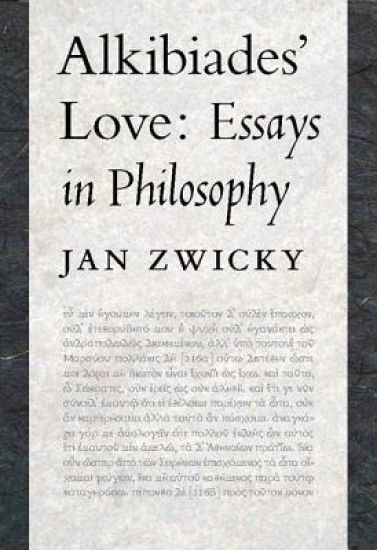
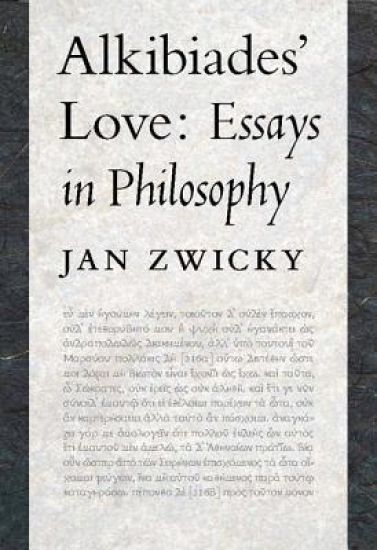
Alkibiades' Love

Alkibiades' Love

Jan Zwicky

McGill-Queen's University Press
2015
sidottu
Alkibiades, a central character in Plato's Symposium, claims that philosophy touches him to the quick. When Socrates speaks, he's often moved to tears and realizes he must change his life. In Alkibiades' Love, Jan Zwicky demonstrates that this image of philosophy is not anachronistic, but remains the living heart of the discipline. Philosophy can indeed matter to our lives, but for it to do so, we must reconceive the methods that, since the Enlightenment, have dominated its self-image in the West. In these meticulously researched essays, Zwicky argues that analytic and poststructuralist philosophy are not simply fashions in academic discourse, but are manifestations of the technocracy which they sustain and promote. The alternative she develops, by showing it in action, is lyric philosophy - an integrated mode of understanding whose foundations lie in the way we comprehend music and metaphor. Written in lucid and powerful prose, Alkibiades' Love will interest a broad readership, from students of ancient Greek philosophy to ecologists seeking a coherent foundation for their work. Zwicky offers deep and original readings of Freud, Plato, and Simone Weil, and resuscitates Max Wertheimer's work, linking it to our comprehension of mathematics, metaphor, and ecological structures. Zwicky has been hailed as one of the most important and original thinkers of our time. Alkibiades' Love illuminates and extends her groundbreaking work while providing an accessible introduction for those coming to her thought for the first time.
Alkibiades' Love

Alkibiades' Love

Jan Zwicky

McGill-Queen's University Press
2015
nidottu
Alkibiades, a central character in Plato's Symposium, claims that philosophy touches him to the quick. When Socrates speaks, he's often moved to tears and realizes he must change his life. In Alkibiades' Love, Jan Zwicky demonstrates that this image of philosophy is not anachronistic, but remains the living heart of the discipline. Philosophy can indeed matter to our lives, but for it to do so, we must reconceive the methods that, since the Enlightenment, have dominated its self-image in the West. In these meticulously researched essays, Zwicky argues that analytic and poststructuralist philosophy are not simply fashions in academic discourse, but are manifestations of the technocracy which they sustain and promote. The alternative she develops, by showing it in action, is lyric philosophy - an integrated mode of understanding whose foundations lie in the way we comprehend music and metaphor. Written in lucid and powerful prose, Alkibiades' Love will interest a broad readership, from students of ancient Greek philosophy to ecologists seeking a coherent foundation for their work. Zwicky offers deep and original readings of Freud, Plato, and Simone Weil, and resuscitates Max Wertheimer's work, linking it to our comprehension of mathematics, metaphor, and ecological structures. Zwicky has been hailed as one of the most important and original thinkers of our time. Alkibiades' Love illuminates and extends her groundbreaking work while providing an accessible introduction for those coming to her thought for the first time.
The Experience of Meaning

The Experience of Meaning

Jan Zwicky

McGill-Queen's University Press
2019
sidottu
The aim of this book is a recovery of interest in the experience of meaning. Jan Zwicky defends the claim that we experience meaning in the apprehension of wholes and their internal structural relations, providing examples of such insight in mathematics and physics, literature, music, and Plato's ancient theory of forms. Taken together, these essays constitute a powerful indictment of the aggressive reductionism and the reliance on calculative modes of thought that dominate our present conception of understanding. The Experience of Meaning proposes a more just epistemology, arguing for a new grammar of thought, a new way of understanding the relationship of human intelligence to the world. Engaging with philosophy, psychology, literature, fine arts, music, and environmental studies in a profound way, The Experience of Meaning will interest any reader who ponders the question of meaning and its relation to true human expression.
The Experience of Meaning

The Experience of Meaning

Jan Zwicky

McGill-Queen's University Press
2019
nidottu
The aim of this book is a recovery of interest in the experience of meaning. Jan Zwicky defends the claim that we experience meaning in the apprehension of wholes and their internal structural relations, providing examples of such insight in mathematics and physics, literature, music, and Plato's ancient theory of forms. Taken together, these essays constitute a powerful indictment of the aggressive reductionism and the reliance on calculative modes of thought that dominate our present conception of understanding. The Experience of Meaning proposes a more just epistemology, arguing for a new grammar of thought, a new way of understanding the relationship of human intelligence to the world. Engaging with philosophy, psychology, literature, fine arts, music, and environmental studies in a profound way, The Experience of Meaning will interest any reader who ponders the question of meaning and its relation to true human expression.
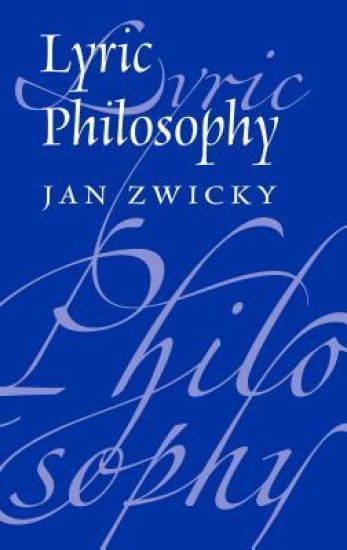
Lyric Philosophy

Lyric Philosophy

Jan Zwicky

Brush Education Inc
2017
sidottu
In this ground-breaking study on the nature of philosophy, Jan Zwicky demonstrates how much of potential philosophical significance is lost if our notion of meaningful language is constrained by narrow concepts of analytic rigour. Her aim is not to dismiss the role of analysis in philosophy; rather she strives to augment its resources and thereby give to philosophy a voice with greater range and integrity.Two parallel texts, on facing pages, run through the book. The primary one is Zwicky's, which begins with a critique of existing criteria for defining a work as philosophy, and then develops the notion of lyric in its relation to two other key terms: technology and domesticity. She finishes with an exploration of meaning, form, and content in lyric contexts. The parallel text consists of quotations from other authors. It serves as commentary on, illustration of, and reaction to, the main text; as a way of acknowledging intellectual debts; and as a way of providing an historical context for some of the main text's claims.Highly original in its thought and presentation, Zwicky's discussion makes an exciting contribution to contemporary philosophy, forging new connections and expanding old boundaries.
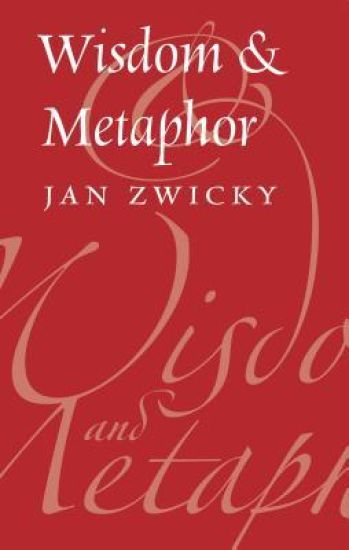
Wisdom & Metaphor

Wisdom & Metaphor

Jan Zwicky

Brush Education Inc
2017
sidottu
In the foreword to Wisdom & Metaphor, Jan Zwicky observes that "those who think metaphorically are enabled to think truly, because the shape of their thinking echoes the shape of the world." Wisdom & Metaphor explores the ways we come to understand the world through analogical structures, and the relation of this form of knowing to conventional epistemology and ontology. Zwicky uses the nature of the book itself, with its facing pages, to create resonant structures of aphorism and quotation which allow the reader to experience the kind of thinking she describes. The author's wide-ranging influences, coupled with an understated, largely spatial, style of discourse, make this a remarkably original approach to long-standing questions about meaning and language. It offers a unique and compelling argument for the fundamental importance of metaphor to philosophy.
Chamber Music

Chamber Music

Jan Zwicky

Wilfrid Laurier University Press
2014
nidottu
Arcing across thirty years and seven volumes, Jan Zwicky's poetry has always been acutely musical (and sensitive to the silence out of which music comes). In the compositions in Chamber Music, the first anthology of Zwicky's poems, one may perceive the attunement of her vocations: poet, philosopher, violinist. Her poetry both praises and relinquishes the earth, bearing witness to the fierce skies of the prairies and the freezing rain of the West Coast. Enacting the virtue of clarity prized and defended by her explicitly philosophical work, this poetry is both resonant and integrated. It is also formally diverse, ranging from the singular focus of the lyric ode to suites of variations and fugal structures, from polyphonic textures to the sprawling reach of narrative gestures. Throughout, one feels the deft hand of an adept using powerful metaphors to explore themes of colonial violence, environmental devastation, spiritual catastrophe, and transformation. Resisting Western philosophy's exclusion of imagination from civic life, Zwicky's poetry is noteworthy for the tension it achieves between the abstract and the personal, the general and the particular. Meditating repeatedly on themes of love and grief, this poetry is at once passionately committed to the lucidity of its utterances and the fidelity of its images.
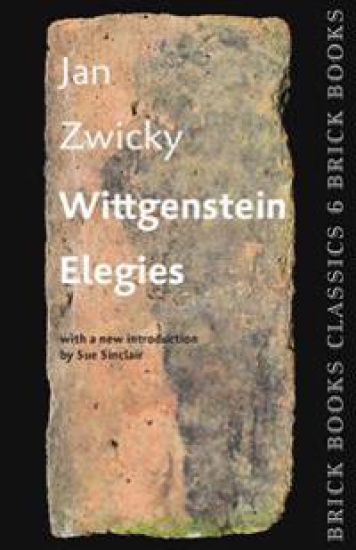
Wittgenstein Elegies: Brick Books Classics 6
New and revised edition of an early work by the Governor General's Award?winning poet. On the occasion of the press's 40th anniversary, Brick Books is proud to present the last of our six new editions of classic books from our back catalogue. This edition of Wittgenstein Elegies features an expansive Introduction by Sue Sinclair, a new Afterword by the author and a new cover and design by the renowned typographer Robert Bringhurst. First published in 1986, Wittgenstein Elegies is a polyphonic poem in five parts. It establishes the parameters of a long conversation between logic and the lyre that has continued over multiple books and in multiple genres. Long out of print, this revised edition is both a must-have for Zwicky's readers and a perfect introduction to her work. "Here was the one guy in recent history who appeared to have got it right and he was being taught all wrong. I wrote Wittgenstein Elegies in an attempt to respond to this state of affairs. I wanted to draw attention to the unity of Wittgenstein's life and work. I hoped to show how profoundly he experienced the moral dimensions of language's relation to the world." - Jan Zwicky, from the Afterword "Zwicky shows us that there is a way of speaking that leaves room for what cannot be spoken." - Sue Sinclair, from the Introduction
Trettiosju små sånger & tretton tystnader
"Trettiosju små sånger" tillägnas och för ett samtal med vardagliga ting och erfarenheter, fåglar, träd, skuggor och ljus, väder och årstider. "Sju etyder" rör sig dröjande mellan nuet och det förflutna. "Sex variationer på tystnad" fokuserar stillheten mitt i världens, växandets och strömmandets ständiga rörelse. Jan Zwicky är född 1955, kanadensisk filosof, poet, essäist och musiker. Hon har publicerat över tjugo böcker, varav åtta diktsamlingar, och erhållit flera prestigefyllda kanadensiska litterära utmärkelser. "Trettiosju små sånger & tretton tystnader" publicerades 2005 och är den första av hennes böcker som ges ut på svenska.