Kirjojen hintavertailu. Mukana 11 244 527 kirjaa ja 12 kauppaa.

Kirjahaku

Etsi kirjoja tekijän nimen, kirjan nimen tai ISBN:n perusteella.

14 kirjaa tekijältä Jane Bennett

The Enchantment of Modern Life

The Enchantment of Modern Life

Jane Bennett

Princeton University Press
2001
pokkari
It is a commonplace that the modern world cannot be experienced as enchanted--that the very concept of enchantment belongs to past ages of superstition. Jane Bennett challenges that view. She seeks to rehabilitate enchantment, showing not only how it is still possible to experience genuine wonder, but how such experience is crucial to motivating ethical behavior. A creative blend of political theory, philosophy, and literary studies, this book is a powerful and innovative contribution to an emerging interdisciplinary conversation about the deep connections between ethics, aesthetics, and politics. As Bennett describes it, enchantment is a sense of openness to the unusual, the captivating, and the disturbing in everyday life. She guides us through a wide and often surprising range of sources of enchantment, showing that we can still find enchantment in nature, for example, but also in such unexpected places as modern technology, advertising, and even bureaucracy. She then explains how everyday moments of enchantment can be cultivated to build an ethics of generosity, stimulating the emotional energy and honing the perceptual refinement necessary to follow moral codes. Throughout, Bennett draws on thinkers and writers as diverse as Kant, Schiller, Thoreau, Kafka, Marx, Weber, Adorno, and Deleuze. With its range and daring, The Enchantment of Modern Life is a provocative challenge to the centuries-old "narrative of disenchantment," one that presents a new "alter-tale" that discloses our profound attachment to the human and nonhuman world.
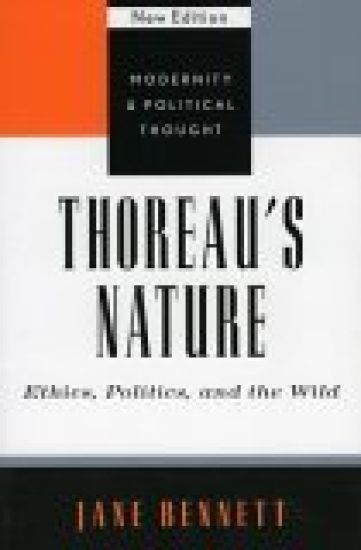
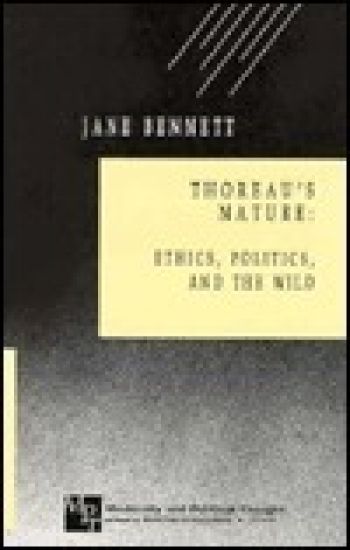
Thoreau's Nature

Thoreau's Nature

Jane Bennett

Rowman Littlefield Publishers
2002
nidottu
Thoreau's Nature: Ethics, Politics, and the Wild explores how Thoreau crafted a life open to 'the Wild,' a term that marks the startling element of foreignness in every object of experience, however familiar. Thoreau's encounters with nature, Bennett argues, allowed him to resist his all-too-human tendency toward intellectual laziness, social conformity, and political complacency. Bennett pursues this theme by constructing a series of dialogues between Thoreau and our contemporaries: Foucault on identity and power, Haraway on the nature/culture of division, Hollywood celebrities on the Walden Woods Project, the National Endowment for the Humanities on politics and art, and Kafka on the question of political idealism. The pertinence to the late 20th century of Thoreau's pursuit of independent judgment, ecological foresight, and moral nobility becomes apparent through these engagements.
Thoreau's Nature

Thoreau's Nature

Jane Bennett

AltaMira Press,U.S.
1994
sidottu
Inserting a nineteent century thinker into the intellectual debates of the late twentieth century, Jane Bennett enters Thoreau into a series of dialogues with recent contemporary thinkers: Foucault on the question of identity and power; Donna Haraway on nature and culture; Hollywood celebrities on the Walden Woods project on the environment; the National Endowment for the Humanities and others regarding the relation between politics and arts; and Kafka on the question of political idealism. Bennett suggests that many dimensions of Thoreau's thought exhibit a 'postmodern sensibility' that crosses into the late twentieth century.
Thoreau's Nature

Thoreau's Nature

Jane Bennett

AltaMira Press,U.S.
1994
nidottu
Inserting a nineteent century thinker into the intellectual debates of the late twentieth century, Jane Bennett enters Thoreau into a series of dialogues with recent contemporary thinkers: Foucault on the question of identity and power; Donna Haraway on nature and culture; Hollywood celebrities on the Walden Woods project on the environment; the National Endowment for the Humanities and others regarding the relation between politics and arts; and Kafka on the question of political idealism. Bennett suggests that many dimensions of Thoreau's thought exhibit a 'postmodern sensibility' that crosses into the late twentieth century.
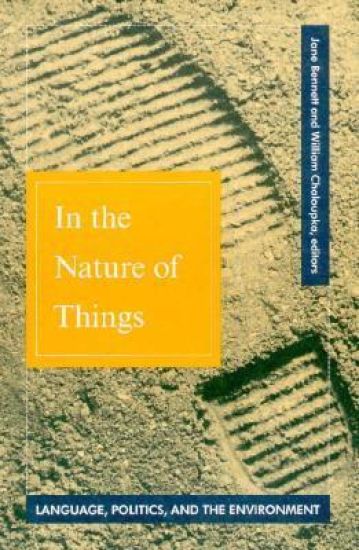
In the Nature of Things

In the Nature of Things

Jane Bennett

University of Minnesota Press
1993
nidottu
Informed by recent developments in literary criticism and social theory, In the Nature of Things addresses the presumption that nature exists independent of culture and, in particular, of language. The theoretical approaches of the contributors represent both modernist and postmodernist positions, including feminist theory, critical theory, Marxism, science fiction, theology, and botany. They demonstrate how the concept of nature is invoked and constituted in a wide range of cultural projects-from the Bible to science fiction movies, from hunting to green consumerism. Ultimately, it weeks to link the work of theorists concerned with nature and the environment to nontheorists who share similar concerns.Contributors include R. McGreggor Cawley, Romand Coles, William E. Connolly, Jan E. Dizard, Valerie Hartouni, Cheri Lucas Jennings, Bruce H. Jennings, Timothy W. Luke, Shane Phelan, John Rodman, Michael J. Shapiro, and Wade Sikorski.
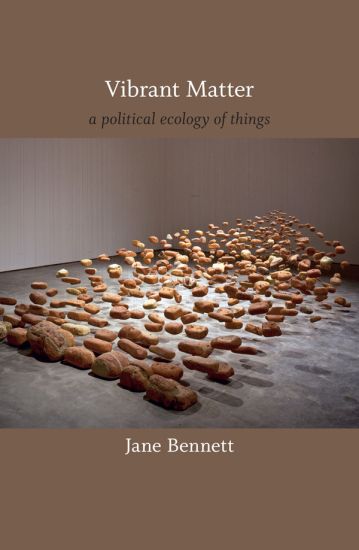
Vibrant Matter

Vibrant Matter

Jane Bennett

Duke University Press
2010
sidottu
In Vibrant Matter the political theorist Jane Bennett, renowned for her work on nature, ethics, and affect, shifts her focus from the human experience of things to things themselves. Bennett argues that political theory needs to do a better job of recognizing the active participation of nonhuman forces in events. Toward that end, she theorizes a “vital materiality” that runs through and across bodies, both human and nonhuman. Bennett explores how political analyses of public events might change were we to acknowledge that agency always emerges as the effect of ad hoc configurations of human and nonhuman forces. She suggests that recognizing that agency is distributed this way, and is not solely the province of humans, might spur the cultivation of a more responsible, ecologically sound politics: a politics less devoted to blaming and condemning individuals than to discerning the web of forces affecting situations and events.Bennett examines the political and theoretical implications of vital materialism through extended discussions of commonplace things and physical phenomena including stem cells, fish oils, electricity, metal, and trash. She reflects on the vital power of material formations such as landfills, which generate lively streams of chemicals, and omega-3 fatty acids, which can transform brain chemistry and mood. Along the way, she engages with the concepts and claims of Spinoza, Nietzsche, Thoreau, Darwin, Adorno, and Deleuze, disclosing a long history of thinking about vibrant matter in Western philosophy, including attempts by Kant, Bergson, and the embryologist Hans Driesch to name the “vital force” inherent in material forms. Bennett concludes by sketching the contours of a “green materialist” ecophilosophy.
Vibrant Matter

Vibrant Matter

Jane Bennett

Duke University Press
2010
pokkari
In Vibrant Matter the political theorist Jane Bennett, renowned for her work on nature, ethics, and affect, shifts her focus from the human experience of things to things themselves. Bennett argues that political theory needs to do a better job of recognizing the active participation of nonhuman forces in events. Toward that end, she theorizes a “vital materiality” that runs through and across bodies, both human and nonhuman. Bennett explores how political analyses of public events might change were we to acknowledge that agency always emerges as the effect of ad hoc configurations of human and nonhuman forces. She suggests that recognizing that agency is distributed this way, and is not solely the province of humans, might spur the cultivation of a more responsible, ecologically sound politics: a politics less devoted to blaming and condemning individuals than to discerning the web of forces affecting situations and events.Bennett examines the political and theoretical implications of vital materialism through extended discussions of commonplace things and physical phenomena including stem cells, fish oils, electricity, metal, and trash. She reflects on the vital power of material formations such as landfills, which generate lively streams of chemicals, and omega-3 fatty acids, which can transform brain chemistry and mood. Along the way, she engages with the concepts and claims of Spinoza, Nietzsche, Thoreau, Darwin, Adorno, and Deleuze, disclosing a long history of thinking about vibrant matter in Western philosophy, including attempts by Kant, Bergson, and the embryologist Hans Driesch to name the “vital force” inherent in material forms. Bennett concludes by sketching the contours of a “green materialist” ecophilosophy.
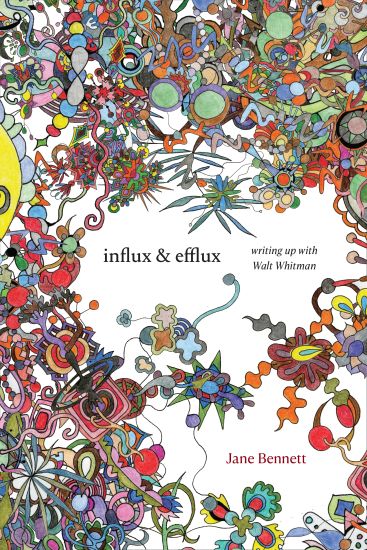
Influx and Efflux

Influx and Efflux

Jane Bennett

Duke University Press
2020
sidottu
In influx & efflux Jane Bennett pursues a question that was bracketed in her book Vibrant Matter: how to think about human agency in a world teeming with powerful nonhuman influences? “Influx & efflux”-a phrase borrowed from Whitman's "Song of Myself"-refers to everyday movements whereby outside influences enter bodies, infuse and confuse their organization, and then exit, themselves having been transformed into something new. How to describe the human efforts involved in that process? What kinds of “I” and “we” can live well and act effectively in a world of so many other lively materialities? Drawing upon Whitman, Thoreau, Caillois, Whitehead, and other poetic writers, Bennett links a nonanthropocentric model of self to a radically egalitarian pluralism and also to a syntax and style of writing appropriate to the entangled world in which we live. The book tries to enact the uncanny process by which we “write up” influences that pervade, enable, and disrupt us.
Influx and Efflux

Influx and Efflux

Jane Bennett

Duke University Press
2020
pokkari
In influx & efflux Jane Bennett pursues a question that was bracketed in her book Vibrant Matter: how to think about human agency in a world teeming with powerful nonhuman influences? “Influx & efflux”-a phrase borrowed from Whitman's "Song of Myself"-refers to everyday movements whereby outside influences enter bodies, infuse and confuse their organization, and then exit, themselves having been transformed into something new. How to describe the human efforts involved in that process? What kinds of “I” and “we” can live well and act effectively in a world of so many other lively materialities? Drawing upon Whitman, Thoreau, Caillois, Whitehead, and other poetic writers, Bennett links a nonanthropocentric model of self to a radically egalitarian pluralism and also to a syntax and style of writing appropriate to the entangled world in which we live. The book tries to enact the uncanny process by which we “write up” influences that pervade, enable, and disrupt us.
Microwave Cookbook 2022

Microwave Cookbook 2022

Jane Bennett

JANE BENNETT
2022
pokkari
The microwave is a convenience appliance that almost everyone has in their home, including hotel rooms and college dorms. But the meals that can be made in the microwave do not have to be limited to heating water and cooking prepared processed foods. There are lots and lots of delicious microwave meals that can be prepared in a fraction of the time that it takes in a conventional oven. This cookbook explores many of the scrumptious, mouth watering recipes that are quick and easy to prepare in the microwave.
Blessing Not a Curse

Blessing Not a Curse

Jane Bennett

Sally Milner Publishing Pty Lt
2002
pokkari
A sensitive book for parents that dispels the notion of the curse, replacing it with a positive view of menarche and menstruation. It offers practical advice on how to explain menstruation to your daughter, help her cope with mood swings and pain, as well as handle such issues as contraception.
Vital materie

Vital materie

Jane Bennett

Existenz forlag
2022
nidottu
Den amerikanske filosofen Jane Bennetts banebrytende bok åpner opp spørsmålet om en politisk materialisme fra en helt annen kant enn den marxistiske. Ved å undersøke materiens egen virkekraft utfordrer hun grensene for hva og hvem som kan regnes som en politisk aktør. Undersøkelsen av materiens eget liv og måtene det tangerer menneskelivet på, fra tarmen til atmosfæren, blir også en revurdering av den klassiske motsetningen mellom mekanistisk og vitalistisk tenkning.
Levende materialitet

Levende materialitet

Jane Bennett

Forlaget Mindspace
2021
pokkari
Da det nordamerikanske elnet i 2003 satte ud i flere dage, konstaterede man, at ingen havde fuld forståelse for det enorme, skyggefulde netværk af transmissionsledninger, elværker og understationer. Man begyndte at tale om, at nettet havde hjerteflimmer og levede og døde efter egne regler. Strømudfaldet er et af Jane Bennetts mange konkrete eksempler på begivenheder, vi almindeligvis ser som forårsaget af livløse dele i en maskine. I stedet må vi begynde at se disse begivenheder som flygtige assemblager af levende materialiteter med handlekraft. Elnettet har kul, sved, elektronstrømme, plastic og profitmotiver som aktanter, for nu blot at nævne nogle få. Levende materialitet. Tingenes politiske økologi er Jane Bennetts indflydelsesrige argumenter for en ny vital materialisme. Gennem anerkendelse af materie som en aktant kan vi begynde at opdyrke en mere ansvarlig, økologisk sund politik. Bennett inddrager Darwins orme, spiselig materie, Kafka og tænkere fra Spinoza til Deleuze for at perspektivere bestræbelsen på at navngive den ”vitale kraft” i materien. @font-face {font-family:"Cambria Math"; panose-1:2 4 5 3 5 4 6 3 2 4; mso-font-charset:0; mso-generic-font-family:roman; mso-font-pitch:variable; mso-font-signature:3 0 0 0 1 0;}@font-face {font-family:Calibri; panose-1:2 15 5 2 2 2 4 3 2 4; mso-font-charset:0; mso-generic-font-family:swiss; mso-font-pitch:variable; mso-font-signature:-536859905 -1073697537 9 0 511 0;}@font-face {font-family:Garamond; panose-1:2 2 4 4 3 3 1 1 8 3; mso-font-charset:0; mso-generic-font-family:roman; mso-font-pitch:variable; mso-font-signature:647 2 0 0 159 0;}p.MsoNormal, li.MsoNormal, div.MsoNormal {mso-style-unhide:no; mso-style-qformat:yes; mso-style-parent:""; margin:0cm; margin-bottom:.0001pt; mso-pagination:widow-orphan; font-size:12.0pt; font-family:"Calibri",sans-serif; mso-ascii-font-family:Calibri; mso-ascii-theme-font:minor-latin; mso-fareast-font-family:Calibri; mso-fareast-theme-font:minor-latin; mso-hansi-font-family:Calibri; mso-hansi-theme-font:minor-latin; mso-bidi-font-family:"Times New Roman"; mso-bidi-theme-font:minor-bidi; mso-fareast-language:EN-US;}.MsoChpDefault {mso-style-type:export-only; mso-default-props:yes; font-family:"Calibri",sans-serif; mso-ascii-font-family:Calibri; mso-ascii-theme-font:minor-latin; mso-fareast-font-family:Calibri; mso-fareast-theme-font:minor-latin; mso-hansi-font-family:Calibri; mso-hansi-theme-font:minor-latin; mso-bidi-font-family:"Times New Roman"; mso-bidi-theme-font:minor-bidi; mso-fareast-language:EN-US;}div.WordSection1 {page:WordSection1;}