
Kirjahaku
Etsi kirjoja tekijän nimen, kirjan nimen tai ISBN:n perusteella.
7 kirjaa tekijältä Jane Collins
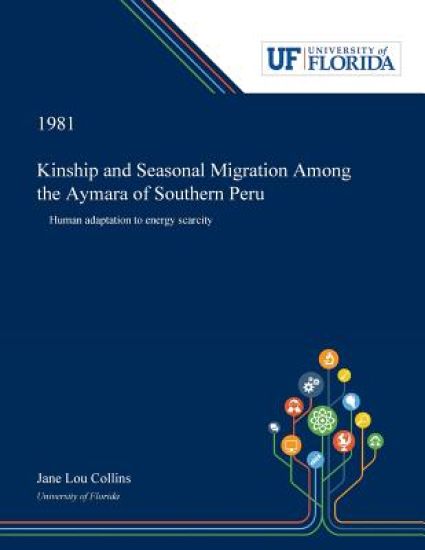
Kinship and Seasonal Migration Among the Aymara of Southern Peru
Jane Collins
Dissertation Discovery Company
2019
pokkari
Abstract: The people of the southern Peruvian highlands have adapted to a condition of energy scarcity through seasonal migration to lowland areas. In the district of Sarata (a fictitious name for a real district on the northeastern shore of Lake Titicaca) people spend three to seven months of every year growing coffee in the Tambopata Valley of the eastern Andes. This migratory pattern, which is hundreds of years old, provides the context for an investigation of human adaptive processes. The present study presents models of the flow of energy through high-altitude households and shows that energy is a limiting factor for the population. There are two periods when energy subsidies from lowland regions become crucial to the continued survival of highland households. These are the periods of peak growth and reproduction experienced by households early in their developmental cycles, and times of sharply lowered productivity caused by environmental crises such as drought or killing frosts. Seasonal migration provides the subsidies which households rely on during these periods. Seasonal migration in Sarata is organized primarily through the structure of kin relationships. Exchanges of labor and goods between consanguineal, affinal, and ritual kin make coordinated production in two widely separated zones possible. The information, initial support, and productive knowledge required in the migratory effort are also transmitted along kinship lines. Prior to the Spanish Conquest, political institutions as well as kinship served to organize the exploitation of lowland ecosystems. When regional political organizations were broken down and replaced by Spanish institutions, kinship structure and to a certain extent community relationships became entirely responsible for maintaining seasonal migration as a strategy. Seasonal exploitation of lowland ecosystems is shown to be vital to the survival of the population of the district of Sarata because of the energy subsidies it provides. This fact must be kept in mind when development efforts for the region are designed. The migration of the people of Sarata to the Tambopata Valley also provides a potential model for the exploitation of the eastern slopes of the Andes, a region which Peru is eager to bring into production and where most previous development efforts have been unsuccessful. Dissertation Discovery Company and University of Florida are dedicated to making scholarly works more discoverable and accessible throughout the world. This dissertation, "Kinship and Seasonal Migration Among the Aymara of Southern Peru" by Jane Lou Collins, was obtained from University of Florida and is being sold with permission from the author. A digital copy of this work may also be found in the university's institutional repository, IR@UF. The content of this dissertation has not been altered in any way. We have altered the formatting in order to facilitate the ease of printing and reading of the dissertation.
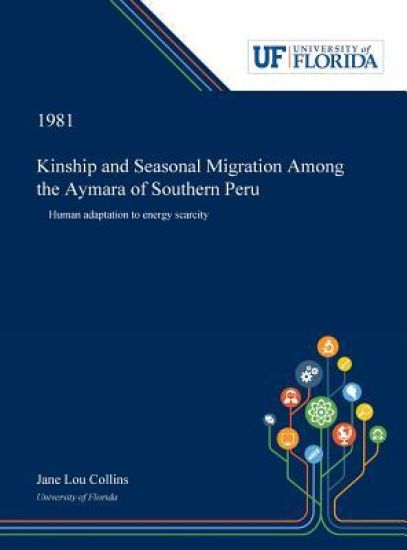
Kinship and Seasonal Migration Among the Aymara of Southern Peru
Jane Collins
Dissertation Discovery Company
2019
sidottu
Abstract: The people of the southern Peruvian highlands have adapted to a condition of energy scarcity through seasonal migration to lowland areas. In the district of Sarata (a fictitious name for a real district on the northeastern shore of Lake Titicaca) people spend three to seven months of every year growing coffee in the Tambopata Valley of the eastern Andes. This migratory pattern, which is hundreds of years old, provides the context for an investigation of human adaptive processes. The present study presents models of the flow of energy through high-altitude households and shows that energy is a limiting factor for the population. There are two periods when energy subsidies from lowland regions become crucial to the continued survival of highland households. These are the periods of peak growth and reproduction experienced by households early in their developmental cycles, and times of sharply lowered productivity caused by environmental crises such as drought or killing frosts. Seasonal migration provides the subsidies which households rely on during these periods. Seasonal migration in Sarata is organized primarily through the structure of kin relationships. Exchanges of labor and goods between consanguineal, affinal, and ritual kin make coordinated production in two widely separated zones possible. The information, initial support, and productive knowledge required in the migratory effort are also transmitted along kinship lines. Prior to the Spanish Conquest, political institutions as well as kinship served to organize the exploitation of lowland ecosystems. When regional political organizations were broken down and replaced by Spanish institutions, kinship structure and to a certain extent community relationships became entirely responsible for maintaining seasonal migration as a strategy. Seasonal exploitation of lowland ecosystems is shown to be vital to the survival of the population of the district of Sarata because of the energy subsidies it provides. This fact must be kept in mind when development efforts for the region are designed. The migration of the people of Sarata to the Tambopata Valley also provides a potential model for the exploitation of the eastern slopes of the Andes, a region which Peru is eager to bring into production and where most previous development efforts have been unsuccessful. Dissertation Discovery Company and University of Florida are dedicated to making scholarly works more discoverable and accessible throughout the world. This dissertation, "Kinship and Seasonal Migration Among the Aymara of Southern Peru" by Jane Lou Collins, was obtained from University of Florida and is being sold with permission from the author. A digital copy of this work may also be found in the university's institutional repository, IR@UF. The content of this dissertation has not been altered in any way. We have altered the formatting in order to facilitate the ease of printing and reading of the dissertation.

For Love of a Soldier contains the stories of 29 people whose family members—spouses, siblings, children—are serving or have served in the American military during the Iraq War. The families tell their stories and explain why they believe that taking action to end American military involvement in Iraq is the best possible way to support the troops who are so dear to them. The passionate and articulate individuals whose interviews make up the body of the book include: spouses and parents of soldiers with post-traumatic stress disorder, a couple with eight children and grandchildren who have served or are currently serving in Iraq, the parents who have formed an organization of anti-war families, parents whose children have been killed or maimed in the war, and parents whose children have committed suicide after returning home from the war.

For Love of a Soldier contains the stories of 29 people whose family members_spouses, siblings, children_are serving or have served in the American military during the Iraq War. The families tell their stories and explain why they believe that taking action to end American military involvement in Iraq is the best possible way to support the troops who are so dear to them. The passionate and articulate individuals whose interviews make up the body of the book include: spouses and parents of soldiers with post-traumatic stress disorder, a couple with eight children and grandchildren who have served or are currently serving in Iraq, the parents who have formed an organization of anti-war families, parents whose children have been killed or maimed in the war, and parents whose children have committed suicide after returning home from the war.

The one work traditionally attributed to Susan DuVerger is her Admirable Events (1639) - a translation of a collection of novellas by Jean Pierre Camus, a French Catholic Bishop - which she dedicated to Queen Henrietta Maria. There is some evidence however to suggest that she was the author of several other works. What little is known of her is based on her literary production - various factors suggest that she was an English Catholic who spent time in exile in France during the Civil War.