
Kirjahaku
Etsi kirjoja tekijän nimen, kirjan nimen tai ISBN:n perusteella.
21 kirjaa tekijältä Jane Haldimand Marcet

Conversations On Natural Philosophy: In Which The Elements Of That Science Are Familiarly Explained And Adapted To The Comprehension Of Young Pupils (
Jane Haldimand Marcet
KESSINGER PUBLISHING, LLC
2008
sidottu
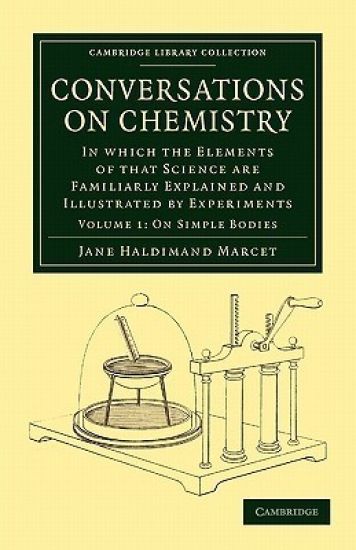
Jane Haldimand Marcet (1769–1858) was a pioneer in the field of education who wrote accessible introductory books on science and economics. Noting that women's education 'is seldom calculated to prepare their minds for abstract ideas', she resolved to write books that would inform, entertain and improve a generation of female readers. First published anonymously in 1805, her two-volume work Conversations on Chemistry swiftly became a standard primer going through sixteen editions in England alone, and is credited with having influenced the young Michael Faraday. Presented as a series of discussions between a fictional tutor, Mrs. Bryan, and her two female students, the flighty Caroline and earnest Emily, Conversations combines entertaining banter with a clear and concise explanation of scientific theories of the day. In Volume 1 the girls are introduced to 'Simple Bodies' through such colourful examples as hot air balloons and the spa waters of Harrogate.

Jane Haldimand Marcet (1769–1858) was a pioneer in the field of education who wrote accessible introductory books on science and economics. Noting that women's education 'is seldom calculated to prepare their minds for abstract ideas', she resolved to write books that would inform, entertain and improve a generation of female readers. First published anonymously in 1805, her two-volume Conversations on Chemistry swiftly became a standard primer going through sixteen editions in England alone, and is credited with having influenced the young Michael Faraday. Presented as a series of discussions between a fictional tutor, Mrs. Bryan, and her two female students, the flighty Caroline and earnest Emily, Conversations combines entertaining banter with a clear and concise explanation of scientific theories of the day. Volume 2 contains spirited exchanges on topics including 'shells and chalk', borax, decomposing vegetables and 'animal economy', which will interest historians of both science and education.

Published at a pivotal moment in the economic development of Britain, Conversations on Political Economy (1816) influenced a generation of economists, politicians and intellectuals. Employing her trademark format of dialogues between Mrs. Bryan and her pupil Caroline, Marcet introduces readers to theories surrounding property, population, and the 'condition of the poor'. Despite a target audience of young women, there is little evidence of feminine sentimentality, nor does the author's commitment to female education prevent her from propounding challenging, often controversial arguments; an approach which won her admiration. As one of her avid readers, Anne Romilly wrote, 'those, who like me know very little … are delighted with the knowledge they have acquired'. In fact, the first edition was so well received that a second was called for before the author had time to make corrections. Marcet had become, as one of her obituarists later put it, the 'instructress of a generation'.
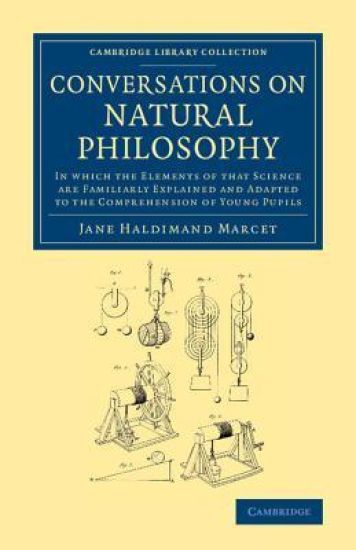
An author of educational works intended especially for young women, Jane Haldimand Marcet (1769–1858) sought to combat the notion that technical topics were unsuitable for female students. Inspired by conversations with the famous scientists she entertained, she wrote textbooks in the lively form of discussions between a teacher and her two female pupils. Published anonymously at first, they found broad popularity: Michael Faraday, as a young bookbinder's apprentice, credited Marcet with introducing him to electrochemistry. The present work, an introduction to physics, astronomy and the properties of matter, sound and light, was Marcet's first, though it remained unpublished until 1819. Her other works include Conversations on Chemistry (1805), Conversations on Political Economy (1816) and Conversations on Vegetable Physiology (1829), all of which are reissued in this series. Never professing to be original, Marcet's work is noted nonetheless for its thoroughness and clear presentation of concepts.

Conversations on Vegetable Physiology: Volume 1
Jane Haldimand Marcet
Cambridge University Press
2013
pokkari
Jane Haldimand Marcet (1769–1858) wrote across a range of topics, from natural philosophy to political economy. Her educational books were especially intended for female students, to combat the prevalent idea that science and economics were unsuitable for women, but they found broader popularity: Michael Faraday, as a young bookbinder's apprentice, credited Marcet with introducing him to electrochemistry. This two-volume work, first published in 1829, is a beginner's guide to botany. Since the chief aim was accessibility, Marcet does not dwell on the often burdensome process of plant classification, but focuses on plant forms and botany's practical applications. She presents the facts in the form of simple conversations between two students and their teacher. Based on the lectures of the Swiss botanist Candolle, Volume 1 introduces roots, leaves, sap, and the effects of different soil and air.
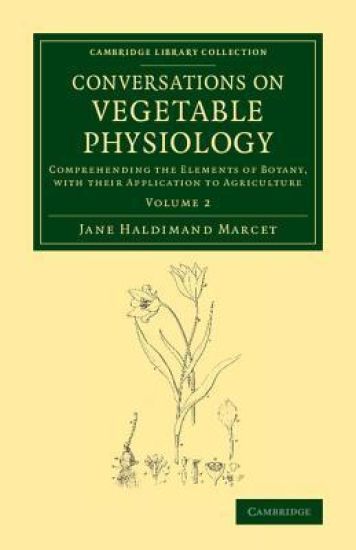
Conversations on Vegetable Physiology: Volume 2
Jane Haldimand Marcet
Cambridge University Press
2013
pokkari
Jane Haldimand Marcet (1769–1858) wrote across a range of topics, from natural philosophy to political economy. Her educational books were especially intended for female students, to combat the prevalent idea that science and economics were unsuitable for women, but they found broader popularity: Michael Faraday, as a young bookbinder's apprentice, credited Marcet with introducing him to electrochemistry. This two-volume work, first published in 1829, is a beginner's guide to botany. Since the chief aim was accessibility, Marcet does not dwell on the often burdensome process of plant classification, but focuses on plant forms and botany's practical applications. She presents the facts in the form of simple conversations between two students and their teacher. Based on the lectures of the Swiss botanist Candolle, Volume 2 considers agriculture and plant diseases, the cultivation of trees and culinary vegetables, and the effects of humans on flora.


Bertha's Visit To Her Uncle In England V3 (1830)
Jane Haldimand Marcet
KESSINGER PUBLISHING, LLC
2008
sidottu
Bertha's Visit To Her Uncle In England V2 (1830)
Jane Haldimand Marcet
KESSINGER PUBLISHING, LLC
2008
sidottu

NEW PRINT WITH PROFESSIONAL TYPE-SET IN CONTRAST TO SCANNED PRINTS OFFERED BY OTHERS Bertha's Visit To Her Uncle In England (Volume I): In Three Volumes, Vol. I. This book is a result of an effort made by us towards making a contribution to the preservation and repair of original classic literature. In an attempt to preserve, improve and recreate the original content, we have worked towards: 1. Type-setting & Reformatting: The complete work has been re-designed via professional layout, formatting and type-setting tools to re-create the same edition with rich typography, graphics, high quality images, and table elements, giving our readers the feel of holding a 'fresh and newly' reprinted and/or revised edition, as opposed to other scanned & printed (Optical Character Recognition - OCR) reproductions. 2. Correction of imperfections: As the work was re-created from the scratch, therefore, it was vetted to rectify certain conventional norms with regard to typographical mistakes, hyphenations, punctuations, blurred images, missing content/pages, and/or other related subject matters, upon our consideration. Every attempt was made to rectify the imperfections related to omitted constructs in the original edition via other references. However, a few of such imperfections which could not be rectified due to intentional\unintentional omission of content in the original edition, were inherited and preserved from the original work to maintain the authenticity and construct, relevant to the work. We believe that this work holds historical, cultural and/or intellectual importance in the literary works community, therefore despite the oddities, we accounted the work for print as a part of our continuing effort towards preservation of literary work and our contribution towards the development of the society as a whole, driven by our beliefs. We are grateful to our readers for putting their faith in us and accepting our imperfections with regard to preservation of the historical content. HAPPY READING

NEW PRINT WITH PROFESSIONAL TYPE-SET IN CONTRAST TO SCANNED PRINTS OFFERED BY OTHERS Bertha's Visit To Her Uncle In England (Volume II): In Three Volumes, Vol. II. This book is a result of an effort made by us towards making a contribution to the preservation and repair of original classic literature. In an attempt to preserve, improve and recreate the original content, we have worked towards: 1. Type-setting & Reformatting: The complete work has been re-designed via professional layout, formatting and type-setting tools to re-create the same edition with rich typography, graphics, high quality images, and table elements, giving our readers the feel of holding a 'fresh and newly' reprinted and/or revised edition, as opposed to other scanned & printed (Optical Character Recognition - OCR) reproductions. 2. Correction of imperfections: As the work was re-created from the scratch, therefore, it was vetted to rectify certain conventional norms with regard to typographical mistakes, hyphenations, punctuations, blurred images, missing content/pages, and/or other related subject matters, upon our consideration. Every attempt was made to rectify the imperfections related to omitted constructs in the original edition via other references. However, a few of such imperfections which could not be rectified due to intentional\unintentional omission of content in the original edition, were inherited and preserved from the original work to maintain the authenticity and construct, relevant to the work. We believe that this work holds historical, cultural and/or intellectual importance in the literary works community, therefore despite the oddities, we accounted the work for print as a part of our continuing effort towards preservation of literary work and our contribution towards the development of the society as a whole, driven by our beliefs. We are grateful to our readers for putting their faith in us and accepting our imperfections with regard to preservation of the historical content. HAPPY READING

NEW PRINT WITH PROFESSIONAL TYPE-SET IN CONTRAST TO SCANNED PRINTS OFFERED BY OTHERS Bertha's Visit To Her Uncle In England (Volume III): In Three Volumes, Vol. III. This book is a result of an effort made by us towards making a contribution to the preservation and repair of original classic literature. In an attempt to preserve, improve and recreate the original content, we have worked towards: 1. Type-setting & Reformatting: The complete work has been re-designed via professional layout, formatting and type-setting tools to re-create the same edition with rich typography, graphics, high quality images, and table elements, giving our readers the feel of holding a 'fresh and newly' reprinted and/or revised edition, as opposed to other scanned & printed (Optical Character Recognition - OCR) reproductions. 2. Correction of imperfections: As the work was re-created from the scratch, therefore, it was vetted to rectify certain conventional norms with regard to typographical mistakes, hyphenations, punctuations, blurred images, missing content/pages, and/or other related subject matters, upon our consideration. Every attempt was made to rectify the imperfections related to omitted constructs in the original edition via other references. However, a few of such imperfections which could not be rectified due to intentional\unintentional omission of content in the original edition, were inherited and preserved from the original work to maintain the authenticity and construct, relevant to the work. We believe that this work holds historical, cultural and/or intellectual importance in the literary works community, therefore despite the oddities, we accounted the work for print as a part of our continuing effort towards preservation of literary work and our contribution towards the development of the society as a whole, driven by our beliefs. We are grateful to our readers for putting their faith in us and accepting our imperfections with regard to preservation of the historical content. HAPPY READING