Kirjojen hintavertailu. Mukana 12 390 323 kirjaa ja 12 kauppaa.

Kirjahaku

Etsi kirjoja tekijän nimen, kirjan nimen tai ISBN:n perusteella.

8 kirjaa tekijältä Janet Biehl

Ecology or Catastrophe

Ecology or Catastrophe

Janet Biehl

Oxford University Press Inc
2015
sidottu
Murray Bookchin (1921-2006) was one of the most significant and influential environmental philosophers of the twentieth century. The founder of the social ecology movement, Bookchin was presenting and publishing foundational ideas about issues like air and water pollution, nuclear radiation, and the dangers of fossil fuels. He was a genuinely original and prescient thinker who was grappling with problems that we still face today-and proposing solutions for them-before most people realized those problems existed. In addition to his work in ecology, Bookchin was also a noted leftist, and he worked to create an authentic, indigenous American Left. Ecology or Catastrophe: The Life of Murray Bookchin is the first-ever biography of Murray Bookchin, written by his personal collaborator and copyeditor, Janet Biehl. From 1987-2006, Biehl edited every word that Bookchin wrote, and worked with him on numerous articles and books. She tells the story of Bookchin's life from a perspective that no one else could, providing a comprehensive biography that examines this pioneer environmentalist's life on both personal and professional levels. She uses her access to Bookchin's papers as well as extensive archival research, and draws upon nearly two decades' worth of a personal relationship with Bookchin. The book discusses the variety of philosophies and movements that Bookchin helped lead, including social ecology, assembly democracy, and even, in certain instances, anarchism. Ecology or Catastrophe is the definitive biography of Murray Bookchin, written by the person who knew him best.
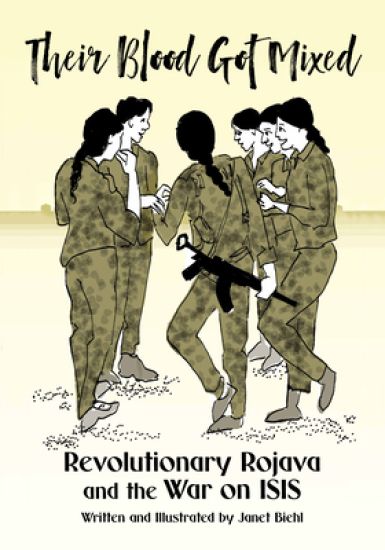
Their Blood Got Mixed

Their Blood Got Mixed

Janet Biehl

PM Press
2022
nidottu
In the summer of 2012 the Kurdish people of northern Syria set out to create a multiethnic society in the Middle East. Persecuted for much of the 20th century, they dared to try to overcome social fragmentation by affirming social solidarity among all the region's ethnic and religious peoples. As Syria plunged into civil war, the Kurds and their Arab and Assyrian allies established a self-governing polity that was not only multiethnic but democratic. And women were not only permitted but encouraged to participate in all social roles alongside men, including political and military roles. To implement these goals, Rojava wanted to live in peace with its neighbors. Instead, it soon faced invasion by ISIS, a force that was in every way its opposite. ISIS attacked its neighbors in Iraq and Syria, imposing theocratic, tyrannical, femicidal rule on them. Those who might have resisted fled in terror. But when ISIS attacked the mostly Kurdish city of Kobane and overran much of it, the YPG and YPJ, or people's militias, declined to flee. Instead they resisted, and several countries, seeing their valiant resistance, formed an international coalition to assist them militarily. While the YPG and YPJ fought on the ground, the coalition coordinated airstrikes with them. They liberated village after village and in March 2019 captured ISIS's last territory in Syria. Around that time, two UK-based filmmakers invited the author to spend a month in Rojava making a film. She accepted, and arrived to explore the society and interview people. During that month, she explored how the revolution had progressed and especially the effects of the war on the society. She found that the war had reinforced social solidarity and welded together the multiethnic, gender-liberated society. As one man in Kobane told her, "Our blood got mixed."
Ecofascism Revisited

Ecofascism Revisited

Janet Biehl; Peter Staudenmaier

Compass Press
2015
nidottu
The disconcerting reappearance of fascism in many parts of the Western world since the late twentieth century has prompted a re-evaluation of previous political assumptions. One of the more controversial facets of this process centers on the role of ecological ideas and practices within fascist circles, historically as well as today. The effort by fascist ideologists and groups to appropriate ecology for reactionary purposes has long historical roots in Germany, an aspect of the past that remains urgently relevant for the present. From the contested history of the Third Reich to the ongoing attempts by far-right currents to modernize their appeal through the selective use of ecological themes, this book traces the surprising background and contemporary significance of reactionary varieties of ecology in Germany and elsewhere. The original chapters have been supplemented by an extensive epilogue exploring the historical and political implications of the ecofascist legacy.