Kirjojen hintavertailu. Mukana 11 717 486 kirjaa ja 12 kauppaa.

Kirjahaku

Etsi kirjoja tekijän nimen, kirjan nimen tai ISBN:n perusteella.

11 kirjaa tekijältä Janet McIntyre-Mills

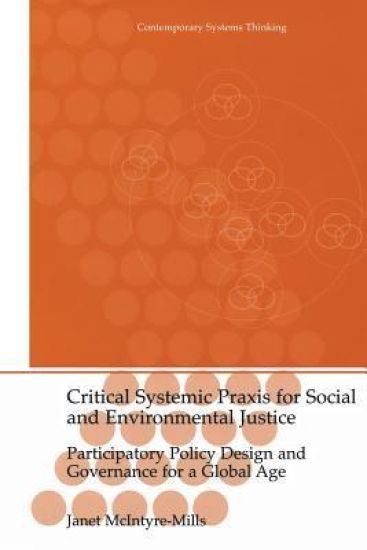
Critical Systemic Praxis for Social and Environmental Justice

Critical Systemic Praxis for Social and Environmental Justice

Janet McIntyre-Mills

Kluwer Academic/Plenum Publishers
2004
sidottu
The book develops a practical approach to public policy issues that have continued to be intractable because of a lack of emphasis on transcultural understanding. Sustained examples help to increase the readability and the accessibility of theory and methodology. The key themes address the issue that: -Management needs to be more systemic. Critical Systemic Praxis is the process whereby we find ways to work across discipline areas and sectoral areas, in order to address complex social, political, economic and environmental problems. -The way we define and address problems depends on an ability to work with, rather than within knowledge areas. -By introducing the notion of governance we can extend traditional management from an organisational context to an inter-organisational context and locate governance as the goal for sustainable social and environmental justice. The core aspects of praxis are: -Respectful listening and dialogue to set up appropriate contexts for participatory design. -Participatory designs based on participatory action research to map tacit and explicit knowledge of participants (professional and ordinary citizens). -Strategic decision making across discipline areas, cultural contexts and knowledge areas. -Action learning to transfer the policy and practice learnings. -Mainstreaming the approach to governance in the social, political, economic and environmental sectors. The book develops a systemic approach to public policy issues. Examples are used throughout to exemplify theory. The integrated approach to policy and practice is ideally suited to addressing the socio-economic and environmental issues.

Systemic Governance and Accountability

Systemic Governance and Accountability

Janet McIntyre-Mills

Springer-Verlag New York Inc.
2007
sidottu
Systemic Governance addresses accounting and accountability and develops conceptual tools to enhance the capacity of policy makers and managers. The structures and processes of international relations and governance need to be re-considered to allow diversity to the extent that is does not undermine the freedoms of others. The book makes a plea for systemic governance. Policy makers and managers need to work with rather than within theoretical and methodological frameworks to achieve multidimensional and multilayered policy decisions. Conceptual tools can be used to enhance systemic governance. The closest we can get to truth is through compassionate dialogue that explores paradoxes and considers the rights and responsibilities of caretakers. Case studies and conceptual tools enliven the text.
Systemic Governance and Accountability

Systemic Governance and Accountability

Janet McIntyre-Mills

Springer-Verlag New York Inc.
2010
nidottu
Systemic Governance addresses accounting and accountability and develops conceptual tools to enhance the capacity of policy makers and managers. The structures and processes of international relations and governance need to be re-considered to allow diversity to the extent that is does not undermine the freedoms of others. The book makes a plea for systemic governance. Policy makers and managers need to work with rather than within theoretical and methodological frameworks to achieve multidimensional and multilayered policy decisions. Conceptual tools can be used to enhance systemic governance. The closest we can get to truth is through compassionate dialogue that explores paradoxes and considers the rights and responsibilities of caretakers. Case studies and conceptual tools enliven the text.
Critical Systemic Praxis for Social and Environmental Justice

Critical Systemic Praxis for Social and Environmental Justice

Janet McIntyre-Mills

Springer-Verlag New York Inc.
2012
nidottu
The book develops a practical approach to public policy issues that have continued to be intractable because of a lack of emphasis on transcultural understanding. Sustained examples help to increase the readability and the accessibility of theory and methodology. The key themes address the issue that: -Management needs to be more systemic. Critical Systemic Praxis is the process whereby we find ways to work across discipline areas and sectoral areas, in order to address complex social, political, economic and environmental problems. -The way we define and address problems depends on an ability to work with, rather than within knowledge areas. -By introducing the notion of governance we can extend traditional management from an organisational context to an inter-organisational context and locate governance as the goal for sustainable social and environmental justice. The core aspects of praxis are: -Respectful listening and dialogue to set up appropriate contexts for participatory design. -Participatory designs based on participatory action research to map tacit and explicit knowledge of participants (professional and ordinary citizens). -Strategic decision making across discipline areas, cultural contexts and knowledge areas. -Action learning to transfer the policy and practice learnings. -Mainstreaming the approach to governance in the social, political, economic and environmental sectors. The book develops a systemic approach to public policy issues. Examples are used throughout to exemplify theory. The integrated approach to policy and practice is ideally suited to addressing the socio-economic and environmental issues.

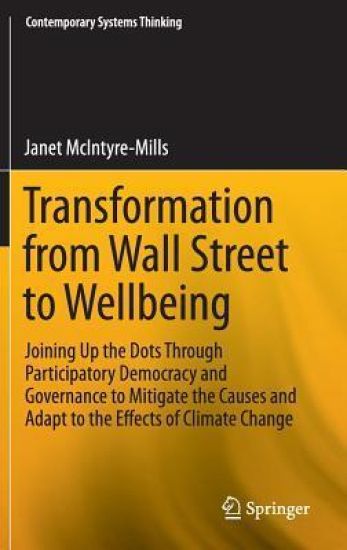
Transformation from Wall Street to Wellbeing

Transformation from Wall Street to Wellbeing

Janet McIntyre-Mills

Springer-Verlag New York Inc.
2014
sidottu
Transformation from Wall Street to Well-being: Joining up the dots through Participatory democracy and governance to mitigate the causes and adapt to the effects of climate change addresses accountable leadership, supports collective interests, ethical governance and fairness to future generations in order to develop systemic approaches relevant to these issues. The humanistic focus, whilst central, addresses how we see ourselves in relation to the environment. It explores cultural perspectives in developed and developing parts of the world where people have a closer connection with the natural environment in comparison to those who live in cities. Furthermore the book discusses participatory action research to prefigure a means to hold the market to ensure that the use of resources that are necessary for the common good are accessible and equitable. The essential systemic aim this book offers is to balance human needs with nature. The research summarizes the discourses and the adaptive praxis in order to develop a bridge between cosmopolitan ethics and cosmopolitan governance. It does this in the interest of supporting and using cultural designs for living that support quality of life and spans five core domains as explained by the author. Overall, this monograph helps evaluates the extent to which the introduced approaches enable the community to consider their perceived assets and risks and the implications of their consumption choices.
Transformation from Wall Street to Wellbeing

Transformation from Wall Street to Wellbeing

Janet McIntyre-Mills

Springer-Verlag New York Inc.
2016
nidottu
Transformation from Wall Street to Well-being: Joining up the dots through Participatory democracy and governance to mitigate the causes and adapt to the effects of climate change addresses accountable leadership, supports collective interests, ethical governance and fairness to future generations in order to develop systemic approaches relevant to these issues. The humanistic focus, whilst central, addresses how we see ourselves in relation to the environment. It explores cultural perspectives in developed and developing parts of the world where people have a closer connection with the natural environment in comparison to those who live in cities. Furthermore the book discusses participatory action research to prefigure a means to hold the market to ensure that the use of resources that are necessary for the common good are accessible and equitable. The essential systemic aim this book offers is to balance human needs with nature. The research summarizes the discourses and the adaptive praxis in order to develop a bridge between cosmopolitan ethics and cosmopolitan governance. It does this in the interest of supporting and using cultural designs for living that support quality of life and spans five core domains as explained by the author. Overall, this monograph helps evaluates the extent to which the introduced approaches enable the community to consider their perceived assets and risks and the implications of their consumption choices.
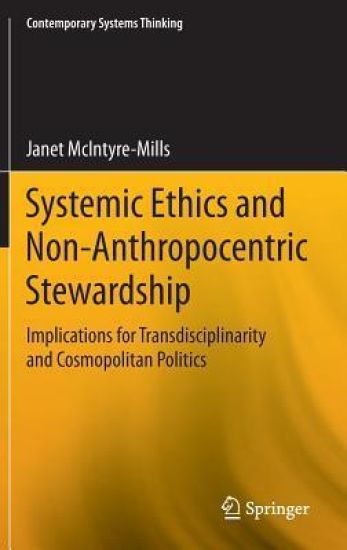
Systemic Ethics and Non-Anthropocentric Stewardship

Systemic Ethics and Non-Anthropocentric Stewardship

Janet McIntyre-Mills

Springer International Publishing AG
2014
sidottu
This book makes a case for rights and responsibilities to be expressed through a cosmopolitan praxis based on developing strong cosmopolitan approaches. This developed approach respects a form of cultural or national identity that is not at the expense of others, the environment or future generations. This new stoicism is based on a sense of responsibility for others. The book also explores systemic ethical praxis in response to the vexed challenge of how to bridge the false dualism of pitting the environment versus profit. Systemic Ethics and Non-Anthropocentric Stewardship: Implications for Transdisciplinarity and Cosmopolitan Politics is organized into seven chapters. The book begins by providing readers with an understanding of the way in which cosmopolitanism (like all social concepts) is shaped by diverse definitions and applied differently by theorists and those that engage in transformative praxis. It also develops an argument based on considering the empirical consequences of social, economic and environmental decisions on the quality of life of current and future generations. The next chapter critiques anthropocentricism and explores how policy makers develop agreements on what constitutes and supports the wellbeing of the planet rather than the GDP. The book then explores the options for social democracy and ways to enhance an ethical approach to post national governance and argues for participatory democracy and governance to respond to diversity within and across national boundaries. The following chapters reflect upon the author’s own participatory action research process and examines the transformations that can arise through critical systemic thinking and practice. Next the book makes the case for systemic ethical governance that is able to manage consumption, before concluding with a final look at the book’s approach, based on critical heuristics.
Systemic Ethics and Non-Anthropocentric Stewardship

Systemic Ethics and Non-Anthropocentric Stewardship

Janet McIntyre-Mills

Springer International Publishing AG
2016
nidottu
This book makes a case for rights and responsibilities to be expressed through a cosmopolitan praxis based on developing strong cosmopolitan approaches. This developed approach respects a form of cultural or national identity that is not at the expense of others, the environment or future generations. This new stoicism is based on a sense of responsibility for others. The book also explores systemic ethical praxis in response to the vexed challenge of how to bridge the false dualism of pitting the environment versus profit. Systemic Ethics and Non-Anthropocentric Stewardship: Implications for Transdisciplinarity and Cosmopolitan Politics is organized into seven chapters. The book begins by providing readers with an understanding of the way in which cosmopolitanism (like all social concepts) is shaped by diverse definitions and applied differently by theorists and those that engage in transformative praxis. It also develops an argument based on considering the empirical consequences of social, economic and environmental decisions on the quality of life of current and future generations. The next chapter critiques anthropocentricism and explores how policy makers develop agreements on what constitutes and supports the wellbeing of the planet rather than the GDP. The book then explores the options for social democracy and ways to enhance an ethical approach to post national governance and argues for participatory democracy and governance to respond to diversity within and across national boundaries. The following chapters reflect upon the author’s own participatory action research process and examines the transformations that can arise through critical systemic thinking and practice. Next the book makes the case for systemic ethical governance that is able to manage consumption, before concluding with a final look at the book’s approach, based on critical heuristics.
Planetary Passport

Planetary Passport

Janet McIntyre-Mills

Springer International Publishing AG
2017
sidottu
This book explores the implications of knowing our place in the universe and recognising our hybridity. It is a series of self-reflections and essays drawing on many diverse ways of knowing. The book examines the complex ethical challenges of closing the wide gap in living standards between rich and poor people/communities. The notion of an ecological citizen is presented with a focus on protecting current and future generations. The idea is to track the distribution and redistribution of resources in the interests of social and environmental justice. The central argument looks for ways to hold the powerful to account so as to enable virtuous living by the majority to be demonstrated in what the author calls a “planetary passport” - a careful use of resources and a way to provide safe passage to those in need of safe habitat. The book argues that nation states need to find ways to control the super-rich through the governance process and to enhance a sense of shared ecological citizenship and responsibility for biodiversity. The fundamental approach is collaborative research. Planetary Passport: Representation, Accountability and Re-Generation is comprised of six chapters. Chapter 1 begins by making a case for a paradigm shift away from business as usual and the pursuit of profit at the expense of the social and environmental fabric of life. The aim is to explore alternatives and to discuss some ways of achieving wellbeing whilst the focus is on human rights, discrimination and outlining the notion of a planetary passport. Chapter 2 makes a specific link between people and the planet as a basis for understanding the nature of hybridity and interconnectedness and the implications for ethics. Chapter 3 focuses on building this planetary passport for social and environmental justice in order to enable people with complex needs to consider the consequences of either continuing to live the same way as before or making changes to the way that they live.Meanwhile Chapter 4 does the same as the previous chapter, but explores the political context of consumption and short term profit Chapter 5 examines the challenges and opportunities that come from explorations within a cross-cultural learning community. This includes a look at co-creation and co-determination. Finally Chapter 6 ends with a look to the future and a potential new framework for people and the planet through a planetary passport.
Planetary Passport

Planetary Passport

Janet McIntyre-Mills

Springer International Publishing AG
2018
nidottu
This book explores the implications of knowing our place in the universe and recognising our hybridity. It is a series of self-reflections and essays drawing on many diverse ways of knowing. The book examines the complex ethical challenges of closing the wide gap in living standards between rich and poor people/communities. The notion of an ecological citizen is presented with a focus on protecting current and future generations. The idea is to track the distribution and redistribution of resources in the interests of social and environmental justice. The central argument looks for ways to hold the powerful to account so as to enable virtuous living by the majority to be demonstrated in what the author calls a “planetary passport” - a careful use of resources and a way to provide safe passage to those in need of safe habitat. The book argues that nation states need to find ways to control the super-rich through the governance process and to enhance a sense of shared ecological citizenship and responsibility for biodiversity. The fundamental approach is collaborative research. Planetary Passport: Representation, Accountability and Re-Generation is comprised of six chapters. Chapter 1 begins by making a case for a paradigm shift away from business as usual and the pursuit of profit at the expense of the social and environmental fabric of life. The aim is to explore alternatives and to discuss some ways of achieving wellbeing whilst the focus is on human rights, discrimination and outlining the notion of a planetary passport. Chapter 2 makes a specific link between people and the planet as a basis for understanding the nature of hybridity and interconnectedness and the implications for ethics. Chapter 3 focuses on building this planetary passport for social and environmental justice in order to enable people with complex needs to consider the consequences of either continuing to live the same way as before or making changes to the way that they live.Meanwhile Chapter 4 does the same as the previous chapter, but explores the political context of consumption and short term profit Chapter 5 examines the challenges and opportunities that come from explorations within a cross-cultural learning community. This includes a look at co-creation and co-determination. Finally Chapter 6 ends with a look to the future and a potential new framework for people and the planet through a planetary passport.