Kirjojen hintavertailu. Mukana 12 296 846 kirjaa ja 12 kauppaa.

Kirjahaku

Etsi kirjoja tekijän nimen, kirjan nimen tai ISBN:n perusteella.

5 kirjaa tekijältä Janis S. Bohan

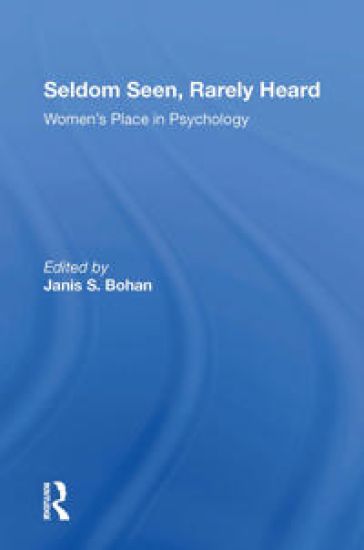
Seldom Seen, Rarely Heard

Seldom Seen, Rarely Heard

Janis S. Bohan

TAYLOR FRANCIS LTD
2024
nidottu
This book uses a constructionist approach to explore the place of women in psychology, both as participants in the discipline and as subjects of psychological theory, research, and practice. The book provides an explanation of the principles of social constructionism and then utilizes this model as a tool for discovering the influences that have shaped psychology's treatment of women. Certainly recent works have addressed the construction of gender, but this is the first to apply the constructionist lens to psychology itself. It asks how the social construction of gender has interacted, both historically and at present, with the sociohistorical forces that shape psychology. It is the intersection of these two understandings–accepted “truths†about the nature of gender and psychology's own understanding of its role–that has framed women's place in the discipline. Utilizing readings from a variety of sources, the book explicates women's place in psychology, from early misogynist to recent feminist attempts to understand the psychology of women. This exploration reveals the tacit assumptions about gender and about psychology that traditionally have acted in concert to discount, demean, marginalize, and misrepresent women's experience. Recent feminist psychology is given an equally thorough review, demonstrating that feminist thought must also be conscientiously queried lest we inadvertently reproduce the very forms we strive to dismantle.
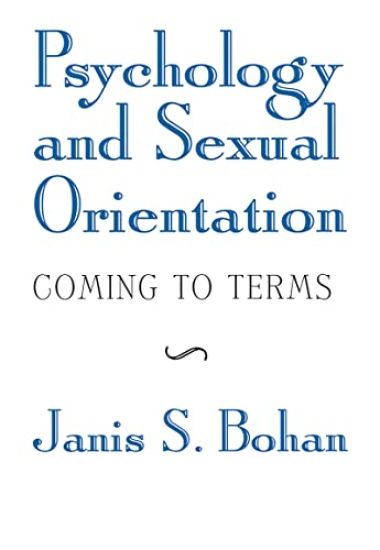
Psychology and Sexual Orientation

Psychology and Sexual Orientation

Janis S. Bohan

Routledge
1996
sidottu
Psychology and Sexual Orientation strives to "come to terms" with lesbian, gay and bisexual life and with the controversial scientific and sociocultural theories and arguments on the origin and meaning of homosexuality and queer life in the US. Janis M. Bohan disrupts conventional psychological perspectives on queer life and identity and animates the ongoing debate between essentialism and constructionism. Bohan discusses the meaning of sexual orientation; lesbian, gay and bisexual identity development and stigma management; diversity in experiences; partners and parenting; and lesbian, gay and bisexual communities.
Psychology and Sexual Orientation

Psychology and Sexual Orientation

Janis S. Bohan

Routledge
1996
nidottu
Psychology and Sexual Orientation strives to "come to terms" with lesbian, gay and bisexual life and with the controversial scientific and sociocultural theories and arguments on the origin and meaning of homosexuality and queer life in the US. Janis M. Bohan disrupts conventional psychological perspectives on queer life and identity and animates the ongoing debate between essentialism and constructionism. Bohan discusses the meaning of sexual orientation; lesbian, gay and bisexual identity development and stigma management; diversity in experiences; partners and parenting; and lesbian, gay and bisexual communities.
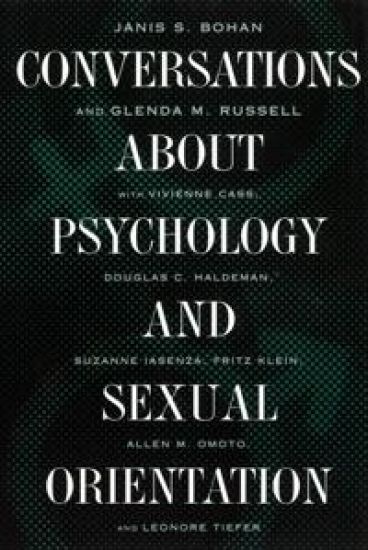
Conversations About Psychology and Sexual Orientation

Conversations About Psychology and Sexual Orientation

Janis S. Bohan; Glenda M. Russell

New York University Press
1999
sidottu
Psychology's approach to sexual orientation has long had its foundation in essentialism, which undergirds psychological theory and research as well as clinical practice and applications of psychology to public policy issues. It is only recently that psychology as a discipline has begun to entertain social constructivism as an alternative approach. Based on the belief that thoughtful dialogue can engender positive change, Conversations about Psychology and Sexual Orientation explores the implications for psychology of both essentialist and social constructionist understandings of sexual orientation. The book opens with an introduction presenting basic theoretical frameworks, followed by three application sections dealing with clinical practice, research and theory, and public policy. In each, the discussion takes the form of a conversation, as the authors first consider essentialist and constructionist approaches to the topic at hand. These thoughts, in turn, are followed by responses from distinguished scholars chosen for their expertise in a particular area. By providing an array of comments and thoughtful responses to topics surrounding psychology's approaches to sexual orientation, this valuable study sheds new light on the contrasting views held in the field and the ways in which essentialist and constructionist understandings may be applied to specific practices and policies.
Conversations About Psychology and Sexual Orientation

Conversations About Psychology and Sexual Orientation

Janis S. Bohan; Glenda M. Russell

New York University Press
1999
pokkari
Psychology's approach to sexual orientation has long had its foundation in essentialism, which undergirds psychological theory and research as well as clinical practice and applications of psychology to public policy issues. It is only recently that psychology as a discipline has begun to entertain social constructivism as an alternative approach. Based on the belief that thoughtful dialogue can engender positive change, Conversations about Psychology and Sexual Orientation explores the implications for psychology of both essentialist and social constructionist understandings of sexual orientation. The book opens with an introduction presenting basic theoretical frameworks, followed by three application sections dealing with clinical practice, research and theory, and public policy. In each, the discussion takes the form of a conversation, as the authors first consider essentialist and constructionist approaches to the topic at hand. These thoughts, in turn, are followed by responses from distinguished scholars chosen for their expertise in a particular area. By providing an array of comments and thoughtful responses to topics surrounding psychology's approaches to sexual orientation, this valuable study sheds new light on the contrasting views held in the field and the ways in which essentialist and constructionist understandings may be applied to specific practices and policies.