Kirjojen hintavertailu. Mukana 11 244 527 kirjaa ja 12 kauppaa.

Kirjahaku

Etsi kirjoja tekijän nimen, kirjan nimen tai ISBN:n perusteella.

5 kirjaa tekijältä Jared Gardner

The Rise and Fall of Early American Magazine Culture

The Rise and Fall of Early American Magazine Culture

Jared Gardner

University of Illinois Press
2012
sidottu
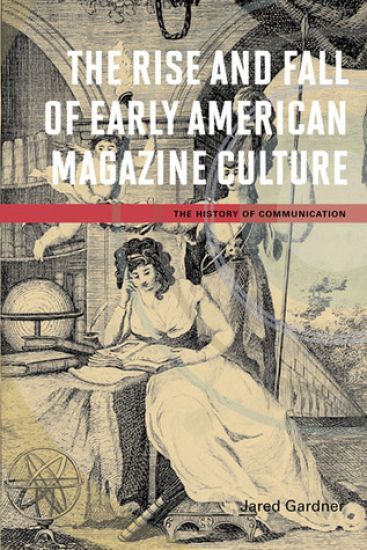
Countering assumptions about early American print culture and challenging our scholarly fixation on the novel, Jared Gardner reimagines the early American magazine as a rich literary culture that operated as a model for nation-building by celebrating editorship over authorship and serving as a virtual salon in which citizens were invited to share their different perspectives. The Rise and Fall of Early American Magazine Culture reexamines early magazines and their reach to show how magazine culture was multivocal and presented a porous distinction between author and reader, as opposed to novel culture, which imposed a one-sided authorial voice and restricted the agency of the reader.
The Rise and Fall of Early American Magazine Culture

The Rise and Fall of Early American Magazine Culture

Jared Gardner

University of Illinois Press
2014
nidottu
Countering assumptions about early American print culture and challenging our scholarly fixation on the novel, Jared Gardner reimagines the early American magazine as a rich literary culture that operated as a model for nation-building by celebrating editorship over authorship and serving as a virtual salon in which citizens were invited to share their different perspectives. The Rise and Fall of Early American Magazine Culture reexamines early magazines and their reach to show how magazine culture was multivocal and presented a porous distinction between author and reader, as opposed to novel culture, which imposed a one-sided authorial voice and restricted the agency of the reader.

Master Plots

Master Plots

Jared Gardner

Johns Hopkins University Press
2001
pokkari
While it is well known that American writers of the early national period were preoccupied with differentiating their work from European models, Jared Gardner argues that the national literature of the United States was equally motivated by the desire to differentiate white Americans from blacks and Indians. Early American writers were drawn to fantasies of an "American race," and an American literature came to be defined not only by its desire for cultural uniqueness but also by its defense of racial purity. Gardner follows the shifts in American narrative's engagement with race, from Royall Tyler's Algerine Captive through the novels of Brockden Brown and Cooper, to Poe's tales and Douglass's autobiographies, narratives that differently sought to rewrite the intersections of racial and national identity the first generation had plotted. The larger story Master Plots describes is how the racial language of "slavery" and "savagery" helped nationalist writers plot a unique identity for the new nation and the cost this "master plot" exacted when the empty rhetoric of one generation confronted the historical facts of slavery and Native American Removal in the next. The question of what it meant to be an American had lost none of its severity and the desire for an answer none of its urgency. As early nationalist writers wrestled with the question, they proved how hard a question it is to answer and how great are the dangers in scripting its answers too easily.
Projections

Projections

Jared Gardner

Stanford University Press
2012
sidottu
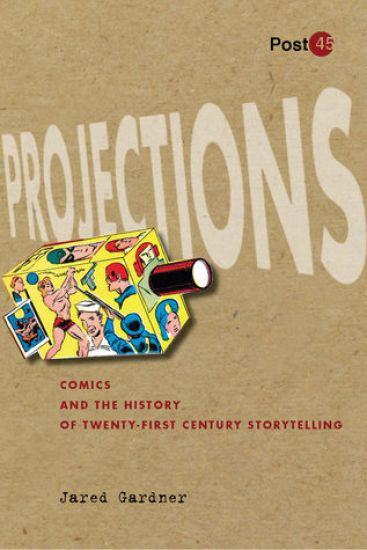
When Art Spiegelman's Maus won the Pulitzer Prize in 1992, it marked a new era for comics. Comics are now taken seriously by the same academic and cultural institutions that long dismissed the form. And the visibility of comics continues to increase, with alternative cartoonists now published by major presses and more comics-based films arriving on the screen each year. Projections argues that the seemingly sudden visibility of comics is no accident. Beginning with the parallel development of narrative comics at the turn of the 20th century, comics have long been a form that invites—indeed requires—readers to help shape the stories being told. Today, with the rise of interactive media, the creative techniques and the reading practices comics have been experimenting with for a century are now in universal demand. Recounting the history of comics from the nineteenth-century rise of sequential comics to the newspaper strip, through comic books and underground comix, to the graphic novel and webcomics, Gardner shows why they offer the best models for rethinking storytelling in the twenty-first century. In the process, he reminds us of some beloved characters from our past and present, including Happy Hooligan, Krazy Kat, Crypt Keeper, and Mr. Natural.
Projections

Projections

Jared Gardner

Stanford University Press
2012
pokkari
When Art Spiegelman's Maus won the Pulitzer Prize in 1992, it marked a new era for comics. Comics are now taken seriously by the same academic and cultural institutions that long dismissed the form. And the visibility of comics continues to increase, with alternative cartoonists now published by major presses and more comics-based films arriving on the screen each year. Projections argues that the seemingly sudden visibility of comics is no accident. Beginning with the parallel development of narrative comics at the turn of the 20th century, comics have long been a form that invites—indeed requires—readers to help shape the stories being told. Today, with the rise of interactive media, the creative techniques and the reading practices comics have been experimenting with for a century are now in universal demand. Recounting the history of comics from the nineteenth-century rise of sequential comics to the newspaper strip, through comic books and underground comix, to the graphic novel and webcomics, Gardner shows why they offer the best models for rethinking storytelling in the twenty-first century. In the process, he reminds us of some beloved characters from our past and present, including Happy Hooligan, Krazy Kat, Crypt Keeper, and Mr. Natural.