Kirjojen hintavertailu. Mukana 11 244 527 kirjaa ja 12 kauppaa.

Kirjahaku

Etsi kirjoja tekijän nimen, kirjan nimen tai ISBN:n perusteella.

4 kirjaa tekijältä Jason Baehr

Inquiry and Agency

Inquiry and Agency

Jason Baehr

Oxford University Press
2025
sidottu
In Inquiry and Agency, Jason Baehr develops a systematic account of the nature, structure, and evaluative status of intellectual virtues and vices. Drawing on a theory of moral virtue by Robert Adams (2006), Baehr argues that intellectual virtues like curiosity, open-mindedness, and intellectual courage are ways of "excellently being for epistemic goods" that reflect favorably on who we are as persons, and that intellectual vices like dogmatism, narrow-mindedness, and intellectual arrogance are ways of falling short of this standard, ways that contribute negatively to our personal worth. Inquiry and Agency is the most in-depth and sophisticated treatment of intellectual virtues and vices since Linda Zagzebski's pioneering work Virtues of the Mind (1996). While advancing several debates in virtue epistemology, it proposes a model of intellectual virtues and vices that will be accessible to non-experts and useful to researchers in other disciplines. Inquiry and Agency is the product of decades of reflection by a leading figure in the field. It is essential reading for anyone interested in the characterological dimensions of the life of the mind.
The Inquiring Mind

The Inquiring Mind

Jason Baehr

Oxford University Press
2011
sidottu
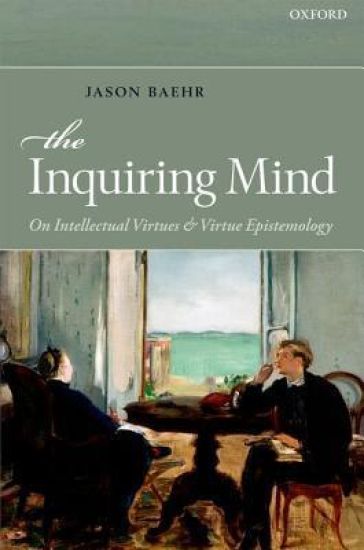
This book is the first systematic treatment of 'responsibilist' or character-based virtue epistemology, an approach to epistemology that focuses on intellectual character virtues like open-mindedness, fair-mindedness, inquisitiveness, and intellectual courage, rigor, and carefulness. Baehr distinguishes four main varieties of character-based virtue epistemology and develops a comprehensive assessment of each. For students and professional philosophers looking for an introduction to this important and exciting new field, Baehr provides a brief history of virtue epistemology, an overview of contemporary research in the field, and an introduction to the intellectual virtues that distinguishes them from intellectual talents, temperaments, faculties, and skills. For specialists in epistemology, the book offers the most in depth examination to date of the role that the concept of intellectual virtue should play in a philosophical account of knowledge. Baehr also argues for expanding the borders of epistemology proper to include a more immediate concern with intellectual virtues and their role in a good intellectual life. For virtue theorists and moral psychologists, Baehr defends a 'personal worth' account of the nature and structure of an intellectual virtue, situating this account vis-à-vis several related accounts of moral and intellectual virtue in the literature. The book also contains chapter-length analyses of two individual character virtues (open-mindedness and intellectual courage) and an appendix on the relation between intellectual virtues and moral virtues. Overall, the book is a comprehensive and groundbreaking treatment of an important topic in philosophy.
The Inquiring Mind

The Inquiring Mind

Jason Baehr

Oxford University Press
2012
nidottu
The Inquiring Mind is a new contribution to 'responsibilist' or character-based virtue-epistemology--an approach to epistemology in which intellectual character traits like open-mindedness, fair-mindedness, inquisitiveness, and intellectual courage, rigor, and generosity are given a central and fundamental role. Jason Baehr provides an accessible introduction to virtue epistemology and intellectual virtues, and establishes two main goals. The first is to shed light on the nature and structure of intellectual virtues and their role in the cognitive economy. To this end, he examines the difference between intellectual virtues and intellectual faculties, talents, temperaments, and skills, develops a 'personal worth' account of the nature of an intellectual virtue, contrasts this account with several others, and provides analyses of two individual virtues: namely, open-mindedness and intellectual courage. The second main goal is to account for the role that reflection on intellectual character virtues should play within epistemology at large. Here Baehr defends three main claims. The first is that the concept of intellectual virtue does not merit a central or fundamental role within traditional epistemology. The second is that it does, nonetheless, merit a secondary or background role in this context. The third is that intellectual character virtues and their role in intellectual life can form the basis of an approach to epistemology that is distinct from but complementary to traditional epistemology. Finally, Baehr examines the relation between intellectual and moral virtues.
Deep in Thought

Deep in Thought

Jason Baehr

Harvard Educational Publishing Group
2021
nidottu
Deep in Thought provides an introduction to intellectual virtues—the personal qualities and character strengths of good thinkers and learners—and outlines a pragmatic approach for teachers to reinforce them in the classroom. With a combination of theoretical expertise and practical experience, philosopher Jason Baehr endorses intellectual virtues as a rich, meaningful way to think about and understand the purpose of education. He makes a persuasive case for prioritizing intellectual virtues in the classroom to facilitate deeper learning, encourage lifelong learning, and enrich teacher practice. Baehr profiles nine key virtues that enable learners to initiate the process of learning, maintain forward momentum, and overcome common obstacles. With engaging anecdotes and concrete examples, he presents a wealth of principles, postures, and practices that educators can employ in promoting essential habits of mind such as critical thinking and problem solving. Baehr illustrates how opportunities to practice these intellectual habits can be integrated into the classroom in ways that align with current teaching practices. In addition, he shows how educators can adapt these practices to accommodate students’ identities, developmental abilities, and interests. This thought-provoking book supports all educators, especially middle and high school teachers, in teaching for intellectual virtues. Deep in Thought is a philosophical and yet practical guide to one of the most important aims of education: helping students become skilled thinkers and learners.