Kirjojen hintavertailu. Mukana 11 244 527 kirjaa ja 12 kauppaa.

Kirjahaku

Etsi kirjoja tekijän nimen, kirjan nimen tai ISBN:n perusteella.

4 kirjaa tekijältä Jason Hannan

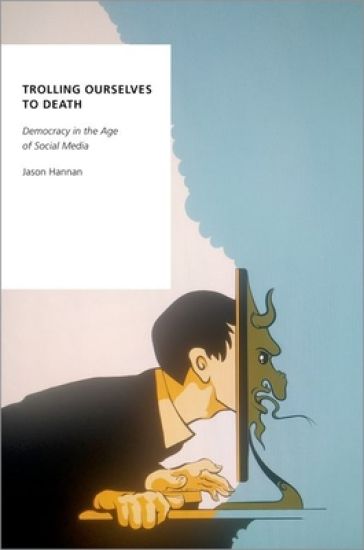
Trolling Ourselves to Death

Trolling Ourselves to Death

Jason Hannan

OXFORD UNIVERSITY PRESS INC
2024
sidottu
Almost forty years ago, Neil Postman argued that television had brought about a fundamental transformation to democracy. By turning entertainment into our supreme ideology, television had recreated public discourse in its image and converted democracy into show business. In Trolling Ourselves to Death, Jason Hannan builds on Postman's classic thesis, arguing that we are now not so much amusing, as trolling ourselves to death. Yet, how do we explain this profound change? What are the primary drivers behind the deterioration of civic culture and the toxification of public discourse? Trolling Ourselves to Death moves beyond the familiar picture of trolling by recasting it in a broader historical light. Contrary to the popular view of the troll as an exclusively anonymous online prankster who hides behind a clever avatar and screen name, Hannan asserts that trolls have emerged from the cave, so to speak, and now walk in the clear light of day. Trolls now include politicians, performers, patriots, and protesters. What was once a mysterious phenomenon limited to the darker corners of the Internet has since gone mainstream, eroding our public culture and changing the rules of democratic politics. Hannan shows how trolling is the logical outcome of a culture of possessive individualism, widespread alienation, mass distrust, and rampant paranoia. Synthesizing media ecology with historical materialism, he explores the disturbing rise of political unreason in the form of mass trolling and sheds light on the proliferation of disinformation, conspiracy theory, "cancel culture," and digital violence. Taking inspiration from Robert Brandom's innovative reading of Georg Wilhelm Friedrich Hegel, Trolling Ourselves to Death makes a case for building "a spirit of trust" to curb the epidemic of mass distrust that feeds the plague of political trolling.
Trolling Ourselves to Death

Trolling Ourselves to Death

Jason Hannan

OXFORD UNIVERSITY PRESS INC
2024
nidottu
Almost forty years ago, Neil Postman argued that television had brought about a fundamental transformation to democracy. By turning entertainment into our supreme ideology, television had recreated public discourse in its image and converted democracy into show business. In Trolling Ourselves to Death, Jason Hannan builds on Postman's classic thesis, arguing that we are now not so much amusing, as trolling ourselves to death. Yet, how do we explain this profound change? What are the primary drivers behind the deterioration of civic culture and the toxification of public discourse? Trolling Ourselves to Death moves beyond the familiar picture of trolling by recasting it in a broader historical light. Contrary to the popular view of the troll as an exclusively anonymous online prankster who hides behind a clever avatar and screen name, Hannan asserts that trolls have emerged from the cave, so to speak, and now walk in the clear light of day. Trolls now include politicians, performers, patriots, and protesters. What was once a mysterious phenomenon limited to the darker corners of the Internet has since gone mainstream, eroding our public culture and changing the rules of democratic politics. Hannan shows how trolling is the logical outcome of a culture of possessive individualism, widespread alienation, mass distrust, and rampant paranoia. Synthesizing media ecology with historical materialism, he explores the disturbing rise of political unreason in the form of mass trolling and sheds light on the proliferation of disinformation, conspiracy theory, "cancel culture," and digital violence. Taking inspiration from Robert Brandom's innovative reading of Georg Wilhelm Friedrich Hegel, Trolling Ourselves to Death makes a case for building "a spirit of trust" to curb the epidemic of mass distrust that feeds the plague of political trolling.
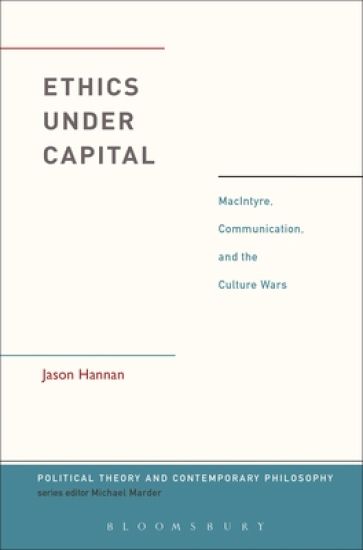
Ethics Under Capital

Ethics Under Capital

Jason Hannan

Bloomsbury Academic
2019
sidottu
We in the West are living in the midst of a deadly culture war. Our rival worldviews clash with increasing violence in the public arena, culminating in deadly riots and mass shootings. A fragmented left now confronts a resurgent and reactionary right, which threatens to reverse decades of social progress. Commentators have declared that we live in a “post-truth world,” one dominated by online trolls and conspiracy theorists. How did we arrive at this cultural crisis? How do we respond?This book speaks to this critical moment through a new reading of the thought of Alasdair MacIntyre. Over thirty years ago, MacIntyre predicted the coming of a new Dark Ages. The premise of this book is that MacIntyre was right all along. It presents his diagnosis of our cultural crisis. It further presents his answer to the challenge of public reasoning without foundations. Pitting him against John Rawls, Jürgen Habermas, and Chantal Mouffe, Ethics Under Capital argues that MacIntyre offers hope for a critical democratic politics in the face of the culture wars.
Ethics Under Capital

Ethics Under Capital

Jason Hannan

Bloomsbury Academic
2021
nidottu
We in the West are living in the midst of a deadly culture war. Our rival worldviews clash with increasing violence in the public arena, culminating in deadly riots and mass shootings. A fragmented left now confronts a resurgent and reactionary right, which threatens to reverse decades of social progress. Commentators have declared that we live in a “post-truth world,” one dominated by online trolls and conspiracy theorists. How did we arrive at this cultural crisis? How do we respond?This book speaks to this critical moment through a new reading of the thought of Alasdair MacIntyre. Over thirty years ago, MacIntyre predicted the coming of a new Dark Ages. The premise of this book is that MacIntyre was right all along. It presents his diagnosis of our cultural crisis. It further presents his answer to the challenge of public reasoning without foundations. Pitting him against John Rawls, Jürgen Habermas, and Chantal Mouffe, Ethics Under Capital argues that MacIntyre offers hope for a critical democratic politics in the face of the culture wars.