Kirjojen hintavertailu. Mukana 11 518 949 kirjaa ja 12 kauppaa.

Kirjahaku

Etsi kirjoja tekijän nimen, kirjan nimen tai ISBN:n perusteella.

6 kirjaa tekijältä Jay Watson

Fossil-Fuel Faulkner

Fossil-Fuel Faulkner

Jay Watson

Oxford University Press
2022
sidottu
Fossil-Fuel Faulkner is the first book-length study of a single writer in the emerging field of the energy humanities. As we try to imagine our way beyond a deeply problematic fossil energy regime that depletes and degrades the planet and sharpens the gap between Global North and Global South and move toward as more just and sustainable energy future, there is much to learn from how previous generations imagined the modern transition into a hydrocarbon-fueled world from the solar- and muscle-powered order that preceded it, and from how they imagined the consequences of that transition, including the new cultural forms it elicited and the new social problems it created. Jay Watson turns to the life and writings of William Faulkner, creator of one of the richest imaginative landscapes in American literary history, for new insights into the deep-reaching connections linking the extraction, production, and use of energy resources in his native US South to its histories of slavery and Jim Crow, its ecologies of disruption and despoilation, the logic of its cultural practices, and the nuances of literary form. Surveying the author's personal and imaginative engagements with coal and oil, with modern automobility and the road narrative, and with the profligate energies of the sun and the human animal, Fossil-Fuel Faulkner explores nearly all of Faulkner's novels and over a dozen of his short stories, and reveals the author to be one of petromodernity's keenest chroniclers and critics.
William Faulkner and the Faces of Modernity

William Faulkner and the Faces of Modernity

Jay Watson

Oxford University Press
2019
sidottu
Winner of the 2020 C. Hugh Holman Award William Faulkner has enjoyed a secure reputation as American modernism's foremost fiction writer, and as a landmark figure in international literary modernism, for well over half a century. Less secure, however, has been any scholarly consensus about what those modernist credentials actually entail. Over recent decades, there have been lively debates in modernist studies over the who, what, where, when, and how of the surprisingly elusive phenomena of modernism and modernity. This book broadens and deepens an understanding of Faulkner's oeuvre by following some of the guiding questions and insights of new modernism studies scholarship into understudied aspects of Faulkner's literary modernism and his cultural modernity. William Faulkner and the Faces of Modernity explores Faulkner's rural Mississippians as modernizing subjects in their own right rather than mere objects of modernization; traces the new speed gradients, media formations, and intensifications of sensory and affective experience that the twentieth century brought to the cities and countryside of the US South; maps the fault lines in whiteness as a racial modernity under construction and contestation during the Jim Crow period; resituates Faulkner's fictional Yoknapatawpha County within the transnational counter-modernities of the Black Atlantic; and follows the author's imaginative engagement with modern biopolitics through his late work A Fable, a novel Faulkner hoped to make his 'magnum o.' By returning to the utterly uncontroversial fact of Faulkner's modernism with a critical sensibility sharpened by new modernism studies, William Faulkner and the Faces of Modernity aims to spark further reappraisal of a distinguished and quite dazzling body of fiction. Perhaps even make it new.
Ecocriticism and the Future of Southern Studies

Ecocriticism and the Future of Southern Studies

Jay Watson

Louisiana State University Press
2019
sidottu
As the planet faces ever-worsening disruptions to global ecosystems, carbon and chemical emissions, depletions of the ozone layer, the loss of biodiversity, rising sea levels, air toxification, and worsening floods and droughts, scholars across academia must examine the cultural effects of this increasingly postnatural world. That task proves especially vital for southern studies, given how often the U.S. South serves as a site for large-scale damming initiatives like the TVA, disasters on the scale of Hurricane Katrina and the Deepwater Horizon spill, and the extraction of coal, oil, and natural gas. Ecocriticism and the Future of Southern Studies is the first book-length collection of scholarship that applies interdisciplinary environmental humanities research to cultural analyses of the U.S. South. Sixteen essays examine novels, nature writing, films, television, and music that address a broad range of ecological topics related to the region, including climate change, manmade and natural environments, the petroleum industry, food cultures, waterways, natural and human-induced disasters, waste management, and the Anthropocene. Edited by Zackary Vernon, this volume demonstrates how the greening of southern studies, in tandem with the southernization of environmental studies, can catalyze alternative ways of understanding the connections between regional and global cultures and landscapes.By addressing ecological issues central to life throughout the South, Ecocriticism and the Future of Southern Studies considers the confluence between region and environment, while also illustrating the growing need to see environmental issues as matters of social justice.
Forensic Fictions

Forensic Fictions

Jay Watson

University of Georgia Press
2008
pokkari
Forensic Fictions is the first book-length critical study of William Faulkner's fictional depictions of the legal vocation and the practice of law. Examining Faulkner's lawyer characters in light of the southern storytelling tradition, Jay Watson argues that the forensic competence of the Faulknerian lawyer is a direct function of his skill as a raconteur.To trace the biographical and historical roots of Faulkner's lifelong preoccupation with the legal profession, Watson draws on contemporary scholarship in narrative, rhetoric, jurisprudence, legal and intellectual history, literary theory, and Lacanian psychoanalysis. His approach yields insightful readings of forensic characters and scenes from such works as "An Odor of Verbena," The Hamlet, "Wild Palms," Absalom, Absalom! and The Reivers.Watson shows the links between storytelling and the competence of Faulkner's legal characters by examining the intertextual logic that connects the two most important lawyers in the Yoknapatawpha fiction: the incompetent Horace Benbow and the more capable Gavin Stevens, whose entrance into Faulkner's oeuvre coincides with Benbow's untimely departure from it. Focusing on the nine novels in which these two characters appear, Watson traces the evolutionary process by which Stevens supplants Benbow. Three of the Stevens novels--Intruder in the Dust, Knight's Gambit, and Requiem for a Nun--from what Watson calls Faulkner's "forensic trilogy" and, when read together, constitute the writer's most sustained investigation of the rhetorical and ethical responsibilities of the lawyer-citizen.Faulkner, Watson argues, saw the forensic figure as a potential hybrid of homo loquens and homo politicus, capable of combing the roles of storyteller, rhetorician, and theatrical performer with those of critic, citizen, and ethical man. As such, this figure served as a provocative authorial surrogate through whom Faulkner could explore diverse and often contradictory aspects of his personal experience, his family background, his cultural heritage, and, most of all, his own artistic use of language.
Reading for the Body

Reading for the Body

Jay Watson

University of Georgia Press
2012
sidottu
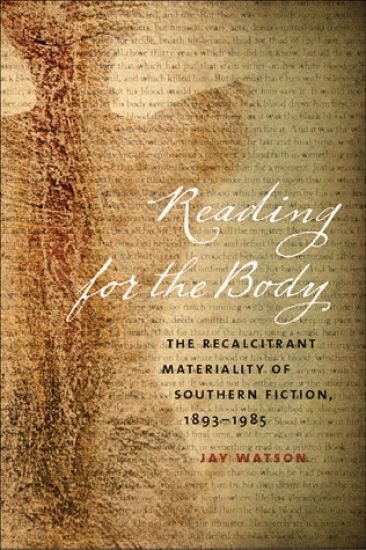
Jay Watson argues that southern literary studies has been overidealized and dominated by intellectual history for too long. In Reading for the Body, he calls for the field to be rematerialized and grounded in an awareness of the human body as the site where ideas, including ideas about the U.S. South itself, ultimately happen.Employing theoretical approaches to the body developed by thinkers such as Karl Marx, Colette Guillaumin, Elaine Scarry, and Friedrich Kittler, Watson also draws on histories of bodily representation to mine a century of southern fiction for its insights into problems that have preoccupied the region and nation alike: slavery, Jim Crow, and white supremacy; the marginalization of women; the impact of modernization; the issue of cultural authority and leadership; and the legacy of the Vietnam War. He focuses on the specific bodily attributes of hand, voice, and blood and the deeply embodied experiences of pain, illness, pregnancy, and war to offer new readings of a distinguished group of literary artists who turned their attention to the South: Mark Twain, Jean Toomer, Zora Neale Hurston, William Faulkner, Richard Wright, Katherine Anne Porter, Bobbie Ann Mason, and Walker Percy.In producing an intensely embodied U.S. literature these writers, Watson argues, were by turns extending and interrogating a centuries-old tradition in U.S. print culture, in which the recalcitrant materiality of the body serves as a trope for the regional alterity of the South. Reading for the Body makes a powerful case for the body as an important methodological resource for a new southern studies.
Reading for the Body

Reading for the Body

Jay Watson

University of Georgia Press
2012
pokkari
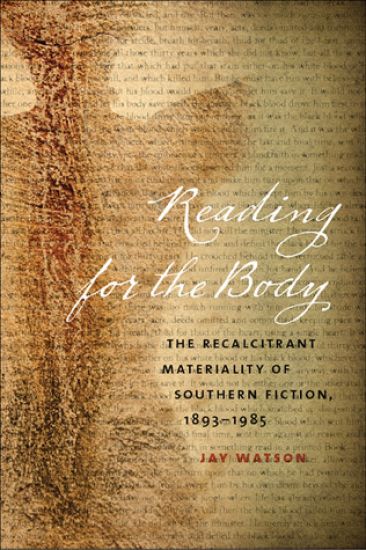
Jay Watson argues that southern literary studies has been overidealized and dominated by intellectual history for too long. In Reading for the Body, he calls for the field to be rematerialized and grounded in an awareness of the human body as the site where ideas, including ideas about the U.S. South itself, ultimately happen.Employing theoretical approaches to the body developed by thinkers such as Karl Marx, Colette Guillaumin, Elaine Scarry, and Friedrich Kittler, Watson also draws on histories of bodily representation to mine a century of southern fiction for its insights into problems that have preoccupied the region and nation alike: slavery, Jim Crow, and white supremacy; the marginalization of women; the impact of modernization; the issue of cultural authority and leadership; and the legacy of the Vietnam War. He focuses on the specific bodily attributes of hand, voice, and blood and the deeply embodied experiences of pain, illness, pregnancy, and war to offer new readings of a distinguished group of literary artists who turned their attention to the South: Mark Twain, Jean Toomer, Zora Neale Hurston, William Faulkner, Richard Wright, Katherine Anne Porter, Bobbie Ann Mason, and Walker Percy.In producing an intensely embodied U.S. literature these writers, Watson argues, were by turns extending and interrogating a centuries-old tradition in U.S. print culture, in which the recalcitrant materiality of the body serves as a trope for the regional alterity of the South. Reading for the Body makes a powerful case for the body as an important methodological resource for a new southern studies.