Kirjojen hintavertailu. Mukana 11 518 949 kirjaa ja 12 kauppaa.

Kirjahaku

Etsi kirjoja tekijän nimen, kirjan nimen tai ISBN:n perusteella.

72 kirjaa tekijältä Jean Baudrillard

The Jean Baudrillard Reader

The Jean Baudrillard Reader

Jean Baudrillard

Columbia University Press
2008
sidottu
Jean Baudrillard (1929-2007) was a controversial social and cultural theorist known for his trenchant analyses of media and technological communication. Belonging to the generation of French thinkers that included Gilles Deleuze, Jean-Francois Lyotard, Michel Foucault, and Jacques Lacan, Baudrillard has at times been vilified by his detractors, but the influence of his work on critical thought and pop culture is impossible to deny (many might recognize his name from The Matrix movies, which claimed to be based on the French theorist's ideas). Steve Redhead takes a fresh look at Baudrillard in relation to the intellectual and political climates in which he wrote. Baudrillard sought to produce a theory of modernity, but the modern world of the 1950s was radically different from the reality of the early twenty-first century. Beginning with Baudrillard's initial publications in the 1960s and concluding with his writings on 9/11 and Abu Ghraib, Redhead guides the reader through Baudrillard's difficult texts and unorthodox views on current issues. He also proposes an original theory of Baudrillard's relation to postmodernism, presenting the theorist's work as "non-postmodernist," after Bruno Latour's concept of "non-modernity." Each section of the Reader includes an extract from one of Baudrillard's writings, prefaced by a short bibliographical introduction that places the piece in context and puts the debate surrounding the theorist into sharp perspective. The conflict over Baudrillard's legacy stems largely from the fact that a comprehensive selection of his writings has yet to be translated and collected into one volume. The Jean Baudrillard Reader provides an expansive and much-needed portrait of the critic's resonant work.
The Jean Baudrillard Reader

The Jean Baudrillard Reader

Jean Baudrillard

Columbia University Press
2008
pokkari
Jean Baudrillard (1929-2007) was a controversial social and cultural theorist known for his trenchant analyses of media and technological communication. Belonging to the generation of French thinkers that included Gilles Deleuze, Jean-Francois Lyotard, Michel Foucault, and Jacques Lacan, Baudrillard has at times been vilified by his detractors, but the influence of his work on critical thought and pop culture is impossible to deny (many might recognize his name from The Matrix movies, which claimed to be based on the French theorist's ideas). Steve Redhead takes a fresh look at Baudrillard in relation to the intellectual and political climates in which he wrote. Baudrillard sought to produce a theory of modernity, but the modern world of the 1950s was radically different from the reality of the early twenty-first century. Beginning with Baudrillard's initial publications in the 1960s and concluding with his writings on 9/11 and Abu Ghraib, Redhead guides the reader through Baudrillard's difficult texts and unorthodox views on current issues. He also proposes an original theory of Baudrillard's relation to postmodernism, presenting the theorist's work as "non-postmodernist," after Bruno Latour's concept of "non-modernity." Each section of the Reader includes an extract from one of Baudrillard's writings, prefaced by a short bibliographical introduction that places the piece in context and puts the debate surrounding the theorist into sharp perspective. The conflict over Baudrillard's legacy stems largely from the fact that a comprehensive selection of his writings has yet to be translated and collected into one volume. The Jean Baudrillard Reader provides an expansive and much-needed portrait of the critic's resonant work.

Jean Baudrillard: Selected Writings

Jean Baudrillard: Selected Writings

Jean Baudrillard

Stanford University Press
2002
sidottu
This is an expanded edition of the first comprehensive overview of the work of Jean Baudrillard, one of the most fascinating thinkers on the French intellectual scene. To the original selection of his writings from 1968 to 1985, this new edition adds examples of Baudrillard's work since that time. Reviews of the First Edition "This is a good book, and the author of its selected writings, Jean Baudrillard, deserves only a share of the compliment. It is difficult to introduce a difficult author, and Mark Poster has done a brilliant job. He has selected wisely from Baudrillard's writings. . . . More important, Poster has written what may be, pound for pound, the best introduction to a social theorist I have read. . . . Poster has somehow said everything the uninitiated needs to know before deciding to read Baudrillard."—Contemporary Sociology "Following the lead of thinkers such as Foucault, Derrida, and Deleuze, Baudrillard engages in a task of pointing away from any traditional sociological themes. His writings demand that one turn away from convenient or customary interpretations of society and, in the process, one is forced to use his or her imagination in new ways."—Choice "Poster's Introduction presents what is probably as clear and intelligent an exposition of Baudrillard's ideas as you'll find anywhere."—Philosophy and Literature
Jean Baudrillard: Selected Writings

Jean Baudrillard: Selected Writings

Jean Baudrillard

Stanford University Press
2002
pokkari
This is an expanded edition of the first comprehensive overview of the work of Jean Baudrillard, one of the most fascinating thinkers on the French intellectual scene. To the original selection of his writings from 1968 to 1985, this new edition adds examples of Baudrillard's work since that time. Reviews of the First Edition "This is a good book, and the author of its selected writings, Jean Baudrillard, deserves only a share of the compliment. It is difficult to introduce a difficult author, and Mark Poster has done a brilliant job. He has selected wisely from Baudrillard's writings. . . . More important, Poster has written what may be, pound for pound, the best introduction to a social theorist I have read. . . . Poster has somehow said everything the uninitiated needs to know before deciding to read Baudrillard."—Contemporary Sociology "Following the lead of thinkers such as Foucault, Derrida, and Deleuze, Baudrillard engages in a task of pointing away from any traditional sociological themes. His writings demand that one turn away from convenient or customary interpretations of society and, in the process, one is forced to use his or her imagination in new ways."—Choice "Poster's Introduction presents what is probably as clear and intelligent an exposition of Baudrillard's ideas as you'll find anywhere."—Philosophy and Literature
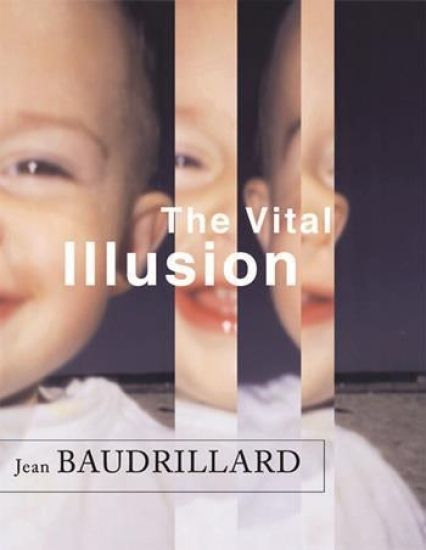
The Vital Illusion

The Vital Illusion

Jean Baudrillard

Columbia University Press
2000
sidottu
Aren't we actually sick of sex, of difference, of emancipation, of culture? With this provocative taunt, the indomitable sociologist Jean Baudrillard challenges us to face up to our deadly, technologically empowered renunciation of mortality and subjectivity as he grapples with the complex issues that define our postmillennial world. What does the advent and proliferation of cloning mean for our sense of ourselves as human beings? What does the turn of the millennium say about our relation to time and history? What does the instantaneous, virtual realm of cyberspace do to reality? In The Vital Illusion-as always-Baudrillard leads his readers to some surprising conclusions. Baudrillard considers how human cloning-as well as the "cloning" of ideas and social identities-heralds an end to sex and death and the divagations of living by instituting a realm of the Same, beyond the struggles of individuation. In this day and age when everything can be cloned, simulated, programmed, and genetically and neurologically managed, humanity shows itself unable to brave its own diversity, preferring instead to regress to the pathological eternity of self-replicating cells. By reverting to our viral origins as sexless immortal beings, we are, ironically, fulfilling a death wish, putting an end to our own species as we know it. Next, Baudrillard explores the "nonevent" that was and is the turn of the millennium. He provocatively puts forward the thesis that the arrival of the year 2000 could never take place because we could neither resolve nor leave behind our history, nor could we stop counting down toward our future. For Baudrillard, the millennial clock reading to the millionth of a second on its way to zero is the perfect symbol of our time: history decays rather than progresses. In closing, Baudrillard examines what he calls "the murder of the real" by the virtual. In a world of copies and clones in which everything can be made present in an instant by technology, we can no longer even speak of reality. Beyond Nietzsche's symbolic murder of God, our virtual world free of referents is in the process of exterminating reality, leaving no trace: "The corps(e) of the Real-if there is any-has not been recovered, is nowhere to be found." Peppered with Baudrillard's signature counterintuitive moves, prophetic visions, and dark humor, The Vital Illusion exposes the contradictions that guide our contemporary culture and rule our lives.
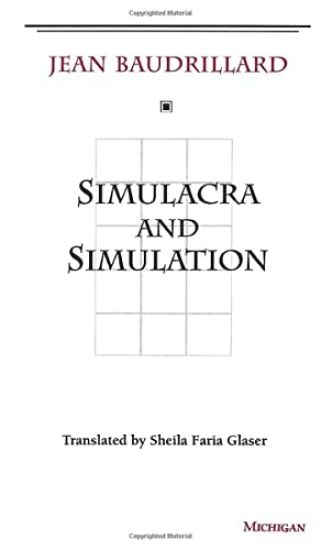
Simulacra and Simulation

Simulacra and Simulation

Jean Baudrillard

The University of Michigan Press
1994
nidottu
The first full-length translation in English of an essential work of postmodernist thought The publication in France of Simulacra et Simulation in 1981 marked Jean Baudrillard’s first important step toward theorizing the postmodern. Moving away from the Marxist/Freudian approaches that had concerned him earlier, Baudrillard developed in this book a theory of contemporary culture that replies on displacing economic notions of cultural production with notions of cultural expenditure. Baudrillard uses the concepts of the simulacrum¬—the copy without an original—and simulation, crucial to an understanding of the postmodern, to address the concept of mass reproduction and reproducibility that characterizes our electronic media culture. Translator Sheila Faria Glaser provides the first complete English edition of Baudrillard’s rich speculations on the simulacrum: from the hologram to Apocalypse Now, clones to Crash, and Disneyland to Three Mile Island. Simulacra and Simulation represents a unique and original effort to rethink cultural theory from the perspective of a new concept of cultural materialism, one that radically redefines postmodern formulations of the body. Jean Baudrillard (1929-2007), one of France’s leading intellectuals, began teaching in 1966 at Nanterre in Paris, where he spent most of his teaching career. His works in English translation include The Mirror of Production (1975), For a Critique of the Political Economy of the Sign (1976), The Ecstasy of Communication (1988), America (1988), Cool Memories (1990), Fatal Strategies (1993), The Transparency of Evil (1993), Symbolic Exchange and Death (1993), The Art of Disappearance (1994), The Gulf War Did Not Take Place (1995), The Consumer Society (1998), The Vital Illusion (2000) and The Spirit of Terrorism and Requiem for the Twin Towers (2002).
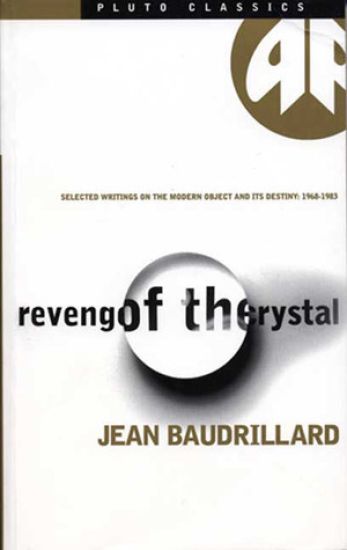
Revenge of the Crystal

Revenge of the Crystal

Jean Baudrillard

Pluto Press
1999
pokkari
Jean Baudrillard's work has enraged and baffled critics and commentators in the English speaking world for over twenty years. Has he gone beyond a joke? Or do his writings on the contemporary world and its significance offer us revelatory insights? One thing is certain: Baudrillard is neither an easy writer nor a soft target. Revenge of the Crystal supplies a corrective to those who would dismiss his work as irrelevant - and a welcome introduction to those who are coming to his work for the first time. It includes substantial translations of his major writings from the 1960s through to his critiques of consumption and Marxism in the 1970s, and his more speculative pronouncements in the 1980s on sexuality, the nature of politics and the effects of the 'image machine' on our imaginations and systems of meaning.
Revenge of the Crystal

Revenge of the Crystal

Jean Baudrillard

Pluto Press
1999
sidottu
This anthology features a breadth of work from cultural commentator Baudrillard, with translations of his major writings from the 1960s through to his critiques of Marxism in the 1970s and sexuality in the 1980s. The book serves as an introduction to those unfamiliar with his writings, as it features a range of commentary and choice of texts, and outlines the extent of Baudrillard's reading of Marx and the subtlety of his thought on the fate of the object within society.
Fatal Strategies

Fatal Strategies

Jean Baudrillard

Pluto Press
1999
pokkari
'The world is not dialectical ... madness now rules everywhere' - Jean BaudrillardJean Baudrillard is one of France's leading modern thinkers and a scholar whose work has necessitated major reassessments across several academic disciplines. Fatal Strategies, first published in France in 1983, comprises his key writings on postmodernism. In this fascinating collection, Baudrillard challenges many of our assumptions about the world in which we live. Claiming that the world is sworn to extremes, he turns received wisdom on its head, arguing for the triumph of unreason and of the victory of the pure object and its 'ironic strategy' over the subject. He looks at illusion, secrets, the visible and the hidden, and claims that the only possible response to the delirious world is the ultimatum of realism and the Principle of Evil.
Fatal Strategies

Fatal Strategies

Jean Baudrillard

Pluto Press
1999
sidottu
In this collection of his work, which represents a key text on postmodernism, Baudrillard challenges many of our assumptions about the world in which we live. Claiming that the world is sworn to extremes, he turns received wisdom on its head, arguing for the triumph of unreason and of the victory of the pure object and its "ironic strategy" over the subject. He looks at illusion, secrets, the visible and the hidden, and claims that the only possible response to the delirious world is the ultimatum of realism and the Principle of Evil.
The Illusion of the End

The Illusion of the End

Jean Baudrillard

Polity Press
1994
nidottu
In this book Jean Baudrillard, one of the most celebrated and controversial contemporary social theorists, argues that the notion of the end of history is an illusion, and that we are now engaged in a gigantic process of historical revisionism.
Cool Memories V

Cool Memories V

Jean Baudrillard

Polity Press
2006
sidottu
Prophet of the apocalypse, hysterical lyric poet, obsessive recounter of the desolation of the postmodern scene and currently the hottest property on the New York intellectual circuit. The Guardian A sharp-shooting lone-ranger from the post-Marxist left. New York Times The most important French thinker of the past twenty years. J. G. Ballard "Theory is never so fine as when it takes the form of a fiction or a fable," writes Baudrillard in Cool Memories V – the latest in a series of aphoristic journals that covers the period 2000-2004. During these years Baudrillard re-emerged strongly in the international arena with his trenchant and controversial essay Spirit of Terrorism, developed his work as a photographer and developed cancer. As his attack on the inanities of "hyperreality" has grown more radical, Baudrillard has come to display an ever more marked penchant for the aphoristic style he has so long admired in such writers as Canetti, Lichtenberg and Nietzsche. "'Aphorizein'", he writes, "from which we get the word ‘aphorism', means to retreat to such a distance that a horizon of thought is formed which never again closes on itself. " Cool Memories are carnets, notebooks, but these are notes for keeping the horizon of thought open within a daunting sphere of ideas that is no less than "a jungle, a nature red in tooth and claw. " "Mentally and affectively," he writes, "we have remained hunters. At every moment, in thought and writing, there is a prey and a predator. And survival is a miracle. " Jean Baudrillard was born in Reims in 1929 and now lives in Paris. From 1966 to1987 he taught sociology at the University of Paris X (Nanterre). Among his works translated into English are Simulations and Simulacra, Fatal Strategies, Seduction, America, Cool Memories I- IV, The Illusion of the End and The Spirit of Terrorism
Cool Memories V

Cool Memories V

Jean Baudrillard

Polity Press
2006
nidottu
Prophet of the apocalypse, hysterical lyric poet, obsessive recounter of the desolation of the postmodern scene and currently the hottest property on the New York intellectual circuit. The Guardian A sharp-shooting lone-ranger from the post-Marxist left. New York Times The most important French thinker of the past twenty years. J. G. Ballard "Theory is never so fine as when it takes the form of a fiction or a fable," writes Baudrillard in Cool Memories V – the latest in a series of aphoristic journals that covers the period 2000-2004. During these years Baudrillard re-emerged strongly in the international arena with his trenchant and controversial essay Spirit of Terrorism, developed his work as a photographer and developed cancer. As his attack on the inanities of "hyperreality" has grown more radical, Baudrillard has come to display an ever more marked penchant for the aphoristic style he has so long admired in such writers as Canetti, Lichtenberg and Nietzsche. "'Aphorizein'", he writes, "from which we get the word ‘aphorism', means to retreat to such a distance that a horizon of thought is formed which never again closes on itself. " Cool Memories are carnets, notebooks, but these are notes for keeping the horizon of thought open within a daunting sphere of ideas that is no less than "a jungle, a nature red in tooth and claw. " "Mentally and affectively," he writes, "we have remained hunters. At every moment, in thought and writing, there is a prey and a predator. And survival is a miracle. " Jean Baudrillard was born in Reims in 1929 and now lives in Paris. From 1966 to1987 he taught sociology at the University of Paris X (Nanterre). Among his works translated into English are Simulations and Simulacra, Fatal Strategies, Seduction, America, Cool Memories I- IV, The Illusion of the End and The Spirit of Terrorism
The Illusion of the End

The Illusion of the End

Jean Baudrillard

Stanford University Press
1994
pokkari
The year 2000, the end of the millennium: is this anything other than a mirage, the illusion of an end, like so many other imaginary endpoints which have littered the path of history? In this remarkable book Jean Baurdrillard—France's leading theorist of postmodernity—argues that the notion of the end is part of the fantasy of a linear history. Today we are not approaching the end of history but moving into reverse, into a process of systematic obliteration. We are wiping out the entire twentieth century, effacing all signs of the cold War one by one, perhaps even the signs of the First and Second World Wars and of the political and ideological revolutions of our time. In short, we are engaged in a gigantic process of historical revisionism, and we seem in a hurry to finish it before the end of the century, secretly hoping perhaps to be able to begin again from scratch. Baudrillard explores the "fatal strategies of time" which shape our ways of thinking about history and its imaginary end. Ranging from the revolutions in Eastern Europe to the Gulf War, from the transformation of nature to the hyper-reality of the media, this postmodern mediation on modernity and its aftermath will be widely read.
The Singular Objects of Architecture

The Singular Objects of Architecture

Jean Baudrillard

University of Minnesota Press
2005
nidottu
What is a singular object? An idea, a building, a color, a sentiment, a human being. Each in turn comes under scrutiny in this exhilarating dialogue between two of the most interesting thinkers working in philosophy and architecture today. From such singular objects, Jean Baudrillard and Jean Nouvel move on to fundamental problems of politics, identity, and aesthetics as their exchange becomes an imaginative exploration of the possibilities of modern architecture and the future of modern life. Among the topics the two speakers take up are the city of tomorrow and the ideal of transparency, the gentrification of New York City and Frank Gehry's surprising Guggenheim Museum in Bilbao. As Nouvel prompts Baudrillard to reflect on some of his signature concepts (the virtual, transparency, fatal strategies, oblivion, and seduction, among others), the confrontation between such philosophical concerns and the specificity of architecture gives rise to novel and striking formulations—and a new way of establishing and understanding the connections between the practitioner and the philosopher, the object and the idea. This wide-ranging conversation builds a bridge between the fields of architecture and philosophy. At the same time it offers readers an intimate view of the meeting of objects and ideas in which the imagined, constructed, and inhabited environment is endlessly changing, forever evolving. Jean Baudrillard is one of the most influential thinkers of his generation and author of The Vital Illusion (2001). Jean Nouvel has designed buildings throughout the world, including the new Guthrie Theater in Minneapolis, and is a recipient of France's Grand Prix d'Architecture. Robert Bononno, a translator and teacher, lives in New York City.
Cool Memories II, 1987-1990

Cool Memories II, 1987-1990

Jean Baudrillard

Duke University Press
1996
sidottu
Jean Baudrillard is widely recognized as one of the most important and provocative writers of our age. Variously termed “France’s leading philosopher of postmodernism” and “a sharp-shooting Lone Ranger of the post-Marxist left,” he might also be called our leading philosopher of seduction or of mass culture. Following his acclaimed America and Cool Memories, this book is the third in a series of personal records in hyperreality. Idiosyncratic, outrageous, and brilliantly original, Baudrillard here casts his net widely and combines autobiographical memories with further reflections on America, the crisis of cultural production, new ideas in fiction/theory, and the “verbal fornication” of the postmodern. In this wide-ranging discussion of events and ideas, Baudrillard moves between poetry and waterfalls, strikes and stealth bombers, Freud and La Cicciolina, shadows and simulacra, deconstruction and the zodiac, Reagan’s smile and Kennedy’s death, the “curse” on South America and the future of the West, the last tango of French intellectual life and the exemplary disappearing act of Italian politics. Writing at the site where the philosophic and the poetic merge, he once again offers us commentary in the form of the riveting insight, the short distillation of reality that establishes its truth with the force of recognition. Cool Memories II, Baudrillard’s latest commentary on the technopresent and future, an installment of his reflections on the reality of contemporary western culture, will entice all readers concerned with postmodernism and the current state of theory.
Cool Memories II, 1987-1990

Cool Memories II, 1987-1990

Jean Baudrillard

Duke University Press
1996
pokkari
Jean Baudrillard is widely recognized as one of the most important and provocative writers of our age. Variously termed “France’s leading philosopher of postmodernism” and “a sharp-shooting Lone Ranger of the post-Marxist left,” he might also be called our leading philosopher of seduction or of mass culture. Following his acclaimed America and Cool Memories, this book is the third in a series of personal records in hyperreality. Idiosyncratic, outrageous, and brilliantly original, Baudrillard here casts his net widely and combines autobiographical memories with further reflections on America, the crisis of cultural production, new ideas in fiction/theory, and the “verbal fornication” of the postmodern. In this wide-ranging discussion of events and ideas, Baudrillard moves between poetry and waterfalls, strikes and stealth bombers, Freud and La Cicciolina, shadows and simulacra, deconstruction and the zodiac, Reagan’s smile and Kennedy’s death, the “curse” on South America and the future of the West, the last tango of French intellectual life and the exemplary disappearing act of Italian politics. Writing at the site where the philosophic and the poetic merge, he once again offers us commentary in the form of the riveting insight, the short distillation of reality that establishes its truth with the force of recognition. Cool Memories II, Baudrillard’s latest commentary on the technopresent and future, an installment of his reflections on the reality of contemporary western culture, will entice all readers concerned with postmodernism and the current state of theory.
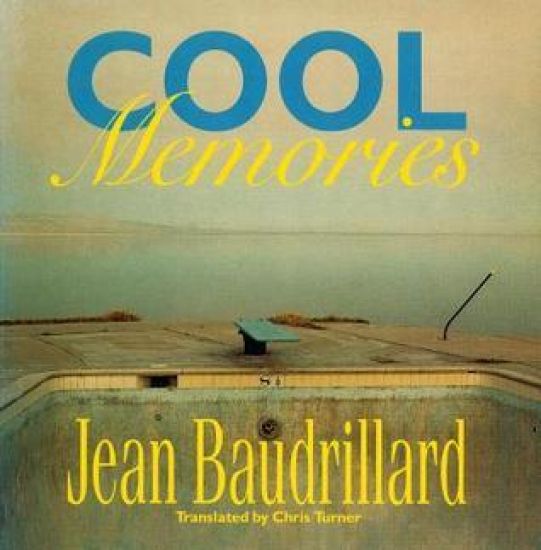
Cool Memories

Cool Memories

Jean Baudrillard

Verso Books
1990
nidottu
Jean Baudrillard's last book was about America. His new one is about cats, Foucault, Alfa Romeas, leukemia, Catholicism, the Berlin Wall, mattresses, Laurent Fabius, Jean-Paul II, roses, Antarctica, Lech Walesa, mud wrestling, Zinoviev, porn films, snow, feminism, Rio, Jacques Lacan, Stevie Wonder, Palermo, DNA and terrorism."Cool Memories is the other side of America, the disillusioned side, presented in the form of a diary, though not in the classical sense. I'm trying to grasp a world in all its silences and its brutality. Can you grasp a world when you're no longer tied to it by some kind of ideological enthusiasm, or by traditional passions? Can things "tell" themselves through stories and fragments? These are some of the questions posed in a book which may seem melancholic. But then I think almost every diary is melancholic. Melancholy is in the very state of things."