Kirjojen hintavertailu. Mukana 12 392 342 kirjaa ja 12 kauppaa.

Kirjahaku

Etsi kirjoja tekijän nimen, kirjan nimen tai ISBN:n perusteella.

12 kirjaa tekijältä Jean-Pierre Vernant

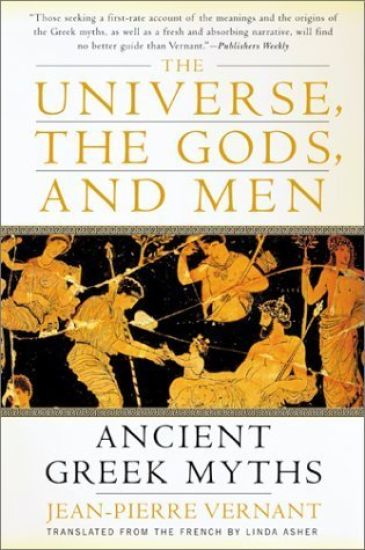
The Universe, the Gods, and Men: Ancient Greek Myths Told by Jean-Pierre Vernant
In this enchanting retelling of Greek myth, Jean-Pierre Vernant combines his deep knowledge of the subject with an original storytelling style. Beginning with the creation of Earth out of Chaos, Vernant continues with the castration of Uranus, the war between the Titans and the Olympian gods, the wily ruses of Prometheus and Zeus, and the creation of Pandora, the first woman. His narrative takes readers from the Trojan War to the voyage of Odysseus, from the story of Dionysus to the terrible destiny of Oedipus, to Perseus's confrontation with the Gorgons.Jean-Pierre Vernant has devoted himself to the study of Greek mythology. In recounting these tales, he unravels for us their multiple meanings and brings to life the beloved figures of legend whose narratives lie at the origin of our civilization.
JeanPierre Vernant – From the Maquis to the Polis

JeanPierre Vernant – From the Maquis to the Polis

Jean-Pierre Vernant

Prickly Paradigm Press, LLC
2021
nidottu
Jean-Pierre Vernant (1914-2007) was one of most important intellectual figures of modern France, well-known for his structuralist approach to Greek myth and tragedy. Taking the form of an interview with the notoriously private French classicist and anthropologist, this volume relates the story of Vernant's remarkable career, revealing deep continuities across his life and intellectual work. As a student, Vernant became involved with the Communist Party. In the 1940s, he joined the French Resistance, serving first as a soldier and, later, as the pseudonymous "Colonel Berthier," in charge of forces in the Haut-Garonne. After the war, Vernant had a distinguished academic career, capped by a prestigious professorship at the College de France. With an insightful preface by renowned historian Francois Hartog, this volume, composed in Vernant's own words, makes clear the continuity of the themes of warfare and political change across his work, including a fascination with Achilles and the concept of heroic death, offering insight as well into his important cultural influences.
Mortals and Immortals

Mortals and Immortals

Jean-Pierre Vernant

Princeton University Press
1991
pokkari
Jean-Pierre Vernant has profoundly transformed our perceptions of ancient Greece. Published in 1991, this collection of nineteen essays probes deeply into themes of enduring interest--death, the body, the soul, the individual, and relations between mortals and immortals; the mask, the mirror, the image, and the imagination; the self and the other, and, more broadly, the concept of otherness itself, or "alterity."
The Origins of Greek Thought

The Origins of Greek Thought

Jean-Pierre Vernant

Cornell University Press
1984
pokkari
Jean-Pierre Vernant's concise, brilliant essay on the origins of Greek thought relates the cultural achievement of the ancient Greeks to their physical and social environment and shows that what they believed in was inseparable from the way they lived. The emergence of rational thought, Vernant claims, is closely linked to the advent of the open-air politics that characterized life in the Greek polis. Vernant points out that when the focus of Mycenaean society gave way to the agora, the change had profound social and cultural implications. "Social experience could become the object of pragmatic thought for the Greeks," he writes, "because in the city-state it lent itself to public debate. The decline of myth dates from the day the first sages brought human order under discussion and sought to define it.... Thus evolved a strictly political thought, separate from religion, with its own vocabulary, concepts, principles, and theoretical aims."
Myth and Society in Ancient Greece

Myth and Society in Ancient Greece

Jean-Pierre Vernant

Zone Books
1990
pokkari
In this groundbreaking study, Jean Pierre-Vernant delineates a compelling new vision of ancient Greece. Myth and Society in Ancient Greece takes us far from the calm and familiar images of Polykleitos and the Parthenon to reveal a fundamentally other culture: one of slavery, of masks and death, of scapegoats, of ritual hunting and ecstasies.Vernant's provocative discussion of various institutions and practices including war, marriage, and sacrifice details the complex intersection of the religious, social, and political structures of ancient Greece. The book concludes with Vernant's authoritative genealogy of the study of myth from antiquity to structuralism and beyond.
The Universe, The Gods And Mortals

The Universe, The Gods And Mortals

Jean-Pierre Vernant

Profile Books Ltd
2002
pokkari
In this engrossing retelling of Greek myth, Jean-Pierre Vernant combines his profound knowledge of the subject with brilliant and original story-telling. Beginning with the creation of Earth out of Chaos, Vernant continues with the castration of Uranus, the war between the Titans and the gods of Olympus, the wily ruses of Prometheus and Zeus, and the creation of Pandora, the first woman. His narrative takes us from the Trojan War to the voyage of Odysseus, from the story of Dionysus to the terrible destiny of Oedipus and to Perseus's confrontation with the Gorgons. Jean-Pierre Vernant has devoted himself to the study of Greek mythology. In recounting these tales, he unravels for us their multiple meanings and brings to life cherished figures of legend whose stories lie at the origin of our civilization.
Myth and Thought among the Greeks

Myth and Thought among the Greeks

Jean-Pierre Vernant

Zone Books
2006
pokkari
A classic work that rereads questions of "muthos" and "logos" in multifaceted contexts.When Jean-Pierre Vernant first published Myth and Thought among the Greeks in 1965, it transformed the field of ancient Greek scholarship, calling forth a new way to think about Greek myth and thought. In eighteen essays-three of which, along with a new preface, are translated into English for the first time-Vernant freed the subject of ancient Greece from its philological chains and reread the questions of "muthos" and "logos" within multifaced and transdisciplinary contexts-of religion, ritual, and art, philosophy, science, social and economic institutions, and historical psychology. A major contribution to both the humanities and the social sciences, Myth and Thought among the Greeks aims to come to terms with a single, essential question: How were individual persons in ancient Greece inseparable from a social and cultural environment of which they were simultaneously the creators and products? Seven themes organize this stellar work-from "Myth Structures" and "Mythic Aspects of Memory and Time" to "The Organization of Space," "Work and Technological Thought," and "Personal Identity and Religion." A master storyteller, an innovative, precise, and original thinker, Vernant continues to change the narratives we tell about the histories of civilizations and the histories of human beings in their individual and collective identities.
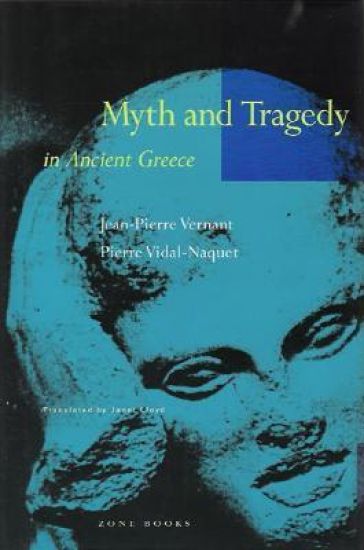
Myth and Tragedy in Ancient Greece

Myth and Tragedy in Ancient Greece

Jean-Pierre Vernant; Pierre Vidal-Naquet

Zone Books
1990
pokkari
Jean-Pierre Vernant and Pierre Vidal-Naquet are leaders in a contemporary French classical scholarship that has produced a a stunning reconfiguration of Greek thought and literature. In this work, published here as a single volume, the authors present a disturbing and decidedly non-classical reading of Greek tragedy that insists on its radical discontinuity with our own outlook and with our social, aesthetic, and psychological categories. Originally published in French in two volumes, this new single-volume edition includes revised essays from volume one and is the first English translation of both volumes.Distributed for Zone Books.
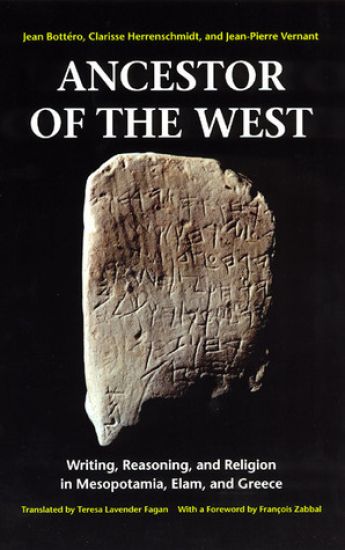
Ancestor of the West

Ancestor of the West

Jean Bottero; Clarisse Herrenschmidt; Jean-Pierre Vernant

University of Chicago Press
2003
nidottu
With "Ancestor of the West", three distinguished French historians reveal the story of the birth of writing and reason, demonstrating how the logical and religious structures of Near Eastern and Mesopotamian cultures served as precursors to those of the West.
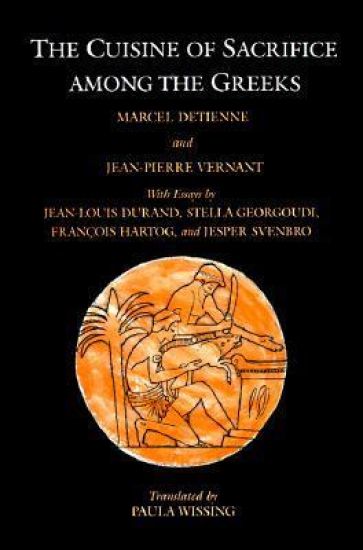
The Cuisine of Sacrifice among the Greeks

The Cuisine of Sacrifice among the Greeks

Marcel Detienne; Jean-Pierre Vernant

University of Chicago Press
1998
nidottu
For the Greeks, the sharing of cooked meats was the fundamental communal act, so that to become vegetarian was a way of refusing society. It follows that the roasting or cooking of meat was a political act, as the division of portions asserted a social order. And the only proper manner of preparing meat for consumption, according to the Greeks, was blood sacrifice. The fundamental myth is that of Prometheus, who introduced sacrifice and, in the process, both joined us to and separated us from the gods—and ambiguous relation that recurs in marriage and in the growing of grain. Thus we can understand why the ascetic man refuses both women and meat, and why Greek women celebrated the festival of grain-giving Demeter with instruments of butchery. The ambiguity coded in the consumption of meat generated a mythology of the "other"—werewolves, Scythians, Ethiopians, and other "monsters." The study of the sacrificial consumption of meat thus leads into exotic territory and to unexpected findings. In The Cuisine of Sacrifice, the contributors—all scholars affiliated with the Center for Comparative Studies of Ancient Societies in Paris—apply methods from structural anthropology, comparative religion, and philology to a diversity of topics: the relation of political power to sacrificial practice; the Promethean myth as the foundation story of sacrificial practice; representations of sacrifice found on Greek vases; the technique and anatomy of sacrifice; the interaction of image, language, and ritual; the position of women in sacrificial custom and the female ritual of the Thesmophoria; the mythical status of wolves in Greece and their relation to the sacrifice of domesticated animals; the role and significance of food-related ritual in Homer and Hesiod; ancient Greek perceptions of Scythian sacrificial rites; and remnants of sacrificial ritual in modern Greek practices.