Kirjojen hintavertailu. Mukana 12 093 959 kirjaa ja 12 kauppaa.

Kirjahaku

Etsi kirjoja tekijän nimen, kirjan nimen tai ISBN:n perusteella.

7 kirjaa tekijältä Jeff Jarvis

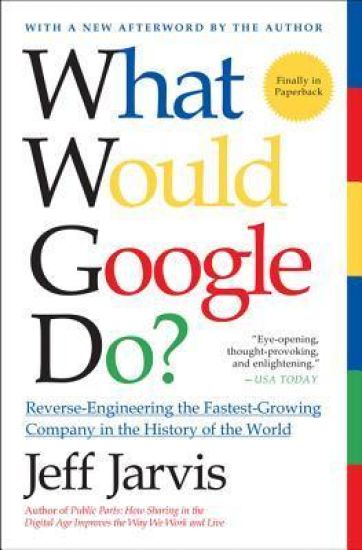
What Would Google Do?

What Would Google Do?

Jeff Jarvis

HarperBusiness
2011
nidottu
What's the question every business should be asking itself? According to Jeff Jarvis, it's What Would Google Do? If you're not thinking or acting like Google - the fastest-growing company in the history of the world - then you're not going to survive, let alone prosper, in the Internet age. To demonstrate how to emulate Google, Jarvis lays out his laws of what he calls the new Google century, including such insights as: Think Distributed, Become a Platform, Join the Post-Scarcity, Open-Source, Gift Economy, The Middleman Has Died, Your Worst Customers Are Your Best Friends and Your Best Customers Are Your Partners, Do What You Do Best and Link to the Rest, Get Out of the Way, and Make Mistakes Well and More. Jarvis applies these principles not just to emerging technologies and the Internet, but to other industries - telecommunications, airlines, television, government, healthcare, education, journalism, and yes, book publishing - showing ultimately what the world would look like if Google ran it. The result is an astonishing, mind-opening book that will change the way readers ask questions and solve problems.
What Would Google Do?

What Would Google Do?

Jeff Jarvis

HARPER BUSINESS
2009
sidottu
Jeff Jarvis is an intelligent observer of technology and the media. What would google do? is an exceptional book that captures the massive changes the internet is effecting in our culture, in marketing, and in advertising. Jarvis has a sharp eye for what is relevant, real, and actionable. He knows that Google is not just a company, it is an entirely new way of thinking about understanding who we are and what we want.
What Would Google Do?

What Would Google Do?

Jeff Jarvis

HarperLuxe
2009
pokkari
"Eye-opening, thought-provoking, and enlightening."--USA Today"An indispensable guide to the business logic of the networked era."--Clay Shirky, author of Here Comes Everybody"A stimulating exercise in thinking really, really big."--San Jose Mercury NewsWhat Would Google Do? is an indispensable manual for survival and success in today's internet-driven marketplace. By "reverse engineering the fastest growing company in the history of the world," author Jeff Jarvis, proprietor of Buzzmachine.com, one of the Web's most widely respected media blogs, offers indispensible strategies for solving the toughest new problems facing businesses today. With a new afterword from the author, What Would Google Do? is the business book that every leader or potential leader in every industry must read.
Public Parts

Public Parts

Jeff Jarvis

Simon Schuster
2015
pokkari
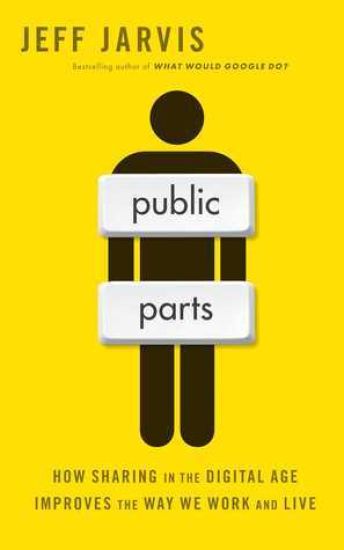
A visionary and optimistic thinker examines the tension between privacy and publicness that is transforming how we form communities, create identities, do business, and live our lives.Thanks to the internet, we now live—more and more—in public. More than 750 million people (and half of all Americans) use Facebook, where we share a billion times a day. The collective voice of Twitter echoes instantly 100 million times daily, from Tahrir Square to the Mall of America, on subjects that range from democratic reform to unfolding natural disasters to celebrity gossip. New tools let us share our photos, videos, purchases, knowledge, friendships, locations, and lives.Yet change brings fear, and many people—nostalgic for a more homogeneous mass culture and provoked by well-meaning advocates for privacy—despair that the internet and how we share there is making us dumber, crasser, distracted, and vulnerable to threats of all kinds. But not Jeff Jarvis.In this shibboleth-destroying book, Public Parts argues persuasively and personally that the internet and our new sense of publicness are, in fact, doing the opposite. Jarvis travels back in time to show the amazing parallels of fear and resistance that met the advent of other innovations such as the camera and the printing press. The internet, he argues, will change business, society, and life as profoundly as Gutenberg’s invention, shifting power from old institutions to us all.Based on extensive interviews, Public Parts introduces us to the men and women building a new industry based on sharing. Some of them have become household names—Facebook’s Mark Zuckerberg, Google’s Eric Schmidt, and Twitter’s Evan Williams. Others may soon be recognized as the industrialists, philosophers, and designers of our future. Jarvis explores the promising ways in which the internet and publicness allow us to collaborate, think, ways—how we manufacture and market, buy and sell, organize and govern, teach and learn. He also examines the necessity as well as the limits of privacy in an effort to understand and thus protect it. This new and open era has already profoundly disrupted economies, industries, laws, ethics, childhood, and many other facets of our daily lives. But the change has just begun. The shape of the future is not assured. The amazing new tools of publicness can be used to good ends and bad. The choices—and the responsibilities—lie with us. Jarvis makes an urgent case that the future of the internet—what one technologist calls “the eighth continent”—requires as much protection as the physical space we share, the air we breathe, and the rights we afford one another. It is a space of the public, for the public, and by the public. It needs protection and respect from all of us. As Secretary of State Hillary Clinton said in the wake of the uprisings in the Middle East, “If people around the world are going to come together every day online and have a safe and productive experience, we need a shared vision to guide us.” Jeff Jarvis has that vision and will be that guide.
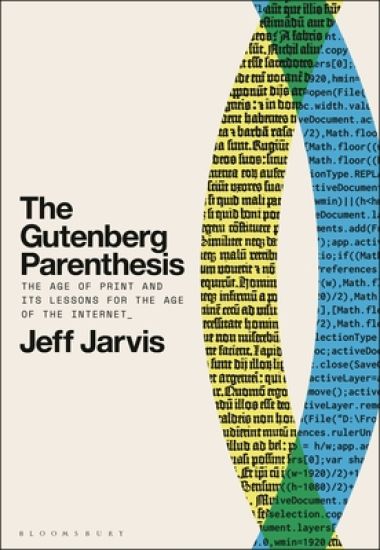
The Gutenberg Parenthesis

The Gutenberg Parenthesis

Jeff Jarvis

BLOOMSBURY PUBLISHING PLC
2023
sidottu
A 2024 CHOICE OUTSTANDING ACADEMIC TITLEPROSE AWARDS MEDIA AND CULTURAL STUDIES FINALIST 2024The Gutenberg Parenthesis traces the epoch of print from its fateful beginnings to our digital present – and draws out lessons for the age to come.The age of print is a grand exception in history. For five centuries it fostered what some call print culture – a worldview shaped by the completeness, permanence, and authority of the printed word. As a technology, print at its birth was as disruptive as the digital migration of today. Now, as the internet ushers us past print culture, journalist Jeff Jarvis offers important lessons from the era we leave behind.To understand our transition out of the Gutenberg Age, Jarvis first examines the transition into it. Tracking Western industrialized print to its origins, he explores its invention, spread, and evolution, as well as the bureaucracy and censorship that followed. He also reveals how print gave rise to the idea of the mass – mass media, mass market, mass culture, mass politics, and so on – that came to dominate the public sphere. What can we glean from the captivating, profound, and challenging history of our devotion to print? Could it be that we are returning to a time before mass media, to a society built on conversation, and that we are relearning how to hold that conversation with ourselves? Brimming with broader implications for today’s debates over communication, authorship, and ownership, Jarvis’ exploration of print on a grand scale is also a complex, compelling history of technology and power.
Magazine

Magazine

Jeff Jarvis

BLOOMSBURY PUBLISHING PLC
2023
nidottu
Object Lessons is a series of short, beautifully designed books about the hidden lives of ordinary things.For a century, magazines were the authors of culture and taste, of intelligence and policy — until they were overthrown by the voices of the public themselves online. Here is a tribute to all that magazines were, from their origins in London and on Ben Franklin’s press; through their boom — enabled by new technologies — as creators of a new media aesthetic and a new mass culture; into their opulent days in advertising-supported conglomerates; and finally to their fall at the hands of the internet. This tale is told through the experience of a magazine founder, the creator of Entertainment Weekly at Time Inc., who was also TV critic at TV Guide and People and finally an executive at Condé Nast trying to shepherd its magazines into the digital age.Object Lessons is published in partnership with an essay series in The Atlantic.
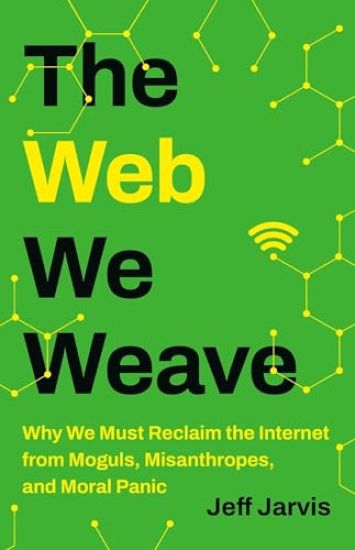
The Web We Weave

The Web We Weave

Jeff Jarvis

BASIC BOOKS
2024
sidottu
A bold defense of the internet, arguing that attempts to fix and regulate it are often misguidedThe internet stands accused of dividing us, spying on us, making us stupid, and addicting our children. In response, the press and panicked politicians seek greater regulation and control, which could ruin the web before we are finished building it.Jeff Jarvis is convinced we can have a saner conversation about the internet. Examining the web's past, present, and future, he shows that most of the problems the media lays at the internet's door are the result of our own failings. The internet did not make us hate; we brought our bias, bigotry, and prejudice with us online. That's why even well-intentioned regulation will fail to fix hate speech and misinformation and may instead imperil the freedom of speech the internet affords to all. Once we understand the internet for what it is-a human network-we can reclaim it from the nerds, pundits, and pols who are in charge now and turn our attention where it belongs: to fostering community, conversation, and creativity online. The Web We Weave offers an antidote to today's pessimism about the internet, outlining a bold vision for a world with a web that works for all of us.