

Kirjahaku
Etsi kirjoja tekijän nimen, kirjan nimen tai ISBN:n perusteella.
10 kirjaa tekijältä Jeff Riggenbach

How to disarm the people in your life who do the things you don't want them to do and don't do the things you do want them to do Tired of bullies running over you and manipulators tricking you? Done getting your buttons pushed? Sick of having that challenging person in your life that makes everything a little more difficult than it needs to be? Today can be the last day they get the best of you There is a science to human behavior. And as you learn to recognize the patterns, you will discover the combination to the vault that has held you captive. Starting today, disarm the difficult person in your life, reclaim your power with people, and restore your peace you once had before you burnout What Experts in the Leadership Development, Faith- Based, Psychotherapy, and Business Communities are saying about Disarming High-Conflict Personalities "Learn how to become the change agent in your relationships and watch what happens in your daily life Thank you, Jeff, for this helpful information "- Dr. Robert A. Rohm President, Personality Insights, and Co-Founder of discoveryreport.com "Dr. Jeff Riggenbach offers his readers a comprehensive and coherent peek into the science of human interaction in his thoughtfully written new book."- Wendy Behary Author/Expert Disarming the Narcissist, 3rd Edition/2021


Why American History is Not What They Say (Large Print Edition): An Introduction to Revisionism
Jeff Riggenbach
Createspace Independent Publishing Platform
2009
nidottu
LARGE PRINT EDITION More at LargePrintLiberty.com Jeff Riggenbach's book is a godsend for anyone who needs a crash course in revisionist history of the United States. What is revisionism? It is the retelling of history from a point of view that differs from the mainstream, which always treats the victor (the state) as glorious and the conquered (individual liberty) as deserving of its fate.Obviously the libertarian telling of American history is going to be different. The state and its creations are not the heroes. The producers of capital, the average people, the voluntary society: these are the forces that make up civilization.There is a massive literature of revisionist American history. It is so vast, in fact, that people whose field is economics, law, or philosophy can feel intimidated by it all, especially since this material is not taught in class. Must we accept the idea that the architects of the Constitution loved liberty, that Lincoln was a liberator, that the United States had to crush Spain in the late 19th century, that World War I was unavoidable, that the U.S. was always the good guy in the Cold War?No, not at all, say the revisionists. They tell a version of events that turns every convention on its head. But there is yet another problem here: most of the major revisionist historians are writing from the point of view of the political left, and their interpretation is skewed by that bias. What Riggenbach does is offer a thoroughgoing critique of leftwing revisionism in favor of a distinctly libertarian form of revisionism.This book is a roundup of the major figures and the most important books; it is also a clear-headed assessment of all the major controversies. What you get from this one book is what would otherwise take a student months or years of searching in the library to locate and learn. There has never been anything like it.He covers the work of Kenneth Roberts, John Dos Passos, Gore Vidal, Harry Elmer Barnes, James J. Martin, Charles A. Beard, William Appleman Williams, Murray Rothbard, Thomas Woods, among many others. He weighs on the great issues of whether the Old Right was really part of the "right" and how the definitions of these terms change. He defends Thomas Woods against his critics among the mainstream while arguing that Woods is not a conservative at all but rather an old-style liberal.This book is written in an engaging style, with the goal of sharing as much knowledge of this literature with the reader as is possible. In this way, this book opens up whole worlds you never knew existed.There is no longer any reason to feel lost in the thicket of interpretation and reinterpretation. Like Virgil in the Inferno, Riggenbach is your guide.

The Libertarian Tradition (Volume 1)
Jeff Riggenbach
Createspace Independent Publishing Platform
2017
nidottu
JEFF RIGGENBACH, widely known as the voice of liberty, has been researching and writing about the history of libertarianism for decades. This is the first volume of his two-volume master work, The Libertarian Tradition. Each of the many essays inside will introduce you one or more of the most important and intriguing people who developed the idea that we humans should live together in peace and freedom. Every chapter sparkles with Riggenbach's erudition, his wry humor, and his gift for storytelling. The Libertarian Tradition takes you from the rise of the idea of liberty in the seventeenth and eighteenth centuries, through innovative and playful adaptations by outsiders and novelists in the twentieth century, and right into current debates at the dawning of the twenty-first. Volume 1 includes sections 1-6: Beginnings, Once There Were Anarchists, Fin de Si cle, Between the World Wars, Modern Times, and Objectivists.

The Libertarian Tradition (Volume 2)
Jeff Riggenbach
Createspace Independent Publishing Platform
2017
nidottu

Can revolution and anarchy be good for you? Did the protests of the 1960s lead to a new American freedom? This author bravely says "Yes!" The great power of the Baby Boom generation was felt a decade earlier when this group was still in diapers: America's economy was energized by the needs of this massive influx of new citizens. As the Boomers grew, their numbers demanded more schools and teachers, graduating to a new awareness in America's colleges and universities as the largest generation ever to flex its political and social muscle. While many conservatives seek to downplay the 1960s as an overpublicized time of drug-induced sexual irresponsibility and fruitless demonstrations, nationally recognized journalist and commentator Jeff Riggenbach passionately demands that we re-evaluate the social and political significance of the time, and the revolutions of thought that it inspired. In Praise of Decadence shows how the perceived social weaknesses of the turbulent '60s actually demonstrated that it was a seminal decade which sparked a demand for individual freedom among the broad-minded Boomers. "The Movement" they began cast aside the dated values and ideals of their parents and inspired an outpouring of creativity that reverberated throughout society in the decades that followed. With a delightfully refreshing libertarian sense of the political right and left, Riggenbach exposes the myths and misinterpretations surrounding anarchism, liberalism, populism, and conservatism, as well as the term "decadence," which so many have used to describe various periods in our nation's history. Boldly testing the boundaries of political and social thought, In Praise of Decadence cuts through the hazy rhetoric of the grumpy critics, the political pretenders, and the dreamy "good old days" to show that as the Boomers' hair goes gray, Americans will fully realize, much to their surprise, that the wave of individualism celebrated so many years ago is stronger now than ever.
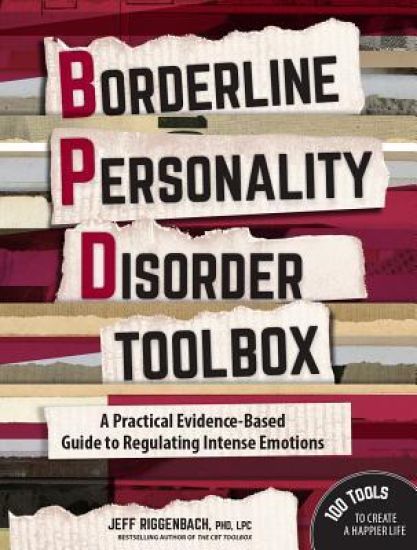
Do you feel misunderstood? Do mood swings hit you quickly and intensely? Are you susceptible to getting your "buttons pushed" more often than others? Can you love your partner with all your heart and passionate intensity one moment, and hate them just as much only an hour later? Do you constantly have a nagging voice in the back of your mind telling you someone you care about is going to leave you, and that you will never be able to make it in life without them? If the answer to the majority of these questions is "yes," it is likely that you have borderline personality disorder, or BPD. But there is hope. And good news -- BPD is a highly treatable disorder. Drawing from a variety of evidence-based approaches, the Borderline Personality Disorder Toolbox is a real-world self-help workbook. Escaping generalizations and stereotypes, this complete guide is filled with practical explanations, along with over 100 worksheets and activities to improve behavior. Highlights include: Empower yourself so others can't push your buttons Tips to cope with intense feelings Retrain your brain to constructively deal with distorted thoughts Take control of your emotions before they take control of you Tools to create a happier, healthier and more productive life

CBT Counseling & Coaching Card Deck: 50 Evidence-Based Tools to Promote Change & Personal Growth
Jeff Riggenbach
Pesi Publishing Media
2020
muu

The Personality Disorder Toolbox: The Challenge of the Hidden Agenda
Jeff Riggenbach
Independently Published
2018
nidottu
Many myths surround people with personality disorders. It is true that they can be "difficult" to deal with. It is not true that they are bad people. It is not true that they are always at fault. And it is not true that they are untreatable. Nobody chooses to have a personality disorder. Such people do inflict emotional (and on rare occasions physical) pain on others. But they suffer from intense emotional pain themselves as well in ways that nobody sees. This pain comes from a combination of genetics and life experiences that produce the development of beliefs that (oftentimes unconsciously) drive behaviors that cause a multitude of problems for themselves and others. The Personality Disorder Toolbox offers practical, evidence-based strategies and techniques for helping a broad range of practitioners work with clients to help: - All individuals with PDs develop awareness and insight as to how their behaviors are contributing to consequences in their relationships and other areas of life - People with these traits change beliefs that drive impulsive, self-sabotaging, and other harmful behaviors - Clients with Narcissistic characteristics develop empathy - BPD patients learn to regulate emotions without acting destructively - Consumers on the anti-social spectrum develop tools for facilitating attachment & decrease rule-breaking behaviors - Individuals with Cluster A & C disorders acquire tools specifically designed to change their lifelong self-defeating behaviors and modify the mindsets behind them