Kirjojen hintavertailu. Mukana 12 403 912 kirjaa ja 12 kauppaa.

Kirjahaku

Etsi kirjoja tekijän nimen, kirjan nimen tai ISBN:n perusteella.

11 kirjaa tekijältä Jeffrey E. Cohen

The President on Capitol Hill

The President on Capitol Hill

Jeffrey E. Cohen

Columbia University Press
2019
sidottu
Can presidents influence whether Congress enacts their agenda? Most research on presidential-congressional relations suggests that presidents have little if any influence on Congress. Instead, structural factors like party control largely determine the fate of the president’s legislative agenda. In The President on Capitol Hill, Jeffrey E. Cohen challenges this conventional view, arguing that existing research has underestimated the president’s power to sway Congress and developing a new theory of presidential influence.Cohen demonstrates that by taking a position, the president converts an issue from a nonpresidential into a presidential one, which leads members of Congress to consider the president’s views when deciding how to vote. Presidential position taking also converts the factors that normally affect roll call voting—such as party, public opinion, and policy type—into resources that presidents can leverage to influence the vote. By testing all House roll calls from 1877 to 2012, Cohen finds that not only do presidents have more influence than previously thought, but through their influence, they can affect the substance of public policy. The President on Capitol Hill offers a new perspective on presidential-congressional relations, showing that presidents are not simply captives of larger political forces but rather major players in the legislative process.
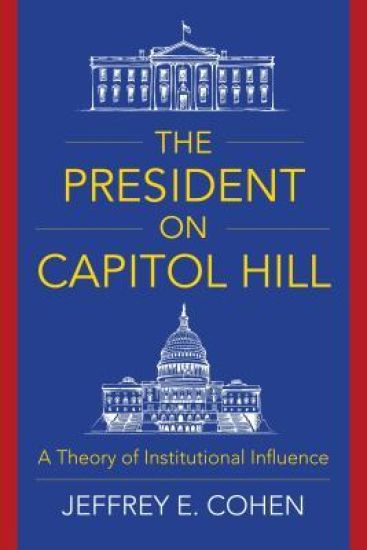
The President on Capitol Hill

The President on Capitol Hill

Jeffrey E. Cohen

Columbia University Press
2019
pokkari
Can presidents influence whether Congress enacts their agenda? Most research on presidential-congressional relations suggests that presidents have little if any influence on Congress. Instead, structural factors like party control largely determine the fate of the president’s legislative agenda. In The President on Capitol Hill, Jeffrey E. Cohen challenges this conventional view, arguing that existing research has underestimated the president’s power to sway Congress and developing a new theory of presidential influence.Cohen demonstrates that by taking a position, the president converts an issue from a nonpresidential into a presidential one, which leads members of Congress to consider the president’s views when deciding how to vote. Presidential position taking also converts the factors that normally affect roll call voting—such as party, public opinion, and policy type—into resources that presidents can leverage to influence the vote. By testing all House roll calls from 1877 to 2012, Cohen finds that not only do presidents have more influence than previously thought, but through their influence, they can affect the substance of public policy. The President on Capitol Hill offers a new perspective on presidential-congressional relations, showing that presidents are not simply captives of larger political forces but rather major players in the legislative process.

Presidential Responsiveness and Public Policy-Making

Presidential Responsiveness and Public Policy-Making

Jeffrey E. Cohen

The University of Michigan Press
1999
nidottu
We expect a president to respond to public opinion as an elected official in a democracy. Indeed, the president needs public support to overcome opposition to his policies in Congress and the bureaucracy. At the same time the president may want to pursue policies that do not have widespread support. How does public opinion affect presidential policy making? Jeffrey Cohen finds that presidents are responsive to the public in selecting issues to focus on. If an issue has captured the interest of the people, then the president will focus on that issue. Cohen finds that having chosen to work on an issue, presidents pay less attention to public opinion when making a policy. The president will try to maintain control over the details of the policy so that the outcome fits his policy agenda. Cohen examines the way presidents from Eisenhower through Clinton have dealt with public opinion in policy making. He uses case studies of issues such as Clinton and gays in the military, Bush and the extension of unemployment benefits, and Kennedy and cutting the income tax, to explore the relationship between presidents and public opinion. In addition Cohen uses a quantitative analysis of State of the Union addresses and positions on roll call votes of presidents from Eisenhower through George Bush to test his theories. This book should appeal to political scientists and historians interested in the presidency and in public opinion, as well as general readers interested in the history of the American presidency. Jeffrey Cohen is Professor of Political Science, Fordham University.
Going Local

Going Local

Jeffrey E. Cohen

Cambridge University Press
2009
pokkari
Going public to gain support, especially through reliance on national addresses and the national news media, has been a central tactic for modern presidential public leadership. In Going Local: Presidential Leadership in the Post-Broadcast Age, Jeffrey E. Cohen argues that presidents have adapted their going-public activities to reflect the current realities of polarized parties and fragmented media. Going public now entails presidential targeting of their party base, interest groups, and localities. Cohen focuses on localities and offers a theory of presidential news management that is tested using several new data sets, including the first large-scale content analysis of local newspaper coverage of the president. Although the post-broadcast age presents hurdles to presidential leadership, Going Local demonstrates the effectiveness of targeted presidential appeals and provides us with a refined understanding of the nature of presidential leadership.
Going Local

Going Local

Jeffrey E. Cohen

Cambridge University Press
2009
sidottu
Going public to gain support, especially through reliance on national addresses and the national news media, has been a central tactic for modern presidential public leadership. In Going Local: Presidential Leadership in the Post-Broadcast Age, Jeffrey E. Cohen argues that presidents have adapted their going-public activities to reflect the current realities of polarized parties and fragmented media. Going public now entails presidential targeting of their party base, interest groups, and localities. Cohen focuses on localities and offers a theory of presidential news management that is tested using several new data sets, including the first large-scale content analysis of local newspaper coverage of the president. Although the post-broadcast age presents hurdles to presidential leadership, Going Local demonstrates the effectiveness of targeted presidential appeals and provides us with a refined understanding of the nature of presidential leadership.
The Presidency in the Era of 24-Hour News

The Presidency in the Era of 24-Hour News

Jeffrey E. Cohen

Princeton University Press
2008
pokkari
The Presidency in the Era of 24-Hour News examines how changes in the news media since the golden age of television--when three major networks held a near monopoly on the news people saw in the United States--have altered the way presidents communicate with the public and garner popular support. How did Bill Clinton manage to maintain high approval ratings during the Monica Lewinsky scandal? Why has the Iraq war mired George Bush in the lowest approval ratings of his presidency? Jeffrey Cohen reveals how the decline of government regulation and the growth of Internet and cable news outlets have made news organizations more competitive, resulting in decreased coverage of the president in the traditional news media and an increasingly negative tone in the coverage that does occur. He traces the dwindling of public trust in the news and shows how people pay less attention to it than they once did. Cohen argues that the news media's influence over public opinion has decreased considerably as a result, and so has the president's ability to influence the public through the news media. This has prompted a sea change in presidential leadership style. Engaging the public less to mobilize broad support, presidents increasingly cultivate special-interest groups that often already back the White House's agenda. This book carries far-reaching implications for the future of presidential governance and American democracy in the era of new media.
Politics of the U.S. Cabinet, The

Politics of the U.S. Cabinet, The

Jeffrey E. Cohen

University of Pittsburgh Press
1988
nidottu
Jeffrey E. Cohen presents a detailed, quantitative study of the characteristics of presidential cabinets from the days of George Washington through the first Reagan administration. Dividing U.S. history into five party eras, he examines cabinet members' age, education, region, occupation, recruitment patterns, party affiliations, and relations with other branches and institutions of government. This study also addresses major theoretical issues: the Constitution never provided for a cabinet, although George Washington established it. Questions soon arose as to its functions, relation to Congress, and the rules and precedents guiding its activities. Cohen examines how the cabinet balanced representation and capability, and how, despite a lack of institutional authority, it has managed to survive through every administration.
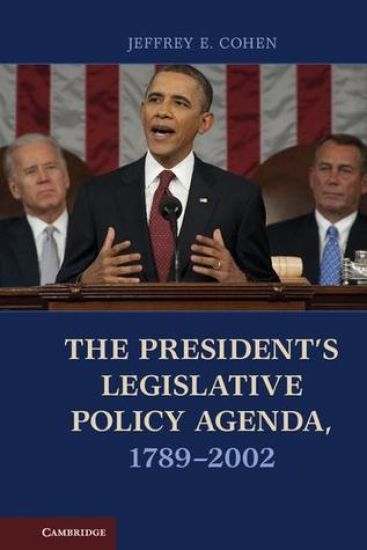
The President's Legislative Policy Agenda, 1789–2002

The President's Legislative Policy Agenda, 1789–2002

Jeffrey E. Cohen

Cambridge University Press
2012
sidottu
Jeffrey E. Cohen asks why US presidents send to Congress the legislative proposals that they do and what Congress does with those proposals. His study covers nearly the entire history of the presidency, from 1789 to 2002. The long historical scope allows Cohen to engage competing perspectives on how the presidency has developed over time. He asks what accounts for the short- and long-term trends in presidential requests to Congress, what substantive policies and issues recommendations are concerned with, and what factors affect the presidential decision to submit a recommendation on a particular issue. The President's Legislative Policy Agenda, 1789–2002 argues that presidents often anticipate the Congressional reaction to their legislative proposals and modify their agendas accordingly.
Presidential Leadership in Public Opinion

Presidential Leadership in Public Opinion

Jeffrey E. Cohen

Cambridge University Press
2015
pokkari
Although presidents may have a difficult time actually leading the public and Congress, voters still desire strong leadership from their commander in chief. In Presidential Leadership in Public Opinion, Jeffrey E. Cohen argues that the perception of presidential leadership in American politics is affected not so much by what presidents accomplish but by whether voters think their president is a good leader. When assessing whether a president is a good leader, voters ask two questions: Does the president represent me and the nation? And, is the president strong? Cohen shows that presidential interactions with Congress affect voter perceptions of presidential representation and strength. These perceptions have important implications for public attitudes about American politics. They affect presidential approval ratings, the performance of candidates in presidential elections, attitudes toward Congress, and trust in government. Perceptions of presidential leadership qualities have implications not only for the presidency but also for the larger political system.
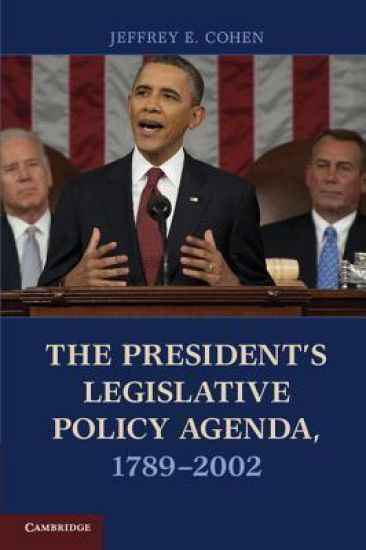
The President's Legislative Policy Agenda, 1789–2002

The President's Legislative Policy Agenda, 1789–2002

Jeffrey E. Cohen

Cambridge University Press
2012
pokkari
Jeffrey E. Cohen asks why US presidents send to Congress the legislative proposals that they do and what Congress does with those proposals. His study covers nearly the entire history of the presidency, from 1789 to 2002. The long historical scope allows Cohen to engage competing perspectives on how the presidency has developed over time. He asks what accounts for the short- and long-term trends in presidential requests to Congress, what substantive policies and issues recommendations are concerned with, and what factors affect the presidential decision to submit a recommendation on a particular issue. The President's Legislative Policy Agenda, 1789–2002 argues that presidents often anticipate the Congressional reaction to their legislative proposals and modify their agendas accordingly.
The Politics of Telecommunications Regulation: The States and the Divestiture of AT&T
Originally published in 1992. This text is a work from a series entitled ' Bureaucracies, Public Administration and Public Policy. The Politics of Telecommunication regulation: The States and the Divestiture of AT&T is an example of high-quality policy analysis conducted at state level. It substitutes for simple theories of public policy more complex and interesting explanations and relies on massive and time-consuming data-gathering that gives careful attention to measurement issues, providing a sophisticated empirical analysis to evaluate the utility of public policy theories.