
Kirjahaku
Etsi kirjoja tekijän nimen, kirjan nimen tai ISBN:n perusteella.
7 kirjaa tekijältä Jeffrey P. Brain
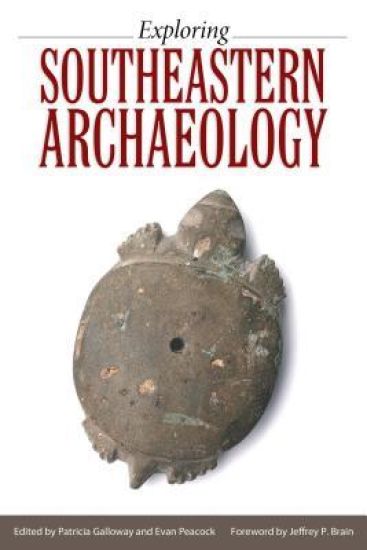
Contributions by Keith A. Baca, Jeffrey P. Brain, Samuel O. Brookes, Ian W. Brown, Philip J. Carr, Jessica Crawford, Patricia Galloway, Alison M. Hadley, Christopher T. Hays, Edward R. Henry, Cliff Jenkins, Jay K. Johnson, Evan Peacock, Janet Rafferty, Maria Schleidt, Mary Evelyn Starr, James B. Stoltman, Andrew M. Triplett, Melissa H. Twaroski, and Richard A. Weinstein This volume includes original scholarship on a wide array of archaeological research across the South. One essay explores the effects of climate on early cultures in Mississippi. Contributors reveal the production and distribution of stone effigy beads, which were centered in southwest Mississippi some 5,000 years ago, and trace contact between different parts of the prehistoric Southeast as seen in the distribution of clay cooking balls. Researchers explore small, enigmatic sites in the hill country of northern Mississippi now marked by scatters of broken pottery and a large, seemingly isolated ""platform"" mound in Calhoun County. Pieces describe a mound group in Chickasaw County built by early agriculturalists who subsequently abandoned the area and a similar prehistoric abandonment event in Winston and Choctaw Counties. A large pottery collection from the famous Anna Mounds site in Adams County, excavations at a Chickasaw Indian site in Lee County, camps and works of the Civilian Conservation Corps in the pine hill country of southern Mississippi, and the history of logging in the Mississippi Delta all yield abundant, new understandings of the past. Overview papers include a retrospective on archaeology in the National Forests of north Mississippi, a look at a number of mound sites in the lower Mississippi Delta, and a study of how communities of learning in field archaeology are built, with prominent archaeologist Samuel O. Brookes's achievements as a focal point. History buffs, artifact enthusiasts, students, and professionals all will find something of interest in this book, which opens doors on the prehistory and history of Mississippi.
This volume includes original scholarship on a wide array of current archaeological research across the South. One essay explores the effects of climate on early cultures in Mississippi. Contributors reveal the production and distribution of stone effigy beads, which were centered in southwest Mississippi some 5,000 years ago, and trace contact between different parts of the prehistoric Southeast as seen in the distribution of clay cooking balls. Researchers explore small, enigmatic sites in the hill country of northern Mississippi now marked by scatters of broken pottery and a large, seemingly isolated ""platform"" mound in Calhoun County. Pieces describe a mound group in Chickasaw County built by early agriculturalists who subsequently abandoned the area and a similar prehistoric abandonment event in Winston and Choctaw Counties. A large pottery collection from the famous Anna Mounds site in Adams County, excavations at a Chickasaw Indian site in Lee County, camps and works of the Civilian Conservation Corps in the pine hill country of southern Mississippi, and the history of logging in the Mississippi Delta all yield abundant, new understandings of the past. Overview papers include a retrospective on archaeology in the National Forests of north Mississippi, a new look at a number of mound sites in the lower Mississippi Delta, and a study of how communities of learning in field archaeology are built, with prominent archaeologist Samuel O. Brookes's achievements as a focal point. History buffs, artifact enthusiasts, students, and professionals all will find something of interest in this book, which opens new doors on the prehistory and history of Mississippi.
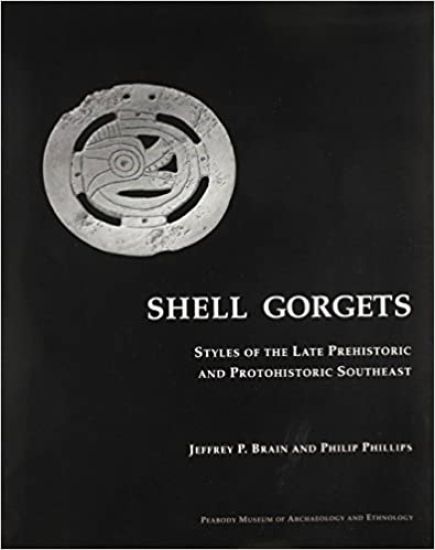
Shell Gorgets
Jeffrey P. Brain; Philip Phillips
Peabody Museum of Archaeology Ethnology,U.S.
1996
nidottu
Engraved shell gorgets are found throughout prehistoric southeastern North America. The artistic sophistication of these gorgets lends itself to the senstive stylistic and chronological analysis offered here. In part one of this volume, the gorgets are classified into styles; in part two, described archaeological sites are analyzed for associations and chronology; and in part three, information about the gorgets is correlated with other artifactual evidence, and patterns of intersite distribution are examined for chronological insights and dynamic interpretations.

Excavations at the Lake George Site, Yazoo Country, Mississippi, 1958–1960
Stephen Williams; Jeffrey P. Brain
Peabody Museum of Archaeology Ethnology,U.S.
1985
nidottu
This volume describes and interprets excavations at one of the greatest late prehistoric sites in the southeastern U.S. Lake George reached its zenith between the 13th and 15th centuries A.D., during the florescence of the Mississippian culture. This is a detailed analysis of the site and its relationship to the corpus of Southeastern archaeology.

The De Soto Chronicles Vol 1 Volume 1
Charles Hudson; John E. Worth; Eugene Lyon; Jeffrey P. Brain; John H. Hann; Frances G. Crowley; David Bost; Rocio Sanchez Rubio; Charmion Shelby; Eduardo Kortright; James A. Robertson; Paul Hoffman
THE UNIVERSITY OF ALABAMA PRESS
1995
nidottu
1993 Choice Outstanding Academic Book, sponsored by Choice Magazine. The De Soto expedition was the first major encounter of Europeans with North American Indians in the eastern half of the United States. De Soto and his army of over 600 men, including 200 cavalry, spent four years traveling through what is now Florida, Georgia, Alabama, North and South Carolina, Tennessee, Mississippi, Louisiana, Arkansas, and Texas. For anthropologists, archaeologists, and historians the surviving De Soto chronicles are valued for the unique ethnological information they contain. These documents, available here in a two volume set, are the only detailed eyewitness records of the most advanced native civilization in North America—the Mississippian culture—a culture that vanished in the wake of European contact.

The De Soto Chronicles Vol 2 Volume 2
Charles Hudson; John E. Worth; Eugene Lyon; Jeffrey P. Brain; John H. Hann; Frances G. Crowley; David Bost; Rocio Sanchez Rubio; Charmion Shelby; Eduardo Kortright; James A. Robertson; Paul Hoffman
THE UNIVERSITY OF ALABAMA PRESS
1995
nidottu
1993 Choice Outstanding Academic Book, sponsored by Choice Magazine. The De Soto expedition was the first major encounter of Europeans with North American Indians in the eastern half of the United States. De Soto and his army of over 600 men, including 200 cavalry, spent four years traveling through what is now Florida, Georgia, Alabama, North and South Carolina, Tennessee, Mississippi, Louisiana, Arkansas, and Texas. For anthropologists, archaeologists, and historians the surviving De Soto chronicles are valued for the unique ethnological information they contain. These documents, available here in a two volume set, are the only detailed eyewitness records of the most advanced native civilization in North America—the Mississippian culture—a culture that vanished in the wake of European contact.