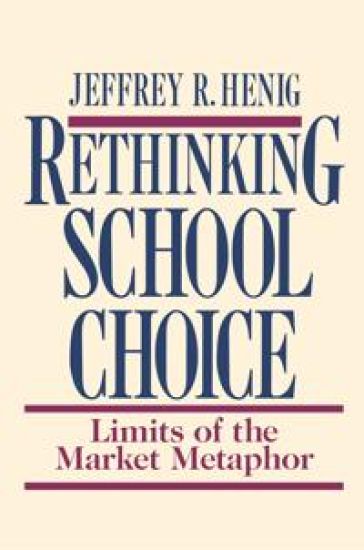
Advocates of school vouchers and other choice proposals couch their arguments in the fashionable language of economic theory. Choice initiatives at all levels of government have succeeded, it is claimed, because they shift responsibility for education reform from government to market forces. This timely book disputes the appropriateness of the market metaphor as a guide to education policy.
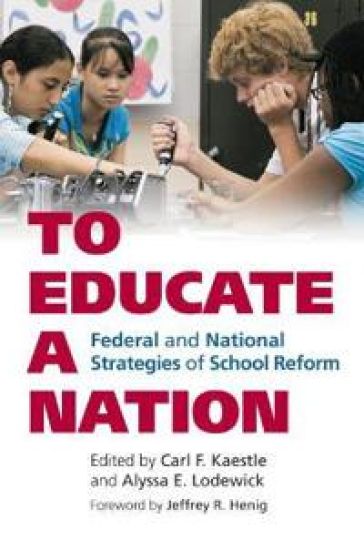
To Educate a Nation brings together the work of some of the most notable young scholars in the field of national education policy studies, focusing on the growing federal role in reform efforts; programs to provide equal educational opportunity; the changing relationships among federal, state, and local agencies; and the shifting boundaries between public and private sectors. Collectively, these essays provide a new and penetrating look at how education policymaking has changed over the past fifty years. Individually, they address such issues as desegregation, education choice, Title I, the National Defense Education Act, the politics of pre-K education, and Supreme Court decisions on equal opportunity - as well as how No Child Left Behind fits into the larger framework of debates over the standards-based reform movement. Developed over three years of seminars at Brown University, ""To Educate a Nation"" brings thematic and analytical coherence to the subject. Bridging historical and social science analyses, the contributors examine the interactions of federal initiatives with state and local practices as they highlight the complications inherent in American education today and provide a framework for grappling with its problems. Their insights expand our understanding of federal policy, national reform movements, and the changing nature of the polity in education - the institutions, traditions, and power relationships that define who has a voice in education policymaking and how they participate in it. For citizens and scholars alike, ""To Educate a Nation"" provides new ways to think about educational decision making in a federal system of governance, about unintended consequences of top-down policies, and about the continued resilience of state and local variation, clarifying how education policy is made in our unusual American system of shared governance and supplying an effective framework for understanding today's complex policymaking context.
Over the past fifty years, the ""special"" status of education decision-making has been eroded. Once the province of local and state school boards, decisions about schools and schooling have begun to emerge in every level and branch of government. In The End of Exceptionalism in American Education, Jeffrey R. Henig traces the roots of this tectonic shift in school governance.Carefully reasoned, astutely observed, and thoughtfully presented, this volume promises to become a classic work in our understanding of education policy and an invaluable resource for those seeking to influence its future trajectory.
Over the past fifty years, the ""special"" status of education decision-making has been eroded. Once the province of local and state school boards, decisions about schools and schooling have begun to emerge in every level and branch of government. In The End of Exceptionalism in American Education, Jeffrey R. Henig traces the roots of this tectonic shift in school governance.Carefully reasoned, astutely observed, and thoughtfully presented, this volume promises to become a classic work in our understanding of education policy and an invaluable resource for those seeking to influence its future trajectory.
The Infrastructure of Accountability brings together leading and emerging scholars who set forth an ambitious conceptual framework for understanding the full impact of large-scale, performance-based accountability systems on education.Over the past 20 years, schools and school systems have been utterly reshaped by the demands of test-based accountability. Interest in large-scale performance data has reached an unprecedented high point. Yet most education researchers focus primarily on questions of data quality and the effectiveness of data use. In this bold and thought-provoking volume, the contributors look beneath the surface of all this activity to uncover the hidden infrastructure that supports the production, flow, and use of data in education, and explore the impact of these large-scale information systems on American schooling. These systems, the editors note, “sit at the juncture of technical networks, work practices, knowledge production, and moral order.”
The widespread popularity of charter schools, and of the charter movement itself, speaks to the unique and chronic desire for substantive change in American education. As an innovation in governance, the ultimate goal of the charter movement is to improve learning opportunities for all students.
The widespread popularity of charter schools, and of the charter movement itself, speaks to the unique and chronic desire for substantive change in American education. As an innovation in governance, the ultimate goal of the charter movement is to improve learning opportunities for all students.
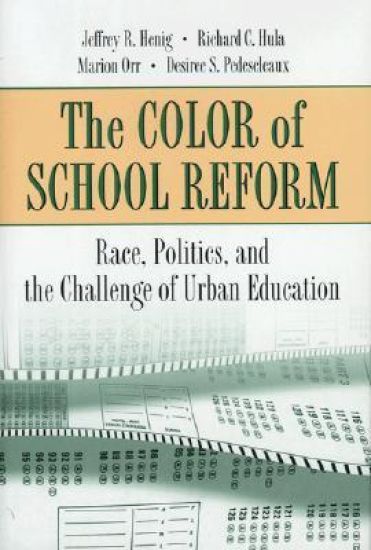
Why is it so difficult to design and implement fundamental educational reform in large city schools in spite of broad popular support for change? How does the politics of race complicate the challenge of building and sustaining coalitions for improving urban schools? These questions have provoked a great deal of theorizing, but this is the first book to explore the issues on the basis of extensive, solid evidence. Here a group of political scientists examines education reform in Atlanta, Baltimore, Detroit, and Washington, D.C., where local governmental authority has passed from white to black leaders. The authors show that black administrative control of big-city school systems has not translated into broad improvements in the quality of public education within black-led cities. Race can be crucial, however, in fostering the broad civic involvement perhaps most needed for school reform. In each city examined, reform efforts often arise but collapse, partly because leaders are unable to craft effective political coalitions that would commit community resources to a concrete policy agenda. What undermines the leadership, according to the authors, is the complex role of race in each city. First, public authority does not guarantee access to private resources, usually still controlled by white economic elites. Second, local authorities must interact with external actors, at the state and national levels, who remain predominantly white. Finally, issues of race divide the African American community itself and often place limits on what leaders can and cannot do. Filled with insightful explanations together with recommendations for policy change, this book is an important component of the debate now being waged among researchers, education activists, and the community as a whole.
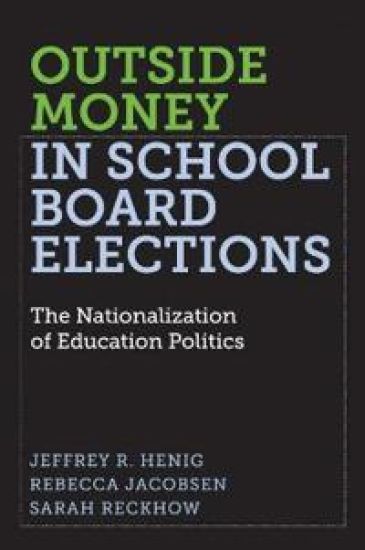
Outside Money in School Board Elections documents and analyzes the injection of external funding into local elections. Local school board contests have recently become flashpoints of national donor interest. Some observers see this engagement as a needed boost for complacent school districts while others view it as a threat to local democracy. Drawing on a detailed study of elections in five districts (Bridgeport, Connecticut, Denver, Indianapolis, Los Angeles, and New Orleans), the authors explore what happens when national issues percolate downward into local politics. They suggest that the involvement of wealthy individuals and national organizations in local school board elections are signs of the nationalization of local education politics that potentially have significant implications for equity and democracy. Outside Money in School Board Elections brings attention back to local participation and the diversity of players at that level, and highlights the national trend of increasing wealth inequality and its impact on the politics of education. This cross-case investigation demonstrates that local and national education politics are not separate fields but closely intertwined areas of political advocacy with complex interactions.
Outside Money in School Board Elections documents and analyzes the injection of external funding into local elections. Local school board contests have recently become flashpoints of national donor interest. Some observers see this engagement as a needed boost for complacent school districts while others view it as a threat to local democracy. Drawing on a detailed study of elections in five districts (Bridgeport, Connecticut, Denver, Indianapolis, Los Angeles, and New Orleans), the authors explore what happens when national issues percolate downward into local politics. They suggest that the involvement of wealthy individuals and national organizations in local school board elections are signs of the nationalization of local education politics that potentially have significant implications for equity and democracy. Outside Money in School Board Elections brings attention back to local participation and the diversity of players at that level, and highlights the national trend of increasing wealth inequality and its impact on the politics of education. This cross-case investigation demonstrates that local and national education politics are not separate fields but closely intertwined areas of political advocacy with complex interactions.
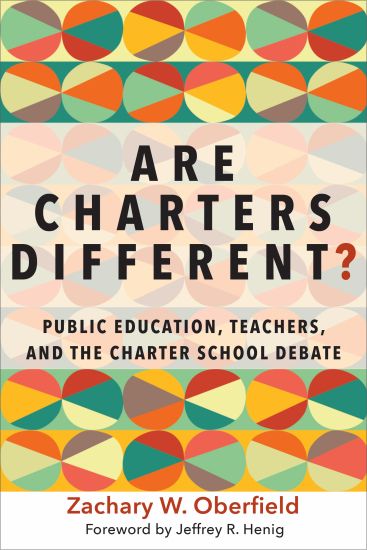
In his new book, Zachary W. Oberfield investigates the question of whether charter schools cultivate different teaching climates from those found in traditional public schools. To answer this question, Oberfield examined hundreds of thousands of teacher surveys from across the nation. The result is a trenchant analysis that deepens our understanding of what the charter experiment means for the future of US public education.Are Charters Different? shows that the teaching climates of charter and public schools do differ in important ways and explores the relative strengths and weaknesses of each. In addition, the book inquires into critical differences within the charter sector, between for-profit and nonprofit charters, and between independently operated schools and those that are part of educational management organizations. Ultimately, the book argues, the choice between charter and public schools should be more about what we value in public education and consider acceptable trade-offs.
In his new book, Zachary W. Oberfield investigates the question of whether charter schools cultivate different teaching climates from those found in traditional public schools. To answer this question, Oberfield examined hundreds of thousands of teacher surveys from across the nation. The result is a trenchant analysis that deepens our understanding of what the charter experiment means for the future of US public education.Are Charters Different? shows that the teaching climates of charter and public schools do differ in important ways and explores the relative strengths and weaknesses of each. In addition, the book inquires into critical differences within the charter sector, between for-profit and nonprofit charters, and between independently operated schools and those that are part of educational management organizations. Ultimately, the book argues, the choice between charter and public schools should be more about what we value in public education and consider acceptable trade-offs.