Kirjojen hintavertailu. Mukana 11 627 630 kirjaa ja 12 kauppaa.

Kirjahaku

Etsi kirjoja tekijän nimen, kirjan nimen tai ISBN:n perusteella.

3 kirjaa tekijältä Jeffrey Rauch

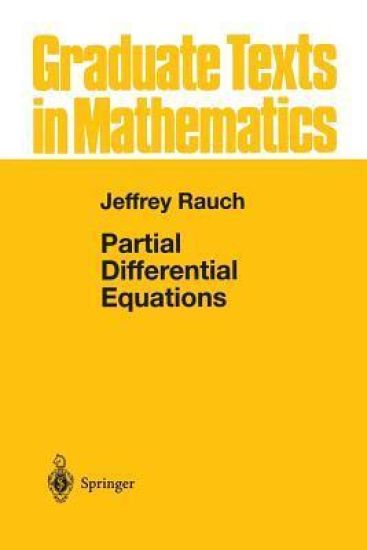
Partial Differential Equations

Partial Differential Equations

Jeffrey Rauch

Springer-Verlag New York Inc.
1991
sidottu
This book is based on a course I have given five times at the University of Michigan, beginning in 1973. The aim is to present an introduction to a sampling of ideas, phenomena, and methods from the subject of partial differential equations that can be presented in one semester and requires no previous knowledge of differential equations. The problems, with hints and discussion, form an important and integral part of the course. In our department, students with a variety of specialties-notably differen­ tial geometry, numerical analysis, mathematical physics, complex analysis, physics, and partial differential equations-have a need for such a course. The goal of a one-term course forces the omission of many topics. Everyone, including me, can find fault with the selections that I have made. One of the things that makes partial differential equations difficult to learn is that it uses a wide variety of tools. In a short course, there is no time for the leisurely development of background material. Consequently, I suppose that the reader is trained in advanced calculus, real analysis, the rudiments of complex analysis, and the language offunctional analysis. Such a background is not unusual for the students mentioned above. Students missing one of the "essentials" can usually catch up simultaneously. A more difficult problem is what to do about the Theory of Distributions.
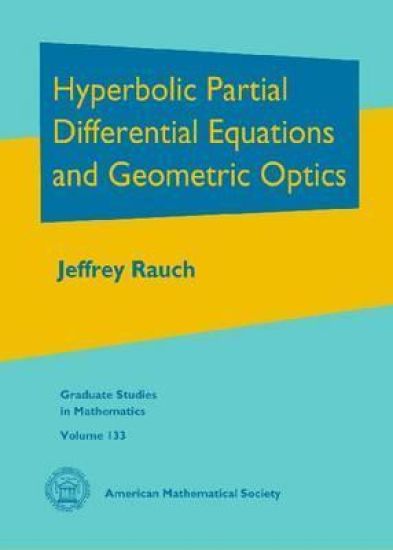
Hyperbolic Partial Differential Equations and Geometric Optics

Hyperbolic Partial Differential Equations and Geometric Optics

Jeffrey Rauch

American Mathematical Society
2012
sidottu
This book introduces graduate students and researchers in mathematics and the sciences to the multifaceted subject of the equations of hyperbolic type, which are used, in particular, to describe propagation of waves at finite speed. Among the topics carefully presented in the book are nonlinear geometric optics, the asymptotic analysis of short wavelength solutions, and nonlinear interaction of such waves. Studied in detail are the damping of waves, resonance, dispersive decay, and solutions to the compressible Euler equations with dense oscillations created by resonant interactions. Many fundamental results are presented for the first time in a textbook format. In addition to dense oscillations, these include the treatment of precise speed of propagation and the existence and stability questions for the three wave interaction equations. One of the strengths of this book is its careful motivation of ideas and proofs, showing how they evolve from related, simpler cases. This makes the book quite useful to both researchers and graduate students interested in hyperbolic partial differential equations. Numerous exercises encourage active participation of the reader. The author is a professor of mathematics at the University of Michigan. A recognized expert in partial differential equations, he has made important contributions to the transformation of three areas of hyperbolic partial differential equations: nonlinear microlocal analysis, the control of waves, and nonlinear geometric optics.
Partial Differential Equations

Partial Differential Equations

Jeffrey Rauch

Springer-Verlag New York Inc.
2012
nidottu
This book is based on a course I have given five times at the University of Michigan, beginning in 1973. The aim is to present an introduction to a sampling of ideas, phenomena, and methods from the subject of partial differential equations that can be presented in one semester and requires no previous knowledge of differential equations. The problems, with hints and discussion, form an important and integral part of the course. In our department, students with a variety of specialties-notably differen­ tial geometry, numerical analysis, mathematical physics, complex analysis, physics, and partial differential equations-have a need for such a course. The goal of a one-term course forces the omission of many topics. Everyone, including me, can find fault with the selections that I have made. One of the things that makes partial differential equations difficult to learn is that it uses a wide variety of tools. In a short course, there is no time for the leisurely development of background material. Consequently, I suppose that the reader is trained in advanced calculus, real analysis, the rudiments of complex analysis, and the language offunctional analysis. Such a background is not unusual for the students mentioned above. Students missing one of the "essentials" can usually catch up simultaneously. A more difficult problem is what to do about the Theory of Distributions.