Kirjojen hintavertailu. Mukana 11 699 587 kirjaa ja 12 kauppaa.

Kirjahaku

Etsi kirjoja tekijän nimen, kirjan nimen tai ISBN:n perusteella.

14 kirjaa tekijältä Jeffrey Strickland

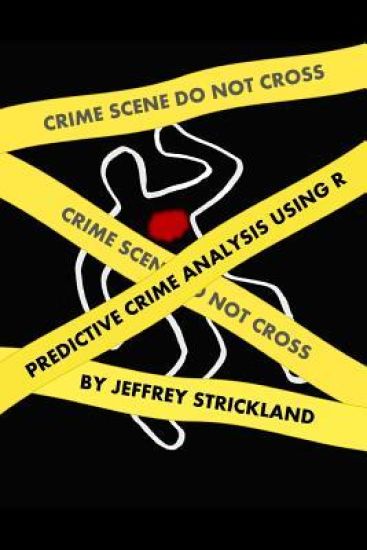
Predictive Crime Analysis using R

Predictive Crime Analysis using R

Jeffrey Strickland

Lulu.com
2019
pokkari
Predictive Crime Analysis using R is Dr. Strickland's second crime analysis book. In this volume, rather than using data to describe crime history, he uses it to predict crime using pattern created with advanced clustering methods, crime series linkage, and text analysis. Coverage includes prediction of conventional crime and terrorist attacks. The open-source software R is introduced and used in developing crime data, including Geo-spatial data, and constructing predictive models and performing post analysis. Using actual crime data from cities like Atlanta, Dr. Strickland also shows how to simulate additional data from actual data. Simulated data can then be used in cities with insufficient actual data, but with similar demographics and human behavior.
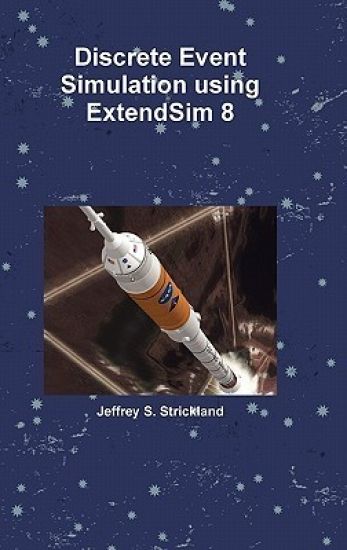
Discrete Event Simulation using ExtendSim 8
This text presents the basic concepts of discrete event simulation using ExtendSim 8. The book can be used as either a desk reference or as a textbook for a course in discrete event simulation. This book is intended to be a blend of theory and application, presenting just enough theory to understand how to build a model, design a simulation experiment, and analyze the results. Most of the text is devoted to building models with ExtendSim 8, starting with a simple single-server queue and culminating with a transportation depot for package transfer and delivery. I have built all the models contained in this book with ExtendSim 8 LT, which limits the number of modeling blocks, but otherwise has the required ExtendSim 8 capabilities. ExtendSim 8 LT is not included in this book. Students may obtain ExtendSim 8 LT from Imagine That, Inc. at www.extendsim.com/ store/cart.php?target=category&category_id=3. ExtendSim 8 is a trademark of Imagine That, Inc.
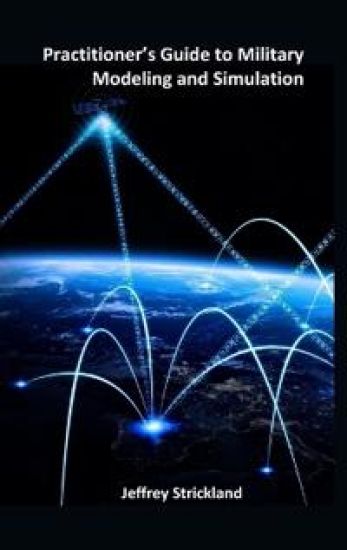
Practitioner's Guide to Military Modeling and Simulation
The Practitioner's Guide to Military Modeling and Simulation (M&S) is a blend of math and simulation that is updated to reflect the technological progress in the 2020s. A practitioner is a person engaged in the practice of a profession, occupation, etc. So, this book is for professionals that delve in military M&S. Practitioners use simulation for a number of applications, including training, material acquisition, operational testing, and analyzing military problems. Practitioners use simulation when the employment of actual military equipment is impractical, unsafe, extremely expensive, etc. The Practitioner's Guide to Military Modeling and Simulation is comprised of categories or parts of modeling and simulation, including agent-based, discrete event, Monte Carlo, Markov process, physics-based M&S. It includes content on the digital transformation, scenario development, queuing theory, and operational availability (AO). It incorporates examples of M&S software and systems, including ExtendSim, SimPy, AgentPy, SEAS, VR-Forces, MATLAB & Simulink, AnyLogic, STK, America's Army, SIMNET, and others. The Practitioner's Guide Military Modeling and Simulation assumes a basic understanding of the tactics, techniques, and procedures (TTP) prevalent in military science today. However, much of the content describes the capabilities and intended uses of M%S software and systems.
Building Scenarios in Freeciv

Building Scenarios in Freeciv

Jeffrey Strickland

Lulu.com
2024
sidottu
This book is about creating scenarios for games and simulations using Freeciv 2.5. Here I demonstrate how use the Freeciv Map Tool to generate a relief map with terrain features and resources. Also, I introduce a new terrain type, pastureland. I also use the open-source tool Terrain2STL to generate STL files, Autodesk Meshmixer to impart and reshape a terrain model, and Autodesk Fusion to complete the terrain model. The terrain modeled include Israel, Lebanon, Syria, Egypt, Turkey, portions of Iraq and Iran. All graphics are available on my GitHub freeciv directory at https: //github.com/stricje1/freeciv. Most of the graphics are created or edited with GIMP, another opens-source tool. I also use Snagit for screen captures and editing images. I created some images from scratch while others are my deviations to images from deviantart.com. All unit images (200+) are new and customized for each nation played in the game, with nation specific behaviors. Also, all the technology images and resource images are new. For file editing, I use Notepad++. Nearly all buildings and wonders are new or redefined and also have new images. Not that the emphasis of this book is on scenario development, not on game play. For the latter, please refer to the online Freeciv user guide.
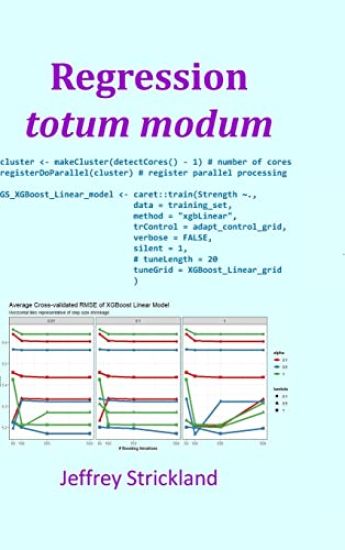
Regression totum modum

Regression totum modum

Jeffrey Strickland

Lulu.com
2023
sidottu
This book characterizes the field of regression analysis beyond its traditional domain of mathematics and statistics. Simply speaking, regression is a technique that relates a dependent variable to one or more independent (explanatory) variables. A regression model can show whether changes observed in the dependent variable are associated with changes in one or more of the explanatory variables. Using this definition, regression methods are extended to machine learning. Consequently, the scope of this book is to present the applications of regression using the totality of methods (totum modum) one can employ in regression analysis: Linear regression polynomial regression general linear models vector generalized linear models binomial regression logistic regression multinomial logistic regression multinomial probit ordered logit multilevel models fixed effects random effects linear mixed-effects model nonlinear mixed-effects model nonlinear regression support vector regression lasso regression ridge regression nonparametric semiparametric robust quantile isotonic principal components Using examples from the Space domain, including endoatmospheric and exoatmospheric environments, space weather, space launch, satellites, and ground sensors, many of these methods are applied. All examples are solved using the R programming language and all code and datasets are accessible from our GitHub site. Although written as a reference, the book can be adapted as an advanced textbook in regression analysis.
The Devil Did Not Make Me Do It

The Devil Did Not Make Me Do It

Jeffrey Strickland

Lulu.com
2018
pokkari
Dr. Jeffrey Strickland is a mathematician who carefully calculates the measures of things, even to the extent of subatomic particles unseen by the naked eye. As he did with bosons and photons in Quantum Phaith, he meticulously calculates the nature and impact of Lucifer, the fallen one. Taking a line from Flip Wilson's character, Geraldine Jones, Dr. Strickland proposes that we cannot blame all of our faults and failures on Satan. He suggests that by [sin] nature, we are perfectly capable of doing evil with no aid at all. For followers of Christ, Dr. Strickland affirms that the Devil is no match for the power of the Holy Spirit that indwells us. However, in order to be effective Christians, we must know our enemy and the environment that in which he operates. In ""The Devil did not Make Me Do it,"" you will learn to discern between Lies of Lucifer and the Truth.
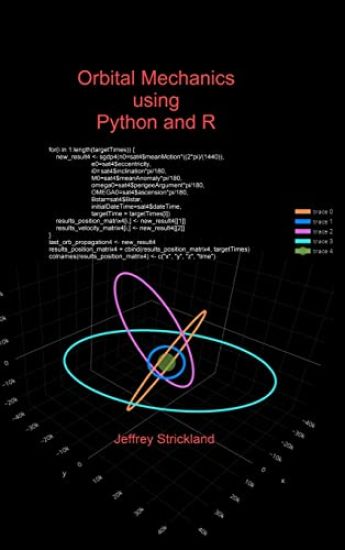
Orbital Mechanics using Python and R

Orbital Mechanics using Python and R

Jeffrey Strickland

Lulu.com
2022
sidottu
This book describes the mechanics or physics of resident space objects (RSOs) in orbits due to the gravitational force of the central mass, like the Earth. In other words, it's about the obit of satellites and other RSOs. Part 1 applies the laws of Newton and Kepler, considers 2-body and N-body problems, and explores Jacobi's constant and Lagrangian points. Using calculus, geometry, trigonometry, and algebra, it develops the equations of orbits and motion, transforms reference frames to other frames, like Cartesian to True Equator, Mean Equinox (TEME). The book investigates orbital maneuvers with applications like Hohmann transfers, and interplanetary trajectories hyperbolic departures. We develop the orbital parameters, like the semilatus rectum, mean anomaly, eccentricity, inclination, and argument of periapsis. Part 2 explores and implements the NORAD two-line element (TLE) set and uses the content to propagate state vectors( position and velocity) to plot orbits and ground tracks. We employ the SGD4 (LEO) propagator and SPD4 (deep space) propagator to validate orbits against Revisiting Spacetrack Report #3. We then use the results to project orbits forward in time and to simulate from selected orbital elements.
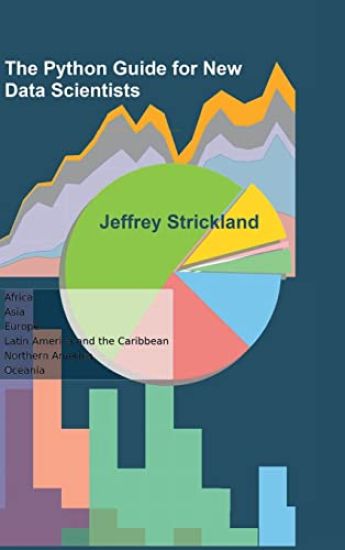
The Python Guide for New Data Scientists

The Python Guide for New Data Scientists

Jeffrey Strickland

Lulu.com
2022
sidottu
The Python Guide for New Data Scientists is written for someone who has graduated from college and has either had some discipline related course or has a desire to learn some of the basic data science building blocks. Data science is interdisciplinary, and I have work with people who have backgrounds in business or economics and are competent data scientists with some additional coursework. Ordinarily, we look for potential data scientists who have degrees in statistics, computer science, econometrics, information technology, operations research, mathematics, or engineering. That encompasses a wide range of disciplines. People who become data scientists generally have coursework in statistics, data analysis, basic programming, and college mathematics. During or after college, they have been exposed to machine learning models and prediction, R or Python programming, and some data wrangling. This book is designed to help with the latter. We'll cover basic data science tools and Python programming with Jupyter Lab. We'll cover getting and cleaning data, data preprocessing, exploratory data analysis (EDA), inferential statistics, regression models, generalized linear models, machine learning and prediction using random forests, and other algorithms. There is Python coding in every chapter, with many examples. Leaning the content is driven by very involved examples, including some using COVID-19 data. You'll find data scientists at banks, insurance companies, railroads, hospitals, utilities, and pharmaceutical companies. They work at Google, Amazon, Facebook, Netflix, Wal-Mart, Caterpillar. They are employed by the Department of Transportation (DoT), the Federal Bureau of Investigation (FBI), the Centers for Disease Control (CDC), the National Aeronautics and Space Administration (NASA). and the Department of Defense (DoD). All source code and markdown are in my GitHub repositories (there are 32 repositories) and are accessible to the public. We have a chapter covering GitHub"
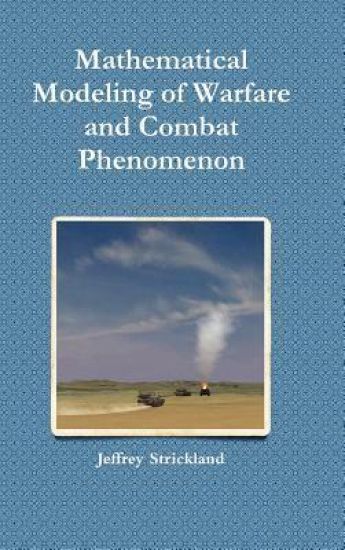
Mathematical Modeling of Warfare and Combat Phenomenon
The primary goal of this book is to assist the student to develop the skills necessary to effectively employ the ideas of mathematics to solve military problems. At the simplest level I seek to promote an understanding of why mathematics is useful as a language for characterizing the interaction and relationships among quantifiable concepts, or in mathematical terms, variables. The text explores models of terrorism, attrition, search, detection, missile defense, radar, and operational reliability Throughout the text I emphasize the notion of added value and why it is the driving force behind military mathematical modeling. For a given mathematical model to be deemed a success something must be learned that was not obvious without the modeling procedure. Very often added value comes in the form of a prediction. In the absence of added value the modeling procedure becomes an exercise not unrelated to digging a ditch simply to fill it back up again.
The R Guide for New Data Scientists

The R Guide for New Data Scientists

Jeffrey Strickland

Lulu.com
2022
sidottu
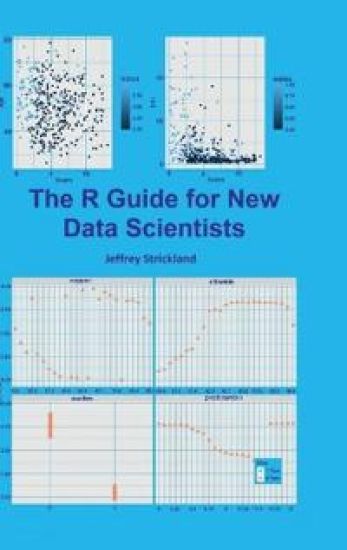
The R Guide for New Data Scientists is written for someone who has graduated from college and has either had some discipline related course or has a desire to learn some of the basic data science building blocks. Data science is interdisciplinary, and I have work with people who have backgrounds in business or economics and are competent data scientists with some additional coursework. Ordinarily, we look for potential data scientists who have degrees in statistics, computer science, econometrics, information technology, operations research, mathematics, or engineering. That encompasses a wide range of disciplines. People who become data scientists generally have coursework in statistics, data analysis, basic programming, and college mathematics. During or after college, they have been exposed to machine learning models and prediction, R or Python programming, and some data wrangling. This book is designed to help with the latter. We'll cover basic data science tools and R programming with RStudio. We'll cover getting and cleaning data, data preprocessing, exploratory data analysis (EDA), inferential statistics, regression models, generalized linear models, machine learning and prediction using random forests, and building Shiny apps. There is R coding in every chapter, with many examples. Leaning the content is driven by very involved examples, including some using COVID-19 data. You'll find data scientists at banks, insurance companies, railroads, hospitals, utilities, and pharmaceutical companies. They work at Google, Amazon, Facebook, Netflix, Wal-Mart, Caterpillar. They are employed by the Department of Transportation (DoT), the Federal Bureau of Investigation (FBI), the Centers for Disease Control (CDC), the National Aeronautics and Space Administration (NASA). and the Department of Defense (Dod). Having a good data science team is like bringing a combined arms force to bear on a stubborn, defending enemy to drive them from their stronghold and reveal their vulnerabilities. "Torture the data, and it will confess to anything." - Ronald Coase, winner of the Nobel Prize in Economics
Discrete Event Simulation Using ExtendSim 10
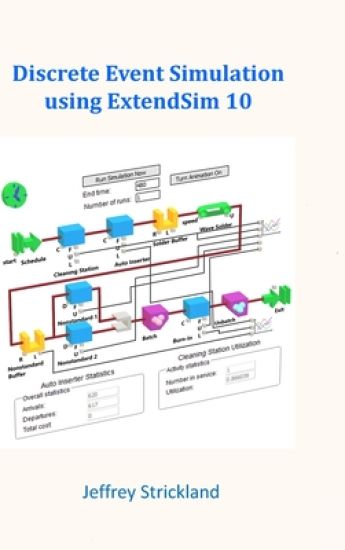
This book characterizes the discrete event simulation and analysis using ExtendSim 10. It is a blend between theory and application leaning largely to the weight of the latter. Since the ExtendSim 8 version of the book (13 years ago) there has been significant improvements to ExtendSim, including the new Reliability library incorporated in this new, enhanced edition of the first book. There are two new chapters, one include a model simulating software reliability and inherent availability and the other is a guided project addressing the Launch Availability of a crew launch vehicle (CLV) for a limited launch window. For those unfamiliar with the first edition, there is coverage of just-enough queuing theory for building discrete event models, using the M/M/1 queuing problem involving warmup and steady-state phenomena, as well as methods for analysis and corrective adjustments. Probability distributions and their inverse transfers for random sampling are covered. The StatFit application is used for fitting and analyzing data, including goodness of fit testing. Also, there is an in-depth treatment of random number generators. A bank model is used to demonstrate hierarchical modeling and basic simulation animation. Advanced queuing processes are addressed using a circuit board production example. Detailed modeling is covered using a delivery system transfer depot handing packages for domestic delivery.