
Kirjojen hintavertailu. Mukana 12 179 054 kirjaa ja 12 kauppaa.

Kirjahaku

Etsi kirjoja tekijän nimen, kirjan nimen tai ISBN:n perusteella.

3 kirjaa tekijältä Jennifer Forestal

Designing for Democracy

Designing for Democracy

Jennifer Forestal

OXFORD UNIVERSITY PRESS INC
2021
sidottu
How should we "fix" digital technologies to support democracy instead of undermining it? In Designing for Democracy, Jennifer Forestal argues that accurately evaluating the democratic potential of digital spaces means studying how the built environment--a primary component of our "modern public square"--structures our activity, shapes our attitudes, and supports the kinds of relationships and behaviors democracy requires. While many scholars and practitioners are attentive to the role of design in shaping behavior, they have yet to fully engage with the question of what structures are required to support democratic communities--and how to build them. Forestal closes this gap by providing a new theory of democratic space. Drawing from a wide range of disciplines, including architecture, psychology, and the history of political thought, she argues that "democratic spaces" must be designed with three environmental characteristics--boundaries, durability, and flexibility--that, taken together, afford users the ability to engage in fundamental civic practices. Through extended analyses of Facebook, Twitter, and Reddit, Forestal shows precisely how well these digital platforms meet the criteria for democratic spaces, or whether they do so at all. The result is a more nuanced analysis of the democratic communities that form--or fail to emerge--in these spaces, as well as more concrete suggestions for how to improve them. In connecting the built environment, digital technologies, and democratic theory, Designing for Democracy provides blueprints for democracy in a digital age.
Designing for Democracy

Designing for Democracy

Jennifer Forestal

OXFORD UNIVERSITY PRESS INC
2022
nidottu
How should we "fix" digital technologies to support democracy instead of undermining it? In Designing for Democracy, Jennifer Forestal argues that accurately evaluating the democratic potential of digital spaces means studying how the built environment--a primary component of our "modern public square"--structures our activity, shapes our attitudes, and supports the kinds of relationships and behaviors democracy requires. While many scholars and practitioners are attentive to the role of design in shaping behavior, they have yet to fully engage with the question of what structures are required to support democratic communities--and how to build them. Forestal closes this gap by providing a new theory of democratic space. Drawing from a wide range of disciplines, including architecture, psychology, and the history of political thought, she argues that "democratic spaces" must be designed with three environmental characteristics--boundaries, durability, and flexibility--that, taken together, afford users the ability to engage in fundamental civic practices. Through extended analyses of Facebook, Twitter, and Reddit, Forestal shows precisely how well these digital platforms meet the criteria for democratic spaces, or whether they do so at all. The result is a more nuanced analysis of the democratic communities that form--or fail to emerge--in these spaces, as well as more concrete suggestions for how to improve them. In connecting the built environment, digital technologies, and democratic theory, Designing for Democracy provides blueprints for democracy in a digital age.
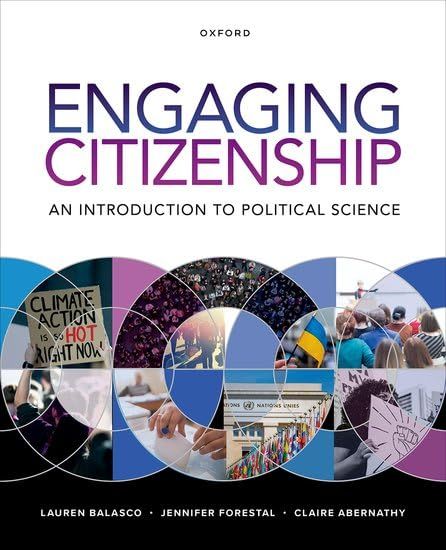
Engaging Citizenship

Engaging Citizenship

Lauren Balasco; Jennifer Forestal; Claire Abernathy

OXFORD UNIVERSITY PRESS INC
2024
nidottu
Engaging Citizenship introduces students to the fundamentals of political science through the lens of citizenship, democracy, and civic engagement. This unique approach aims to help students understand the relevant of political science to their own lives and cultivate the knowledge, skills, values, and habits they need to engage in political life. The text is grounded in three key learning goals: 1) to explore the main subfields of political science, 2) to develop a broad understanding of the U.S. political system within a global context, and 3) to engage with the political process as educated and empowered citizens. The text is divided into four sections-Explaining Statehood, Organizing Political Life, Shaping Participatory Processes, and Challenging the State-to introduce students to the fundamental questions of political science, such as the reasons why citizens join states, the arguments supportive and critical of democracy, and the avenues citizens use to influence state actions. In each section, there are four chapters; each chapter represents one of the four subfields of political science (political theory, comparative politics, American politics, and international relations) and presents its respective theories, concepts, and issues in response to that section's theme. In this way, the text provides a rich and balanced introduction to all four subfields in conversation with one another. The text is accompanied by a series of online civic engagement activities, providing interactive opportunities for students to engage with the themes discussed in each section. In this way, Engaging Citizenship makes it easy for faculty who wish to create opportunities for hands-on learning about citizenship and civic engagement. These activities enable students to practice the skills of effective citizenship and to familiarize themselves with avenues for participation in their communities.