Kirjojen hintavertailu. Mukana 11 590 110 kirjaa ja 12 kauppaa.

Kirjahaku

Etsi kirjoja tekijän nimen, kirjan nimen tai ISBN:n perusteella.

3 kirjaa tekijältä Jennifer M. Silva

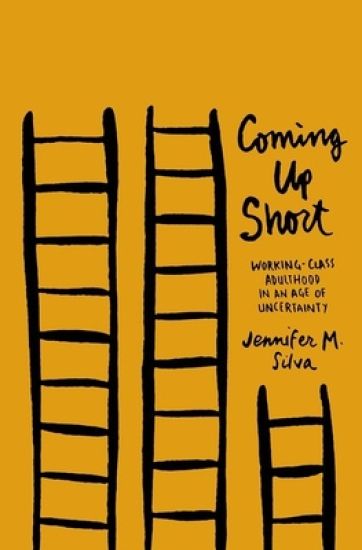
Coming Up Short

Coming Up Short

Jennifer M. Silva

Oxford University Press Inc
2015
nidottu
"Impeccably researched and skillfully articulated, Silva's work is a timely primer on the current state of blue-collar Millennials." --Publishers Weekly "[A] brief yet devastating book that blends academic analysis and oral history to put a new face on well-documented trends that are more usually described in the abstract." --Boston Globe "Silva has made a major contribution to understanding where young adults are coming from, what influences them, and what they consider to be common sense." --The American Conservative "Fascinating" --Feministing.com "[A]n enjoyable read and raises important issues that we generally overlook." --Washington Independent Review of Books "Coming Up Short is a brief, but powerful, update of the status, difficulties, behaviors and distresses that characterize the lives of young working class adults.... highly recommended for sociologists and social welfare students and academics alike. It informs in telling detail the difficult circumstances and self-perceptions of a significant portion of the American population. It is also a window into how the 'helping professions' have influenced the thinking of young adults and suggests that those professions need to help their clients see their troubles in broader terms than they apparently currently do." --Journal of Sociology & Social Welfare What does it mean to grow up today as working-class young adults? How does the economic and social instability left in the wake of neoliberalism shape their identities, their understandings of the American Dream, and their futures? Coming Up Short illuminates the transition to adulthood for working-class men and women. Moving away from easy labels such as the "Peter Pan generation," Jennifer Silva reveals the far bleaker picture of how the erosion of traditional markers of adulthood-marriage, a steady job, a house of one's own-has changed what it means to grow up as part of the post-industrial working class. Based on one hundred interviews with working-class people in two towns-Lowell, Massachusetts, and Richmond, Virginia-Silva sheds light on their experience of heightened economic insecurity, deepening inequality, and uncertainty about marriage and family. Silva argues that, for these men and women, coming of age means coming to terms with the absence of choice. As possibilities and hope contract, moving into adulthood has been re-defined as a process of personal struggle-an adult is no longer someone with a small home and a reliable car, but someone who has faced and overcome personal demons to reconstruct a transformed self. Indeed, rather than turn to politics to restore the traditional working class, this generation builds meaning and dignity through the struggle to exorcise the demons of familial abuse, mental health problems, addiction, or betrayal in past relationships. This dramatic and largely unnoticed shift reduces becoming an adult to solitary suffering, self-blame, and an endless seeking for signs of progress. This powerfully written book focuses on those who are most vulnerable-young, working-class people, including African-Americans, women, and single parents-and reveals what, in very real terms, the demise of the social safety net means to their fragile hold on the American Dream.
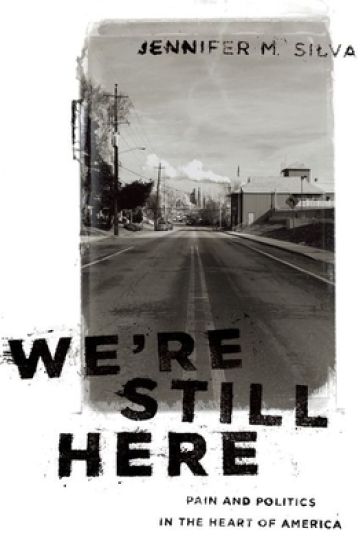
We're Still Here

We're Still Here

Jennifer M. Silva

Oxford University Press Inc
2019
sidottu
The economy has been brutal to American workers for several decades. The chance to give one's children a better life than one's own-the promise at the heart of the American Dream-is withering away. In turn, "deaths of despair" such as drug overdoses, suicides, and cirrhosis of the liver are rising among the working class. The 2016 elections threw into sharp relief how little we know about how working-class people translate their grievances into politics. In We're Still Here, Jennifer M. Silva tells a deep, multi-generational story of pain and politics that will endure long after Trump and the elections of 2016. Drawing on over 100 interviews with black, white, and Latino working-class residents of a declining coal town in Pennsylvania, Silva proposes that the key to understanding the puzzle of working-class politics is to understand how the decline of the American Dream is lived and felt. In the post-industrial age, the routines and rhythms of traditional working-class life such as manual labor, unions, marriage, church, and social clubs have diminished. Moreover, the institutions that have historically mediated between individual, personal struggles and broader, collective political coalitions have become active sites of betrayal. In this void, individual strategies for coping with pain, and finding personal redemption, have themselves become sources of political stimulus and reaction among the working class. In the coal region, understanding how generations of Democratic voters come to reject the social safety net and often politics altogether requires moving beyond simple partisanship into a maze of addiction, joblessness, family disruption, violence, and trauma. How working-class men and women put the pieces back together - if they do at all-will have grave consequences for the future of American democracy. We're Still Here provides powerful, on the ground evidence of the remaking of working-class identity and politics that will spark new tensions but also open up the possibility for shifting alliances and new possibilities.
We're Still Here

We're Still Here

Jennifer M. Silva

OXFORD UNIVERSITY PRESS INC
2021
nidottu
A deep, multi-generational story of pain, place, and politics. The economy has been brutal to American workers for several decades. The chance to give one's children a better life than one's own -- the promise at the heart of the American Dream -- is withering away. While onlookers assume those suffering in marginalized working-class communities will instinctively rise up, the 2016 election threw into sharp relief how little we know about how the working-class translate their grievances into politics. In We're Still Here, Jennifer M. Silva tells a deep, multi-generational story of pain, place, and politics that will endure long after the Trump administration. Drawing on over 100 interviews with black, white, and Latino working-class residents of a declining coal town in Pennsylvania, Silva reveals how the decline of the American Dream is lived and felt. The routines and rhythms of traditional working-class life such as manual labor, unions, marriage, church, and social clubs have diminished. In their place, she argues, individualized strategies for coping with pain, and finding personal redemption, have themselves become sources of political stimulus and reaction among the working class. Understanding how generations of Democratic voters come to reject the social safety net and often politics altogether requires moving beyond simple partisanship into a maze of addiction, joblessness, family disruption, violence, and trauma. Instead, Silva argues that we need to uncover the relationships, loyalties, longings, and moral visions that underlie and generate the civic and political disengagement of working-class people. We're Still Here provides powerful, on the ground evidence of the remaking of working-class identity and politics that will spark new tensions but also open up the possibility for shifting alliances and new possibilities.