Kirjojen hintavertailu. Mukana 11 244 527 kirjaa ja 12 kauppaa.

Kirjahaku

Etsi kirjoja tekijän nimen, kirjan nimen tai ISBN:n perusteella.

177 kirjaa tekijältä Jeremy Bentham

The Collected Works of Jeremy Bentham: Official Aptitude Maximized, Expense Minimized
The essays which Bentham collected together for publication in 1830 under the title of Official Aptitude Maximized; Expense Minimized, written at various times between 1810 and 1830, deal with the means of achieving efficient and economical government. In considering a wide range of themes in the fields of constitutional law, public finance, and legal reform, Bentham places the problem of official corruption at the centre of his analysis. He contrasts his own recommendations for good administration, which he had fully developed in his magisterial Constitutional Code, with the severe deficiencies he saw in English practice. The core of the volume consists of four major essays directed against the principles and policies of four leading statesmen: Edmund Burke, George Rose, Robert Peel, and Lord Chancellor Eldon. Of particular concern to Bentham were the abuses sanctioned by the judges and their officials in the Westminster Hall courts, which, he argues, resulted in the denial of justice to the majority of the population. In this volume, Bentham not only displays the precise logical reasoning for which he is well known, but also his considerable skills as a rhetorician of reform.
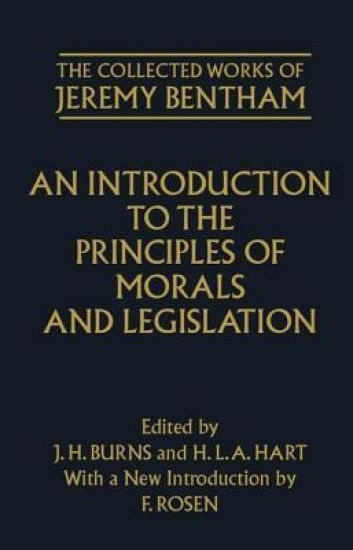
The Collected Works of Jeremy Bentham: An Introduction to the Principles of Morals and Legislation
The new critical edition of the works and correspondence of Jeremy Bentham (1748-1832) is being prepared and published under the supervision of the Bentham Committee of University College London. In spite of his importance as jurist, philosopher, and social scientist, and leader of the Utilitarian reformers, the only previous edition of his works was a poorly edited and incomplete one brought out within a decade or so of his death. Eight volumes of the new Collected Works, five of correspondence, and three of writings on jurisprudence, appeared between 1968 and 1981, published by the Athlone Press. Further volumes in the series since then are published by Oxford University Press. The overall plan and principles of the edition are set out in the General Preface to The Correspondence of Jeremy Bentham, vol. 1, which was the first volume of the Collected Works to be published. An Introduction to the Principles of Morals and Legislation, Jeremy Bentham's best-known work, is a classic text in modern philosophy and jurisprudence. First published in 1789, it contains the important statement of the foundations of utilitarian philosophy and a pioneering study of crime and punishment, both of which remain at the heart of contemporary debates in moral and political philosophy, economics, and legal theory. Printed here in full is the definitive edition, edited by the distinguished scholars J. H. Burns and H. L. A. Hart. An introductory essay by Hart, first published in 1982 and a widely acknowledged classic in its own right, is reprinted here. It contains an important analysis of Bentham's principle of utility, theory of action, and an account of the relationship between law and morality. A new introduction by the leading Bentham scholar F. Rosen, specially written for this Clarendon Paperback edition, provides students with a helpful survey of Bentham's main ideas and an extensive bibliographical study of recent critical work on Bentham. Professor Rosen's essay also contains a new analysis of the principle of utility in Bentham's philosophy which is compared with its use in Hume and J. S. Mill.
The Collected Works of Jeremy Bentham: Legislator of the World
Bentham's central concern during the 1810s and 1820s was with the codification of the law. Rejecting both the common law and the historical approach to codification, he argued that a code of law should be based on a rigorous logical analysis of the categories of human action, and that each enactment should be followed by the reasons which justified it. Such an `all-comprehensive' code containing an `interwoven rationale' would signal a new era in legislation. Once one state had adopted such a code, other states would be obliged to follow its example, and Bentham would become in effect 'legislator of the world'. Bentham attempted to persuade legislative authorities in the United States of America, Russia, Spain, Portugal, Greece, South and Central America, and elsewhere, to invite him to draft a code of law for them. The works presented in this volume record in fascinating detail Bentham's dealings with such eminent figures as James Madison, John Quincy Adams, Emperor Alexander I, Prince Adam Czartoryski, Alexander Mavrokordatos, Bernadino Rivadavia, and José del Valle. The production of a methodology for codification ranks as one of Bentham's outstanding theoretical achievements. Through the materials presented in this volume he emerges as a seminal figure in the development of liberalism throughout Europe and America in the early nineteenth century.
The Collected Works of Jeremy Bentham: Political Tactics
Political Tactics, composed for the Estates General in the months just prior to the outbreak of the French Revolution, is one of Bentham's most original works. It contains the earliest and perhaps most important theoretical analysis of parliamentary procedure ever written. It was subsequently translated into many languages and has had a far-reaching influence -- for instance, it provided the basis for the regulations adopted in the 1820s governing the procedures of the Buenos Aires assembly, and as recently as the early 1990s it was reprinted by the Spanish Cortes. With typical thoroughness and insight, Bentham discusses such central themes as the publicity of procedings, the rules of debate, the conduct of deputies, and the proper steps to be taken in composing, proposing, and voting on a motion. Even such relatively minor points as the size of the assembly-room and the costume of the deputies are not overlooked. All along Bentham illustrates his points by reference to the actual practice of both the British Houses of Parliament and the French provincial assemblies.
The Collected Works of Jeremy Bentham: Correspondence, Volume 11
This eleventh volume of Bentham's Correspondence contains nearly three hundred letters, and covers the period from January 1822 to June 1824. The letters, most of which have never before been published, have been collected from archives, private and official, as far afield as Athens and Bogotá, as well as from the collections of Bentham Papers at University College London and the British Library. By the early 1820s Bentham had acquired an international reputation, and corresponded with leading figures in Europe, the United States of America, and many of the newly independent states of Central and South America. His correspondents included such notable figures as Simón Bolívar, the Liberator of South America; Jean Pierre Boyer, President of Haiti; José da Silva Carvalho, Minister of Justice in Portugal; Étienne Dumont, Bentham's Genevan editor; Bernardino Rivadavia, first President of the United Provinces of Río de la Plata; Jean Baptiste Say, the economist; and members of the provisional government of Greece. Bentham also corresponded with numerous public figures and personal friends in Britain, including Edward Blaquiere, James Silk Buckingham, Richard Carlile, John Cartwright, Rowland and Matthew Davenport Hill, James Mill, Samuel Parr, Francis Place, Leicester Stanhope, and Frances Wright. As well as covering such matters as the launch of the Westminster Review, and his first plan for the Auto-Icon, the volume testifies to the growing importance to Bentham of his writings on codification. Having received news that the Portuguese Cortes had accepted his offer to draw up a complete code of laws, he began to draft material for his Constitutional Code. He became involved in promoting constitutional reform in Tripoli and Greece, and was extensively involved in the negotiations surrounding the Greek Loan raised in London in 1824.
The Collected Works of Jeremy Bentham: Deontology. Together with a Table of the Springs of Action and The Article on Utilitarianism
A critical edition of three of Bentham's works, Deontology and The Article on Utilitarianism previously unpublished. Together with his An Introduction to the Principles of Morals and Legislation, they provide a comprehensive picture of Bentham's psychological and ethical views. This edition, based entirely on manuscripts written by Bentham of by his amanuenses, is equipped with a full introduction linking the three works. Each work is accompanied by detailed critical and explanatory notes.
The Collected Works of Jeremy Bentham: Colonies, Commerce, and Constitutional Law
Colonies, Commerce, and Constitutional Law is a major theoretical analysis of the harmful effects of colonies on commerce and constitiutional democracy, and is one of the most important studies of colonialism written in the nineteenth century. Of the four essays collected in this voloume, three have been edited directly from the original manuscript sources. The only essay to have appeared in print, `Observations on the Restrictive and Prohibitory Commercial System', is generally regarded as an early classic statement of the beneficial effects of freedom of trade. In the these pioneering essays written in 1820-2, Bentham provided a penetrating critique of colonialism from within the liberal utilitarian tradition. Applying his general principles to the case of Spain and Spanish America, he argued that any attempt by Spain to maintain dominion over her Empire, or even to maintain a claim to the dominion was fundamentally misguided. Colonies were not a source of wealth to the colonizing country, but rather led to the imposition of increased taxation. Moreover, the existence of colonies increased the amount of patronage at the disposal of Spain's rulers, and thus would facilitate the corruption of the members of the new legislative assembly and eventually lead to the restoration of the ancient despotism. Colonies were not only wasteful and expensive, but posed a threat to constitutional government itself. The should therefore be granted unconditional independence, as a prererequisite to the establishment of unrestricted commercial relations, which would produce mutual benefit to both Spain and Spanish Amarica.
The Collected Works of Jeremy Bentham: Correspondence: Volume 7
This is the seventh volume of Bentham's Correspondence, and nearly three-quarters of the letters included in it have not been published before. In 1802 Bentham started to acquire an international reputation through the publication of his Traités de législation civile et pénale. The correspondence contains information about the numerous last-minute revisions which Bentham suggested, about early reactions to the work, and about its translation into Russian. When, in 1802 - 3, Bentham failed in his attempt to get his Panopticon penitentiary project implemented by the government, he turned his attention to adjective law, writing extensively about evidence and procedure, and in 1808 he published a substantial pamphlet on the reform of the Scottish judicature. Exchanges of letters with Sir Samuel Romilly, Francis Horner and others throw some light on the composition of these works and also illuminate aspects of his personal life: his relationships with his brother Samuel, with his Genevan editor Etienne Dumont, with Lord Holland's sister Caroline Fox, to whom he proposed marriage in 1805, and with Aaron Burr, adventurer and former vice-president of the United States, who formed a close friendship with him in 1808.
The Collected Works of Jeremy Bentham: Correspondence: Volume 8
This is the eighth volume of the Correspondence produced in the new edition of The Collected Works of Jeremy Bentham. Nearly three-quarters of the letters included in this eighth volume of Correspondence have not been previously published. During the years covered by this volume, Bentham's Panopticon penitentiary scheme was finally rejected by the government; and his efforts to secure its implementation, and then to gain adequate compensation, form a major and recurring theme. But the letters do much more than complete the Panopticon saga. They give an insight into Bentham's relations with his editors and followers Étienne Dumont and James Mill, and provide information on the writing, editing, and in some cases, printing and publishing of works on law, politics, religion, and education. Just as important is the clear impression the correspondence gives of his contacts, especially with the legal and political reformers of the day. Prior to these new volumes, the only edition of Bentham's works was a poorly edited and incomplete one brought out within a decade or so of his death.
The Collected Works of Jeremy Bentham: Correspondence: Volume 9
These letters - the vast majority of which have never been published before - illustrate many aspects of Bentham's public and private life. The composition, editing, printing, publishing, and reception of several of his writings are discussed, while the correspondence with his secretary and protégé John Herbert Koe gives a unique insight into Bentham's working methods. The proposed Chrestomathic School is the subject of many of the letters of 1820, though even in that year Bentham's involvement in the world of radical politics emerges clearly. The volume also testifies to his burgeoning international reputation, and to his interest in reform in North and South America, Russia, Spain, France, and Geneva.
The Collected Works of Jeremy Bentham: Correspondence: Volume 10
This is the tenth volume of the Correspondence produced in the new edition of The Collected Works of Jeremy Bentham. The great majority of the letters have never before been published. They illustrate the composition, editing, publication, and reception of several of his works. The volume reveals Bentham's attempts to influence developments in France, the USA, Greece, Spain, Portugal, and South America. Despite Bentham's importance as jurist, philosopher, and social scientist, and leader of the Utilitarian reformers, the only previous edition of his works was a poorly edited and incomplete one brought out within a decade or so of his death. This new critical edition of his works and correspondence is being prepared by the Bentham Committee of University College London.
The Collected Works of Jeremy Bentham: Securities against Misrule and Other Constitutional Writings for Tripoli and Greece
The writings collected in this volume make an important addition to The Collected Works of Jeremy Bentham. They lend credence to Bentham's claim that his ideas were appropriate `for the use of all nations and all governments professing liberal opinions'. The essays, dating mainly from late 1822 and early 1823, are based exclusively on manuscripts, many of which have not been previously published. Turning his attention towards the Mediterranean basin, Bentham here attempts to legislate for one Islamic state, and offers advice to another in the process of throwing off Islamic rule. The Writings for Tripoli include the famous `Securities against Misrule', in which Bentham draws up a constitutional charter with an accompanying explanation of its provisions. He also discusses the social, political, and religious institutions of the country, and proposes a scheme for the introduction of constitutional reform both there and in the other Barbary states. The Writings for Greece include a rare commentary on the first Greek constitution of 1822, and advice and warnings to the Greek legislators against the temptation of `sinister appetites'. The main theme in both groups of writings is the efficacy of representative institutions and the publicity of official actions in preventing the abuse of government power.
The Collected Works of Jeremy Bentham: First Principles Preparatory to Constitutional Code
The four essays by Jeremy Bentham assembled in this volume date from the spring and summer of 1822 and are based exclusively on manuscripts, many of which have never before been published. In the essays `Economy as Applied to Office', `Identification of Interests', `Supreme Operative', and `Constitutional Code Rationale', Bentham develops the general principles of constitutional law and government which underpin the detailed administrative provisions set out in Constitutional Code . In addition, original and penetrating discussions of such topics as sovereignty, constitutional rule, democratic and monarchical government, public finance, the aptitude and powers of officials, corruption, the influence of public opinion, and the delusive effect of religion and titles of honour, affirm Bentham's status as a political theorist of the first rank. As an important application of utilitarian principles to the structure and organization of government, and a major contribution to the theory of representative democracy, this volume will be of interest to students of philosophy, law, politics, economics, and history.
An Introduction to the Principles of Morals and Legislation. Printed in the Year 1780, and Now First Published. by Jeremy Bentham,
The 18th century was a wealth of knowledge, exploration and rapidly growing technology and expanding record-keeping made possible by advances in the printing press. In its determination to preserve the century of revolution, Gale initiated a revolution of its own: digitization of epic proportions to preserve these invaluable works in the largest archive of its kind. Now for the first time these high-quality digital copies of original 18th century manuscripts are available in print, making them highly accessible to libraries, undergraduate students, and independent scholars.Delve into what it was like to live during the eighteenth century by reading the first-hand accounts of everyday people, including city dwellers and farmers, businessmen and bankers, artisans and merchants, artists and their patrons, politicians and their constituents. Original texts make the American, French, and Industrial revolutions vividly contemporary.++++The below data was compiled from various identification fields in the bibliographic record of this title. This data is provided as an additional tool in helping to insure edition identification: ++++British LibraryT101752With a half-title. The last 33 pages contain 'Corrections and additions' and a table of contents.London: printed for T. Payne, and Son, 1789. 4],9, 1], cccxxxv, 33]p.; 4
Defence of Usury; Shewing the Impolicy of the Present Legal Restraints on the Terms of Pecuniary Bargains. In a Series of Letters to a Friend. To Which is Added, a Letter to Adam Smith, Esq. By Jeremy Bentham The Second Edition
The 18th century was a wealth of knowledge, exploration and rapidly growing technology and expanding record-keeping made possible by advances in the printing press. In its determination to preserve the century of revolution, Gale initiated a revolution of its own: digitization of epic proportions to preserve these invaluable works in the largest archive of its kind. Now for the first time these high-quality digital copies of original 18th century manuscripts are available in print, making them highly accessible to libraries, undergraduate students, and independent scholars.Delve into what it was like to live during the eighteenth century by reading the first-hand accounts of everyday people, including city dwellers and farmers, businessmen and bankers, artisans and merchants, artists and their patrons, politicians and their constituents. Original texts make the American, French, and Industrial revolutions vividly contemporary.++++The below data was compiled from various identification fields in the bibliographic record of this title. This data is provided as an additional tool in helping to insure edition identification: ++++British LibraryT101729London: printed for T. Payne, and Son, 1790. 6],206p.; 8