Kirjojen hintavertailu. Mukana 11 417 260 kirjaa ja 12 kauppaa.

Kirjahaku

Etsi kirjoja tekijän nimen, kirjan nimen tai ISBN:n perusteella.

32 kirjaa tekijältä Jeremy Bernstein

Quantum Profiles

Quantum Profiles

Jeremy Bernstein

Oxford University Press Inc
2020
sidottu
What was Albert Einstein like as a person? How did J. Robert Oppenheimer's religious background impact his scientific endeavors? Why did John Stewart Bell get into physics in the first place? Prolific science writer Jeremy Bernstein has followed up on his original Quantum Profiles, published in 1990, with seven added profiles: Wendell Furry, Philipp Frank, J. Robert Oppenheimer, Victor Weisskopf, Tom Lehrer, Max Jammer, and Robert Serber. The profiles on John Stewart Bell, John Wheeler, and Albert Einstein from the first edition have been revised and expanded, as well. Bernstein presents each profile carefully, and the context provided in these historical profiles is revolutionary in each approach. Bernstein's unique academic and social background allows readers to fully grasp the character profiles in each chapter. With a conversational writing style, Bernstein lets readers get to know these ten prolific physicists-from personalities to historical and scientific significance-in a whole new way.

Secrets of the Old One

Secrets of the Old One

Jeremy Bernstein

Springer-Verlag New York Inc.
2005
sidottu
Beginning on the 18th of March, 1905,at approximately eight week intervals, the noted German physics journal Annalen der Physik received three hand-written manuscripts from a relatively unknown patent examiner in Bern. The patent examiner was the twenty-six year old Albert Einstein and the three papers would set the agenda for twentieth century physics. A fourth short paper was received by the journal on the 27th of September. It contained Einstein's derivation of the formula E=mc2. These papers with their many technological ramifications changed our lives in the twentieth century and beyond. While to a professional physicist the mathematics in these papers is quite straight forward, the ideas behind the mathematics are not. In fact, none of Einstein's contemporaries fully understood what he had done. The goal of this book is to make these ideas accessible to a general reader with no more mathematics than one learns in high school. PRAISE FOR BOOK: "With wonderfully chosen digressions and some sophisticated physics plus the minimum amount of math to support it, Jeremy Bernstein has produced a charming account of Einstein’s epoch-making papers of 1905. Here is surely the thinking person’s guide to Einstein’s ‘Miracle Year." —Owen Gingerich, Harvard-Smithsonian Center for Astrophysics, Author, The Book Nobody Read: Chasing the Revolutions of Nicolaus Copernicus "Why are physicists celebrating the centenary of Einstein’s miracle year? In this gem of a book—and in simple words—Bernstein explains how young Albert, in that one year, set the foundation to a century of progress in physics." —Sheldon L. Glashow, Winner of the 1979 Nobel Prize inPhysics, Professor, Boston University
Physicists on Wall Street and Other Essays on Science and Society

Physicists on Wall Street and Other Essays on Science and Society

Jeremy Bernstein

Springer-Verlag New York Inc.
2008
sidottu
Over the years, Jeremy Bernstein has been in contact with many of the world’s most renowned physicists and other scientists, many of whom were involved in politics, literature, and language. In this diverse collection of essays, he reflects on their work, their personal relationships, their motives, and their contributions. Even for those people he writes about that he did not know personally, he provides important insights into their lives and work, and questions their character, their decisions, and the lives they led. In the first three essays, Professor Bernstein looks at economic theory and how some physicists who developed interesting economic models based on derivatives and hedge funds almost led to the country into bankruptcy. In later essays, he discusses a suspect visit to Poland by the great Heisenberg during the Nazi era, a visit that there is almost nothing written about. Included also are essays on ancient languages and a nuclear weapons program in South Africa that was supposedly dismantled. In one particularly humorous essay, he describes how an ill-conceived manned spaceship to be powered by an atomic bomb was being developed by some of the country’s most powerful intellects. The project never got off the ground. Dipping into these pages is like rummaging around in the mind of a genius who has a potpourri of interests and an abundance of fascinating experiences. Bernstein has not only rubbed elbows with some of the finest minds in world, he has worked and played with them. He has sometimes mourned with them and laughed at them. His sharp wit and even sharper analysis make for a fascinating read.
A Theory for Everything

A Theory for Everything

Jeremy Bernstein

Springer-Verlag New York Inc.
1996
sidottu
Here are fifteen pieces on the history and personalities of physics and related fields, from the well-known physicist and essayist Jeremy Bernstein. The pieces in this collection include profiles of Niels Bohr, Marie Curie, Linus Pauling, the linguist Hans Eberstark, and Julian Schwinger; essays on thought experiments, Einstein's scientific legacy, the early debate on black holes, and the cold fusion controversy; and some humorous short fiction. Most of this work has appeared in the New Yorker, Scientific American, or The Atlantic Monthly.
Hitler’s Uranium Club

Hitler’s Uranium Club

Jeremy Bernstein

Copernicus Books
2000
nidottu
From April through December of 1945, ten of Nazi Germany's greatest nuclear physicists were detained by Allied military and intelligence services in a kind of gilded cage at Farm Hall, an English country manor near Cambridge. The physicists knew the Reich had failed to develop an atomic bomb, and they soon learned, from a BBC radio report on August 6, that the Allies had succeeded in their own efforts to create such a weapon. But what they did not know was that many of their meetings and private conversations were being monitored and recorded by British agents. This book contains the complete collection of transcripts that were made from these secret recordings, providing an unprecedented view of how the German scientists, including two Nobel Laureates, thought and spoke about their roles during the war.
Nuclear Weapons

Nuclear Weapons

Jeremy Bernstein

Cambridge University Press
2010
pokkari
This book is a history of nuclear weapons. From their initial theoretical development at the start of the twentieth century to the recent tests in North Korea, Jeremy Bernstein seeks to describe the basic science of nuclear weaponry at each point in the narrative. At the same time, he offers accounts and anecdotes of the personalities involved, many of whom he has known firsthand. Dr Bernstein writes in response to what he sees as a widespread misunderstanding throughout the media and hence among the general public of the basic workings and potential impact of nuclear weaponry. For example, he points out that it has been nearly thirty years since anyone has even seen a nuclear detonation. Likewise, the Nagasaki bomb, primitive when compared to more modern devices, generated an explosion roughly the equivalent of eight thousand copies of the truck bomb used by Timothy McVeigh in Oklahoma City.
Kinetic Theory in the Expanding Universe

Kinetic Theory in the Expanding Universe

Jeremy Bernstein

Cambridge University Press
1988
sidottu
This graduate/research level text is a self-contained exposition of the applications of kinetic theory to basic problems in modern cosmology, such as the role of stable and unstable massive neutrinos and the theory of cosmological helium production. There has been rapid development of the theory of the origin and evolution of the universe in recent years, stimulated in large part by new observations and theories in astrophysics and particle physics. This book takes a different approach and studies what can be concluded from the application to cosmological problems of kinetic theory and, in particular, the Boltzmann equation and its solutions. The book begins with a brief survey of the necessary relativity, cosmodynamics, and kinetic theory, before going on to discuss specific problems, such as the role of stable and unstable massive neutrinos, electron-poritron annihilation, and the theory of cosmological helium production. The focus is in obtaining both theoretical understanding and concrete numerical results.
Kinetic Theory in the Expanding Universe

Kinetic Theory in the Expanding Universe

Jeremy Bernstein

Cambridge University Press
2004
pokkari
This graduate/research level text is a self-contained exposition of the applications of kinetic theory to basic problems in modern cosmology, such as the role of stable and unstable massive neutrinos and the theory of cosmological helium production. There has been rapid development of the theory of the origin and evolution of the universe in recent years, stimulated in large part by new observations and theories in astrophysics and particle physics. This book takes a different approach and studies what can be concluded from the application to cosmological problems of kinetic theory and, in particular, the Boltzmann equation and its solutions. The book begins with a brief survey of the necessary relativity, cosmodynamics, and kinetic theory, before going on to discuss specific problems, such as the role of stable and unstable massive neutrinos, electron-poritron annihilation, and the theory of cosmological helium production. The focus is in obtaining both theoretical understanding and concrete numerical results.
Nuclear Weapons

Nuclear Weapons

Jeremy Bernstein

Cambridge University Press
2007
sidottu
This book is a history of nuclear weapons. From their initial theoretical development at the start of the twentieth century to the recent tests in North Korea, Jeremy Bernstein seeks to describe the basic science of nuclear weaponry at each point in the narrative. At the same time, he offers accounts and anecdotes of the personalities involved, many of whom he has known firsthand. Dr Bernstein writes in response to what he sees as a widespread misunderstanding throughout the media and hence among the general public of the basic workings and potential impact of nuclear weaponry. For example, he points out that it has been nearly thirty years since anyone has even seen a nuclear detonation. Likewise, the Nagasaki bomb, primitive when compared to more modern devices, generated an explosion roughly the equivalent of eight thousand copies of the truck bomb used by Timothy McVeigh in Oklahoma City.
A Palette of Particles

A Palette of Particles

Jeremy Bernstein

The Belknap Press
2013
sidottu
From molecules to stars, much of the cosmic canvas can be painted in brushstrokes of primary color: the protons, neutrons, and electrons we know so well. But for meticulous detail, we have to dip into exotic hues—leptons, mesons, hadrons, quarks. Bringing particle physics to life as few authors can, Jeremy Bernstein here unveils nature in all its subatomic splendor.In this graceful account, Bernstein guides us through high-energy physics from the early twentieth century to the present, including such highlights as the newly discovered Higgs boson. Beginning with Ernest Rutherford’s 1911 explanation of the nucleus, a model of atomic structure emerged that sufficed until the 1930s, when new particles began to be theorized and experimentally confirmed. In the postwar period, the subatomic world exploded in a blaze of unexpected findings leading to the theory of the quark, in all its strange and charmed variations. An eyewitness to developments at Harvard University and the Institute for Advanced Study in Princeton, Bernstein laces his story with piquant anecdotes of such luminaries as Wolfgang Pauli, Murray Gell-Mann, and Sheldon Glashow.Surveying the dizzying landscape of contemporary physics, Bernstein remains optimistic about our ability to comprehend the secrets of the cosmos—even as its mysteries deepen. We now know that over eighty percent of the universe consists of matter we have never identified or detected. A Palette of Particles draws readers into the excitement of a field where the more we discover, the less we seem to know.
Nuclear Iran

Nuclear Iran

Jeremy Bernstein

Harvard University Press
2014
sidottu
Iran’s nuclear program has generated intense controversy ever since the International Atomic Energy Agency reported in 2003 that Iran was secretly pursuing enrichment activities. Although Iranian officials insist the program is peaceful, many in the international community are skeptical of Iran’s stated aims—and some allege there is no greater nuclear-weapons proliferation danger in the world today.Nuclear Iran guides readers through the intricate maze of science and secrecy that lies at the heart of Iran’s nuclear ambitions. Writing for the general reader, Jeremy Bernstein brings his knowledge as a physicist to bear on the issues, offering elucidations of the scientific principles and technical hurdles involved in creating nuclear reactors and bombs. His explanations range from the physics of fission to methods of isotope separation to the technologies required for weaponizing fissile uranium and plutonium. Iran’s construction of centrifuges capable of producing weapons-grade uranium has received much media attention, and Bernstein explains how these complex devices work. He intersperses many elements of the human story into his discussions of technology, such as the fact that centrifuges were first invented by German war prisoners working in the Soviet Union.Nuclear Iran turns a spotlight on the controversial underground uranium-enrichment facility in Natanz and heavy water reactor in Arak, and profiles key figures in the ongoing international trade in weapons technology, including the Pakistani physicist A. Q. Khan. This succinct book is timely reading for anyone who wishes to understand the science behind the international crisis surrounding Iran’s nuclear program.
One Physicist's Guide to Nuclear Weapons

One Physicist's Guide to Nuclear Weapons

Jeremy Bernstein

Institute of Physics Publishing
2016
sidottu
One Physicist’s Guide to Nuclear Weapons presents a truly global look at the history, use, and issues surrounding nuclear weapons from the perspective of physicist and writer Jeremy Bernstein. A first-hand witness to the development and science of nuclear weapons, he is in a unique position to highlight the ways in which nuclear weapons work with a writing style that is suitable for lay readers and scientists alike. Bernstein brings the reader on a journey from the Nevada nuclear-testing fields in the 1950s to the present day situations in Iran and North Korea, while delving into the physics and science behind the bomb. With an introduction by Sir Chris Llewellyn Smith, this book is a testament to the last 70 years of the nuclear age, affecting every human being on the planet.
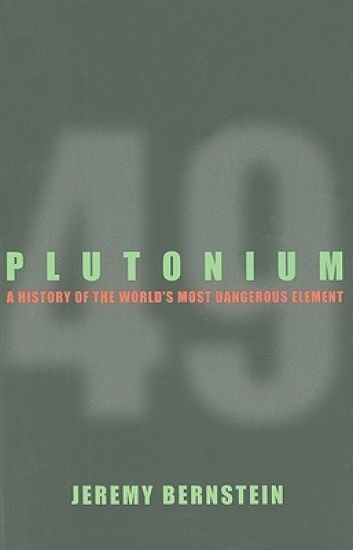
Plutonium

Plutonium

Jeremy Bernstein

Cornell University Press
2009
pokkari
When plutonium was first manufactured at Berkeley in the spring of 1941, there was so little of it that it was not visible to the naked eye. It took a year to accumulate enough so that one could actually see it. Now so much has been produced that we don't know what to do to get rid of it. We have created a monster.The history of plutonium is as strange as the element itself. When scientists began looking for it, they did so simply in the spirit of inquiry, not certain whether there were still spots to fill on the periodic table. But the discovery of fission made it clear that this still-hypothetical element would be more than just a scientific curiosity—it could be the main ingredient of a powerful nuclear weapon. As it turned out, it is good for almost nothing else. Plutonium's nuclear potential put it at the heart of the World War II arms race—the Russians found out about it through espionage, the Germans through independent research, and everybody wanted some. Now it is warehoused around the world—the United States alone possesses about forty-seven metric tons—but it has almost no practical use outside its role in nuclear weaponry. How did the product of scientific curiosity become such a dangerous burden?In his history of this complex and dangerous element, noted physicist Jeremy Bernstein describes the steps that were taken to transform plutonium from a laboratory novelty into the nuclear weapon that destroyed Nagasaki. This is the first book to weave together the many strands of plutonium's story, explaining not only the science but also the people involved.
Physicists on Wall Street and Other Essays on Science and Society

Physicists on Wall Street and Other Essays on Science and Society

Jeremy Bernstein

Springer-Verlag New York Inc.
2010
nidottu
Over the years, Jeremy Bernstein has been in contact with many of the world’s most renowned physicists and other scientists, many of whom were involved in politics, literature, and language. In this diverse collection of essays, he reflects on their work, their personal relationships, their motives, and their contributions. Even for those people he writes about that he did not know personally, he provides important insights into their lives and work, and questions their character, their decisions, and the lives they led. In the first three essays, Professor Bernstein looks at economic theory and how some physicists who developed interesting economic models based on derivatives and hedge funds almost led to the country into bankruptcy. In later essays, he discusses a suspect visit to Poland by the great Heisenberg during the Nazi era, a visit that there is almost nothing written about. Included also are essays on ancient languages and a nuclear weapons program in South Africa that was supposedly dismantled. In one particularly humorous essay, he describes how an ill-conceived manned spaceship to be powered by an atomic bomb was being developed by some of the country’s most powerful intellects. The project never got off the ground. Dipping into these pages is like rummaging around in the mind of a genius who has a potpourri of interests and an abundance of fascinating experiences. Bernstein has not only rubbed elbows with some of the finest minds in world, he has worked and played with them. He has sometimes mourned with them and laughed at them. His sharp wit and even sharper analysis make for a fascinating read.
Secrets of the Old One

Secrets of the Old One

Jeremy Bernstein

Copernicus Books
2014
nidottu
Beginning on the 18th of March, 1905,at approximately eight week intervals, the noted German physics journal Annalen der Physik received three hand-written manuscripts from a relatively unknown patent examiner in Bern. The patent examiner was the twenty-six year old Albert Einstein and the three papers would set the agenda for twentieth century physics. A fourth short paper was received by the journal on the 27th of September. It contained Einstein's derivation of the formula E=mc2. These papers with their many technological ramifications changed our lives in the twentieth century and beyond. While to a professional physicist the mathematics in these papers is quite straight forward, the ideas behind the mathematics are not. In fact, none of Einstein's contemporaries fully understood what he had done. The goal of this book is to make these ideas accessible to a general reader with no more mathematics than one learns in high school. PRAISE FOR BOOK: "With wonderfully chosen digressions and some sophisticated physics plus the minimum amount of math to support it, Jeremy Bernstein has produced a charming account of Einstein’s epoch-making papers of 1905. Here is surely the thinking person’s guide to Einstein’s ‘Miracle Year." —Owen Gingerich, Harvard-Smithsonian Center for Astrophysics, Author, The Book Nobody Read: Chasing the Revolutions of Nicolaus Copernicus "Why are physicists celebrating the centenary of Einstein’s miracle year? In this gem of a book—and in simple words—Bernstein explains how young Albert, in that one year, set the foundation to a century of progress in physics." —Sheldon L. Glashow, Winner of the 1979 Nobel Prize inPhysics, Professor, Boston University
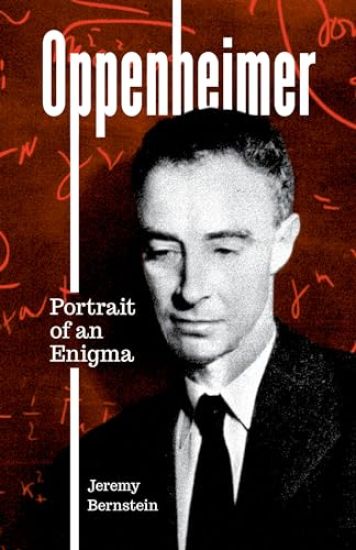
Oppenheimer: Portrait of an Enigma

Oppenheimer: Portrait of an Enigma

Jeremy Bernstein

Rowman Littlefield Publishers
2024
nidottu
The Academy Award winning motion picture Oppenheimer introduced the legendary nuclear physicist to a new generation. Oppenheimer was a puzzle to everyone. The nuclear physicist most responsible for the creation of the atomic bomb, he was a genius both scientifically and otherwise. His standards were impossibly high. He read widely in many languages, wrote poetry, and did superb science. Yet in Jeremy Bernstein's intensely interesting biographical memoir, Oppenheimer emerges as a man unsure of his identity and captive to an element of self-destructiveness in his makeup. As a former colleague of Oppenheimer's, Bernstein has composed a book that is both personal and historical, bringing the reader close to the life and workings of an extraordinary and controversial man. Filled with revealing insights and details that set the historical record straight, Oppenheimer is that rare quantity: a vastly entertaining study of one of the most important and enigmatic scientists of the atomic age.
Dawning of the Raj

Dawning of the Raj

Jeremy Bernstein

Ivan R Dee, Inc
2000
sidottu
Nothing in the history of empire is stranger than the creation of British rule in India, when a small European island became master of a subcontinent ranging from the Indian Ocean to the Himalayas. In the late eighteenth century the person most responsible for this was Warren Hastings, Britain's first governor-general of India. In Dawning of the Raj, Jeremy Bernstein brings to life in vivid colors Hastings's story amidst the rise of British power. Orphaned early, Hastings worked his way up from the lowest clerk in the East India Company to its highest office in India. His concern for native cultures led him to sponsor the first British expedition to Tibet and the first translation into English of the Bhagavadgita. Brilliant and autocratic, he also made enemies, and upon his return to England they charged him with "high crimes and misdemeanors." His impeachment trial, one of the great spectacles of the age, lasted seven years and pitted Hastings against the likes of Edmund Burke and the playwright Richard Sheridan. It attracted the novelist Fanny Burney, who wrote of it with passion in her Journals. This parliamentary drama, replete with the trappings of state, forms the conclusion to Mr. Bernstein's fascinating, unusual, and completely captivating narrative. With 22 black-and-white illustrations.