Kirjojen hintavertailu. Mukana 12 016 292 kirjaa ja 12 kauppaa.

Kirjahaku

Etsi kirjoja tekijän nimen, kirjan nimen tai ISBN:n perusteella.

32 kirjaa tekijältä Jeremy Waldron

Dignity, Rank, and Rights

Dignity, Rank, and Rights

Jeremy Waldron

Oxford University Press Inc
2015
nidottu
Writers on human dignity roughly divide between those who stress the social origins of this concept and its role in marking rank and hierarchy, and those who follow Kant in grounding dignity in an abstract and idealized philosophical conception of human beings. In these lectures, Jeremy Waldron contrives to combine attractive features of both strands. In the first lecture, Waldron presents a conception of dignity that preserves its ancient association with rank and station, thus allowing him to tap rich historical resources while avoiding what many perceive as the excessive abstraction and dubious metaphysics of the Kantian strand. At the same time he argues for a conception of human dignity that amounts to a generalization of high status across all human beings, and so attains the appealing universality of the Kantian position. The second lecture focuses particularly on the importance of dignity - understood in this way - as a status defining persons' relation to law: their presentation as persons capable of self-applying the law, capable of presenting and arguing a point of view, and capable of responding to law's demands without brute coercion. Together the two lectures illuminate the relation between dignity conceived as the ground of rights and dignity conceived as the content of rights; they also illuminate important ideas about dignity as noble bearing and dignity as the subject of a right against degrading treatment; and they help us understand the sense in which dignity is better conceived as a status than as a kind of value.
The Right to Private Property

The Right to Private Property

Jeremy Waldron

Clarendon Press
1990
nidottu
Can the right to private property be claimed as one of the `rights of mankind'? This is the central question of this comprehensive and critical examination of the subject of private property. Jeremy Waldron contrasts two types of arguments about rights: those based on historical entitlement, and those based on the importance of property to freedom. He provides a detailed discussion of the theories of property found in Locke's Second Treatise and Hegel's Philosophy of Right to illustrate this contrast. The book contains original analyses of the concept of ownership, the ideas of rights, and the relation between property and equality. The author's overriding determination throughout is to follow through the arguments and values used to justify private ownership. He finds that the traditional arguments about property yield some surprisingly radical conclusions.
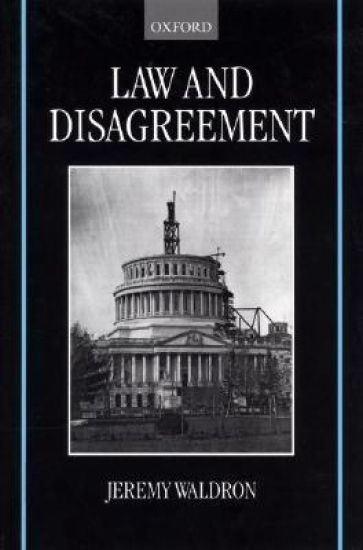
Law and Disagreement

Law and Disagreement

Jeremy Waldron

Clarendon Press
1999
sidottu
When people disagree about justice and about individual rights, how should political decisions be made among them? How should they decide about issues like tax policy, welfare provision, criminal procedure, discrimination law, hate speech, pornography, political dissent and the limits of religious toleration? The most familiar answer is that these decisions should be made democratically, by majority voting among the people or their representatives. Often, however, this answer is qualified by adding providing that the majority decision does not violate individual rights. In this book Jeremy Waldron has revisited and thoroughly revised thirteen of his most recent essays. He argues that the familiar answer is correct, but that the qualification about individual rights is incoherent. If rights are the very things we disagree about, then we are quarrelling precisely about what that qualification should amount to. At best, what it means is that disagreements about rights should be resolved by some other procedure, for example, by majority voting, not among the people or their representatives, but among judges in a court. This proposal although initially attractive seems much less agreeable when we consider that the judges too disagree about rights, and they disagree about them along exactly the same lines as the citizens. This book offers a comprehensive critique of the idea of the judicial review of legislation. The author argues that a belief in rights is not the same as a commitment to a Bill of Rights. He shows the flaws and difficulties in many common defences of the democratic character of judicial review. And he argues for an alternative approach to the problem of disagreement: when disagreements about rights arise, the respectful way to resolve them is by decision-making among the right-holders on a basis that reflects an equal respect for them as the holders of views about rights. This respect for ordinary right-holders, he argues, has been sadly lacking in the theories of justice, rights, and constitutionalism put forward in recent years by philosophers such as John Rawls and Donald Dworkin. But the book is not only about judicial review. The first tranche of essays is devoted to a theory of legislation, a theory which highlights the size, the scale and the diversity of modern legislative assemblies. Although legislation is often denigrated as a source of law, Waldron seeks to restore its tattered dignity. He deprecates the tendency to disparage legislatures and argues that such disparagement is often a way of bolstering the legitimacy of the courts, as if we had to transform our parliaments into something like the American Congress to justify importing American-style judicial reviews. Law and Disagreement redresses the balances in modern jurisprudence. It presents legislation by a representative assembly as a form of law making which is especially apt for a society whose members disagree with one another about fundamental issues of principle, for it is a form of law making that does not attempt to conceal the fact that our decisions are made and claim their authority in the midst of, not in spite of, our political and moral disagreements. This timely rights-based defence of majoritarian legislation will be welcomed by scholars of legal and political philosophy throughout the world.
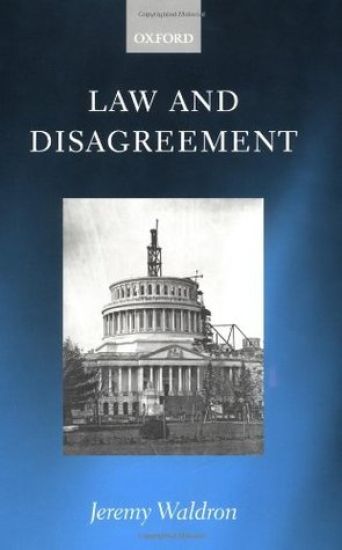
Law and Disagreement

Law and Disagreement

Jeremy Waldron

Oxford University Press
2001
nidottu
When people disagree about justice and about individual rights, how should political decisions be made among them? How should they decide about issues like tax policy, welfare provision, criminal procedure, discrimination law, hate speech, pornography, political dissent and the limits of religious toleration? The most familiar answer is that these decisions should be made democratically, by majority voting among the people or their representatives. Often, however, this answer is qualified by adding ' providing that the majority decision does not violate individual rights.' In this book Jeremy Waldron has revisited and thoroughly revised thirteen of his most recent essays. He argues that the familiar answer is correct, but that the qualification about individual rights is incoherent. If rights are the very things we disagree about, then we are quarrelling precisely about what that qualification should amount to. At best, what it means is that disagreements about rights should be resolved by some other procedure, for example, by majority voting, not among the people or their representatives, but among judges in a court. This proposal - although initially attractive - seems much less agreeable when we consider that the judges too disagree about rights, and they disagree about them along exactly the same lines as the citizens. This book offers a comprehensive critique of the idea of the judicial review of legislation. The author argues that a belief in rights is not the same as a commitment to a Bill of Rights. He shows the flaws and difficulties in many common defences of the 'democratic' character of judicial review. And he argues for an alternative approach to the problem of disagreement: when disagreements about rights arise, the respectful way to resolve them is by decision-making among the right-holders on a basis that reflects an equal respect for them as the holders of views about rights. This respect for ordinary right-holders, he argues, has been sadly lacking in the theories of justice, rights, and constitutionalism put forward in recent years by philosophers such as John Rawls and Donald Dworkin. But the book is not only about judicial review. The first tranche of essays is devoted to a theory of legislation, a theory which highlights the size, the scale and the diversity of modern legislative assemblies. Although legislation is often denigrated as a source of law, Waldron seeks to restore its tattered dignity. He deprecates the tendency to disparage legislatures and argues that such disparagement is often a way of bolstering the legitimacy of the courts, as if we had to transform our parliaments into something like the American Congress to justify importing American-style judicial reviews. Law and Disagreement redresses the balances in modern jurisprudence. It presents legislation by a representative assembly as a form of law making which is especially apt for a society whose members disagree with one another about fundamental issues of principle, for it is a form of law making that does not attempt to conceal the fact that our decisions are made and claim their authority in the midst of, not in spite of, our political and moral disagreements. This timely rights-based defence of majoritarian legislation will be welcomed by scholars of legal and political philosophy throughout the world.

Torture, Terror, and Trade-Offs

Torture, Terror, and Trade-Offs

Jeremy Waldron

Oxford University Press
2010
sidottu
Jeremy Waldron has been a challenging and influential voice in the moral, political and legal debates surrounding the response to terrorism since 9/11. His contributions have spanned the major controversies of the War on Terror - including the morality and legality of torture, whether security can be 'balanced' with liberty, and the relationship between public safety and individual rights. He has also tackled underlying questions essential to understanding the practical debates - including what terrorism is, and what a right to security would entail. This volume collects all Waldron's work on these issues, including six published essays and two previously unpublished essays. It also includes a new introduction in which Waldron presents an overview of his contribution, and looks at the problems currently facing the Obama administration and the UK Government in dealing with the legacy of the Bush White House. The volume will be essential reading for all those engaged with contemporary politics, security law, and the continuing struggle for an ethical response to terrorism.
Torture, Terror, and Trade-Offs

Torture, Terror, and Trade-Offs

Jeremy Waldron

Oxford University Press
2012
nidottu
Jeremy Waldron has been a challenging and influential voice in the moral, political and legal debates surrounding the response to terrorism since 9/11. His contributions have spanned the major controversies of the War on Terror - including the morality and legality of torture, whether security can be 'balanced' with liberty, and the relationship between public safety and individual rights. He has also tackled underlying questions essential to understanding the practical debates - including what terrorism is, and what a right to security would entail. This volume collects all Waldron's work on these issues, including six published essays and two previously unpublished essays. It also includes a new introduction in which Waldron presents an overview of his contribution, and looks at the problems currently facing the Obama administration and the UK Government in dealing with the legacy of the Bush White House. The volume will be essential reading for all those engaged with contemporary politics, security law, and the continuing struggle for an ethical response to terrorism.
Dignity, Rank, and Rights

Dignity, Rank, and Rights

Jeremy Waldron

Oxford University Press Inc
2012
sidottu
Writers on human dignity roughly divide between those who stress the social origins of this concept and its role in marking rank and hierarchy, and those who follow Kant in grounding dignity in an abstract and idealized philosophical conception of human beings. In these lectures, Jeremy Waldron contrives to combine attractive features of both strands. In the first lecture, Waldron presents a conception of dignity that preserves its ancient association with rank and station, thus allowing him to tap rich historical resources while avoiding what many perceive as the excessive abstraction and dubious metaphysics of the Kantian strand. At the same time he argues for a conception of human dignity that amounts to a generalization of high status across all human beings, and so attains the appealing universality of the Kantian position. The second lecture focuses particularly on the importance of dignity - understood in this way - as a status defining persons' relation to law: their presentation as persons capable of self-applying the law, capable of presenting and arguing a point of view, and capable of responding to law's demands without brute coercion. Together the two lectures illuminate the relation between dignity conceived as the ground of rights and dignity conceived as the content of rights; they also illuminate important ideas about dignity as noble bearing and dignity as the subject of a right against degrading treatment; and they help us understand the sense in which dignity is better conceived as a status than as a kind of value.
"Partly Laws Common to All Mankind"

"Partly Laws Common to All Mankind"

Jeremy Waldron

Yale University Press
2012
sidottu
Should judges in United States courts be permitted to cite foreign laws in their rulings? In this book Jeremy Waldron explores some ideas in jurisprudence and legal theory that could underlie the Supreme Court’s occasional recourse to foreign law, especially in constitutional cases. He argues that every society is governed not only by its own laws but partly also by laws common to all mankind (ius gentium). But he takes the unique step of arguing that this common law is not natural law but a grounded consensus among all nations. The idea of such a consensus will become increasingly important in jurisprudence and public affairs as the world becomes more globalized.
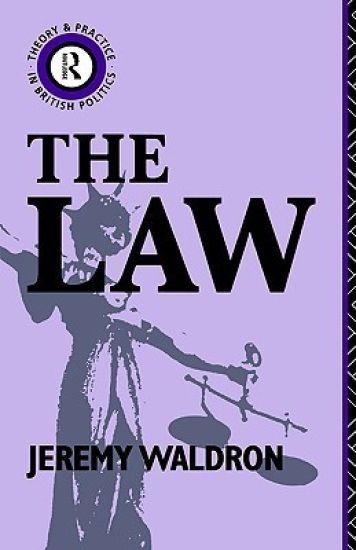
The Law

The Law

Jeremy Waldron

Routledge
1990
nidottu
An examination of legal theory which aims to bring issues to life by relating them to real problems in British politics. Topics discussed include human rights, the rule of law, the unwritten constitution, the role of judges, law and politics, and civil disobedience.
Liberal Rights

Liberal Rights

Jeremy Waldron

Cambridge University Press
1993
pokkari
This volume brings together a wide-ranging collection of the papers written by Jeremy Waldron, one of the most internationally respected political theorists writing today. The main focus of the collection is on substantive issues in modern political philosophy. The first six chapters deal with freedom, toleration and neutrality and argue for a robust conception of liberty. Waldron defends the idea that people have a right to act in ways others disapprove of, and that the state should be neutral vis-á-vis religious and ethical systems. The chapters that follow are concerned with socio-economic rights. Waldron argues that poverty and homelessness are not to be understood apart from the value of freedom. On the contrary our moral response to them should be based on the same values that underlie traditional liberal philosophy.
The Dignity of Legislation

The Dignity of Legislation

Jeremy Waldron

Cambridge University Press
1999
sidottu
Jeremy Waldron here attempts to restore the good name of legislation in political theory. Focused in particular on the writings of Aristotle, Locke and Kant, this book recovers and highlights ways of thinking about legislation that present it as a dignified mode of governance and a respectable source of law. The focus is particularly on legislation by assemblies, large gatherings of representatives who air their disagreements in ferocious debate and make laws by deliberation and voting. Jeremy Waldron has published extensively in law, philosophy and political theory. Here he presents a unique study of the place of legislation in the canon of political thought - a study which emphasises the positive features of democracy and representative assemblies. The Dignity of Legislation is original in conception, trenchantly argued and very clearly presented, and will be of interest to a wide range of scholars and thinkers.
The Dignity of Legislation

The Dignity of Legislation

Jeremy Waldron

Cambridge University Press
1999
pokkari
Jeremy Waldron here attempts to restore the good name of legislation in political theory. Focused in particular on the writings of Aristotle, Locke and Kant, this book recovers and highlights ways of thinking about legislation that present it as a dignified mode of governance and a respectable source of law. The focus is particularly on legislation by assemblies, large gatherings of representatives who air their disagreements in ferocious debate and make laws by deliberation and voting. Jeremy Waldron is Professor of Law at Columbia University; he has published extensively in law, philosophy and political theory. He presents a unique study of the place of legislation in the canon of political thought - a study which emphasises the positive features of democracy and representative assemblies. The Dignity of Legislation is original in conception, trenchantly argued and very clearly presented, and will be of interest to a wide range of scholars and thinkers.
God, Locke, and Equality

God, Locke, and Equality

Jeremy Waldron

Cambridge University Press
2002
sidottu
This is a concise and profound book from one of the world's leading political and legal philosophers about a major theme, equality, and the proposition that humans are all one another's equals. Jeremy Waldron explores the implications of this fundamental tenet for law, politics, society and economy in the company of John Locke, whose work Waldron regards 'as well-worked-out a theory of basic equality as we have in the canon of political philosophy'. Throughout the text, which is based on the Carlyle Lectures given in Oxford in 1999, Jeremy Waldron discusses contemporary approaches to equality and rival interpretations of Locke, and this dual agenda gives the whole an unusual degree of accessibility and intellectual excitement, of interest to philosophers, political theorists, lawyers and theologians around the world.
God, Locke, and Equality

God, Locke, and Equality

Jeremy Waldron

Cambridge University Press
2002
pokkari
This is a concise and profound book from one of the world’s leading political and legal philosophers about a major theme, equality, and the proposition that humans are all one another’s equals. Jeremy Waldron explores the implications of this fundamental tenet for law, politics, society and economy in the company of John Locke, whose work Waldron regards ‘as well-worked-out a theory of basic equality as we have in the canon of political philosophy’. Throughout the text, which is based on the Carlyle Lectures given in Oxford in 1999, Jeremy Waldron discusses contemporary approaches to equality and rival interpretations of Locke, and this dual agenda gives the whole an unusual degree of accessibility and intellectual excitement, of interest to philosophers, political theorists, lawyers and theologians around the world.
Thoughtfulness and the Rule of Law

Thoughtfulness and the Rule of Law

Jeremy Waldron

HARVARD UNIVERSITY PRESS
2023
sidottu
An essential study of the rule of law by one of the world’s leading liberal political and legal philosophers.The meaning and value of the rule of law have been debated since antiquity. For many, the rule of law has become the essence of good government. But Jeremy Waldron takes a different view, arguing that it is but one star in a constellation of ideals that define our political morality, ranking alongside democracy, human rights, economic freedom, and social justice.This timely essay collection, from one of the most respected political philosophers of his generation, is a brief on behalf of thoughtfulness: the intervention of human intelligence in the application of law. Waldron defends thoughtfulness against the claim that it threatens to replace the rule of law with the arbitrary rule of people. To the contrary, he argues, the rule of law requires thoughtfulness: it is impossible to apply a standard such as “reasonableness” on the basis of rules alone, and common legal activities like arguing in court and reasoning from precedents are poorly served by algorithmic logics. This rich compilation also addresses the place of law in protecting human dignity, the relation between rule of law and legislation, and whether vagueness in the law is at odds with law’s role in guiding action.Thoughtfulness and the Rule of Law emphasizes the value of procedures rather than the substance or outcome of legal decisions. Challenging the view that predictability and clarity are cardinal virtues, Waldron shows that real-world controversies often are best approached using a relatively thin concept of the rule of law, together with the thoughtfulness that a legal system frames and enables.
Thoughtfulness and the Rule of Law

Thoughtfulness and the Rule of Law

Jeremy Waldron

HARVARD UNIVERSITY PRESS
2026
nidottu
Political theorist Jeremy Waldron makes a bracing case against identifying rule of law with predictability. Seeing the rule of law as just one value to which democracies aspire, he embraces thoughtfulness rather than rote rule-following, flexibility even at the cost of vagueness, and emphasizing procedure and argument over predictable outcomes.
The Harm in Hate Speech

The Harm in Hate Speech

Jeremy Waldron

Harvard University Press
2014
nidottu
Every liberal democracy has laws or codes against hate speech—except the United States. For constitutionalists, regulation of hate speech violates the First Amendment and damages a free society. Against this absolutist view, Jeremy Waldron argues powerfully that hate speech should be regulated as part of our commitment to human dignity and to inclusion and respect for members of vulnerable minorities.Causing offense—by depicting a religious leader as a terrorist in a newspaper cartoon, for example—is not the same as launching a libelous attack on a group’s dignity, according to Waldron, and it lies outside the reach of law. But defamation of a minority group, through hate speech, undermines a public good that can and should be protected: the basic assurance of inclusion in society for all members. A social environment polluted by anti-gay leaflets, Nazi banners, and burning crosses sends an implicit message to the targets of such hatred: your security is uncertain and you can expect to face humiliation and discrimination when you leave your home.Free-speech advocates boast of despising what racists say but defending to the death their right to say it. Waldron finds this emphasis on intellectual resilience misguided and points instead to the threat hate speech poses to the lives, dignity, and reputations of minority members. Finding support for his view among philosophers of the Enlightenment, Waldron asks us to move beyond knee-jerk American exceptionalism in our debates over the serious consequences of hateful speech.
One Another’s Equals

One Another’s Equals

Jeremy Waldron

The Belknap Press
2017
sidottu
An enduring theme of Western philosophy is that we are all one another’s equals. Yet the principle of basic equality is woefully under-explored in modern moral and political philosophy. In a major new work, Jeremy Waldron attempts to remedy that shortfall with a subtle and multifaceted account of the basis for the West’s commitment to human equality.What does it mean to say we are all one another’s equals? Is this supposed to distinguish humans from other animals? What is human equality based on? Is it a religious idea, or a matter of human rights? Is there some essential feature that all human beings have in common? Waldron argues that there is no single characteristic that serves as the basis of equality. He says the case for moral equality rests on four capacities that all humans have the potential to possess in some degree: reason, autonomy, moral agency, and the ability to love. But how should we regard the differences that people display on these various dimensions? And what are we to say about those who suffer from profound disability—people whose claim to humanity seems to outstrip any particular capacities they have along these lines?Waldron, who has worked on the nature of equality for many years, confronts these questions and others fully and unflinchingly. Based on the Gifford Lectures that he delivered at the University of Edinburgh in 2015, One Another’s Equals takes Waldron’s thinking further and deeper than ever before.
Political Political Theory

Political Political Theory

Jeremy Waldron

Harvard University Press
2016
sidottu
Political institutions are the main subject of political theory—or they ought to be. Making the case with his trademark forcefulness and intellectual aplomb, Jeremy Waldron argues in favor of reorienting the theory of politics toward the institutions and institutional principles of modern democracy and the mechanisms through which democratic ideals are achieved.Too many political theorists are preoccupied with analyzing the nature and importance of justice, liberty, and equality, at the cost of ignoring the governmental institutions needed to achieve them. By contrast, political scientists have kept institutions in view, but they deploy a meager set of value-conceptions in evaluating them. Reflecting on an array of issues about constitutional structure, Waldron considers the uses and abuses of diverse institutions and traditions, from separation of powers and bicameralism to judicial review of legislation, the principle of loyal opposition, the nature of representation, political accountability, and the rule of law. He refines his well-known argument about the undemocratic character of judicial review, providing a capacious perspective on the proper role of courts in a constitutional democracy, and he offers an illuminating critique of the contrasting political philosophies of Hannah Arendt and Isaiah Berlin.Even if political theorists remain fixated on expounding the philosophical foundations of democracy, they need to complement their work with a firmer grasp of the structures through which democracy is realized. This is what political political theory means: theory addressing itself to the way political institutions frame political disagreements and orchestrate resolutions to our disputes over social ideals.
The Rule of Law and the Measure of Property

The Rule of Law and the Measure of Property

Jeremy Waldron

Cambridge University Press
2012
sidottu
When property rights and environmental legislation clash, what side should the Rule of Law weigh in on? It is from this point that Jeremy Waldron explores the Rule of Law both from an historical perspective - considering the property theory of John Locke - and from the perspective of modern legal controversies. This critical and direct account of the relation between the Rule of Law and the protection of private property criticizes the view - associated with the 'World Bank model' of investor expectations - that a society which fails to protect property rights against legislative restriction is failing to support the Rule of Law. In this book, developed from the 2011 Hamlyn Lectures, Waldron rejects the idea that the Rule of Law privileges property rights over other forms of law and argues instead that the Rule of Law should endorse and applaud the use of legislation to achieve valid social objectives.