Kirjojen hintavertailu. Mukana 12 454 878 kirjaa ja 12 kauppaa.

Kirjahaku

Etsi kirjoja tekijän nimen, kirjan nimen tai ISBN:n perusteella.

15 kirjaa tekijältä Jerome Bruner

The Relevance of Education

The Relevance of Education

Jerome Bruner

WW Norton Co
1971
nidottu
Since education takes place under conditions imposed by a technological society, Professor Bruner maintains that it is not enough to attempt reform through minor curriculum revisions. The program that fails to set knowledge within the context of action must be replaced. And to be truly relevant to our social needs, the scope of education must be extended toward overcoming the severe handicaps faced by children from impoverished areas.
Acts of Meaning

Acts of Meaning

Jerome Bruner

Harvard University Press
1993
nidottu
Jerome Bruner argues that the cognitive revolution, with its current fixation on mind as “information processor,” has led psychology away from the deeper objective of understanding mind as a creator of meanings. Only by breaking out of the limitations imposed by a computational model of mind can we grasp the special interaction through which mind both constitutes and is constituted by culture.
Actual Minds, Possible Worlds

Actual Minds, Possible Worlds

Jerome Bruner

Harvard University Press
1987
nidottu
In this characteristically graceful and provocative book, Jerome Bruner, one of the principal architects of the cognitive revolution, sets forth nothing less than a new agenda for the study of mind. According to Professor Bruner, cognitive science has set its sights too narrowly on the logical, systematic aspects of mental life—those thought processes we use to solve puzzles, test hypotheses, and advance explanations. There is obviously another side to the mind—a side devoted to the irrepressibly human acts of imagination that allow us to make experience meaningful. This is the side of the mind that leads to good stories, gripping drama, primitive myths and rituals, and plausible historical accounts. Bruner calls it the “narrative mode,” and his book makes important advances in the effort to unravel its nature.Drawing on recent work in literary theory, linguistics, and symbolic anthropology, as well as cognitive and developmental psychology, Professor Bruner examines the mental acts that enter into the imaginative creation of possible worlds, and he shows how the activity of imaginary world making undergirds human science, literature, and philosophy, as well as everyday thinking, and even our sense of self.Over twenty years ago, Jerome Bruner first sketched his ideas about the mind’s other side in his justly admired book, On Knowing: Essays for the Left Hand. Actual Minds, Possible Worlds can be read as a sequel to this earlier work, but it is a sequel that goes well beyond its predecessor by providing rich examples of just how the mind’s narrative mode can be successfully studied. The collective force of these examples points the way toward a more humane and subtle approach to the investigation of how the mind works.
Making Stories

Making Stories

Jerome Bruner

Harvard University Press
2003
nidottu
Stories pervade our daily lives, from human interest news items, to a business strategy described to a colleague, to daydreams between chores. Stories are what we use to make sense of the world. But how does this work? In Making Stories, the eminent psychologist Jerome Bruner examines this pervasive human habit and suggests new and deeper ways to think about how we use stories to make sense of lives and the great moral and psychological problems that animate them. Looking at legal cases and autobiography as well as literature, Bruner warns us not to be seduced by overly tidy stories and shows how doubt and double meaning can lie beneath the most seemingly simple case.
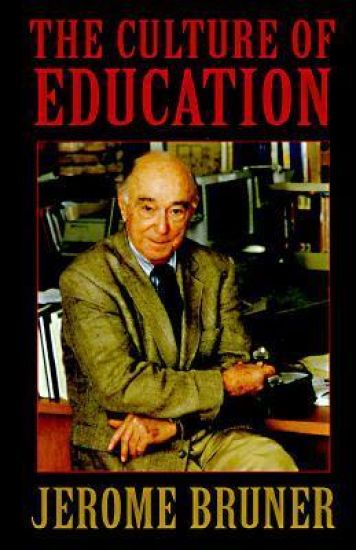
The Culture of Education

The Culture of Education

Jerome Bruner

Harvard University Press
1997
nidottu
What we don't know about learning could fill a book--and it might be a schoolbook. In a masterly commentary on the possibilities of education, the eminent psychologist Jerome Bruner reveals how education can usher children into their culture, though it often fails to do so. Applying the newly emerging "cultural psychology" to education, Bruner proposes that the mind reaches its full potential only through participation in the culture--not just its more formal arts and sciences, but its ways of perceiving, thinking, feeling, and carrying out discourse. By examining both educational practice and educational theory, Bruner explores new and rich ways of approaching many of the classical problems that perplex educators.Education, Bruner reminds us, cannot be reduced to mere information processing, sorting knowledge into categories. Its objective is to help learners construct meanings, not simply to manage information. Meaning making requires an understanding of the ways of one's culture--whether the subject in question is social studies, literature, or science. The Culture of Education makes a forceful case for the importance of narrative as an instrument of meaning making. An embodiment of culture, narrative permits us to understand the present, the past, and the humanly possible in a uniquely human way.Going well beyond his earlier acclaimed books on education, Bruner looks past the issue of achieving individual competence to the question of how education equips individuals to participate in the culture on which life and livelihood depend. Educators, psychologists, and students of mind and culture will find in this volume an unsettling criticism that challenges our current conventional practices--as well as a wise vision that charts a direction for the future.
On Knowing

On Knowing

Jerome Bruner

The Belknap Press
1979
nidottu
The left hand has traditionally represented the powers of intuition, feeling, and spontaneity. In this classic book, Jerome Bruner inquires into the part these qualities play in determining how we know what we do know; how we can help others to know—that is, to teach; and how our conception of reality affects our actions and is modified by them.The striking and subtle discussions contained in On Knowing take on the core issues concerning man’s sense of self: creativity, the search for identity, the nature of aesthetic knowledge, myth, the learning process, and modern-day attitudes toward social controls, Freud, and fate. In this revised, expanded edition, Bruner comments on his personal efforts to maintain an intuitively and rationally balanced understanding of human nature, taking into account the odd historical circumstances which have hindered academic psychology’s attempts in the past to know man.Writing with wit, imagination, and deep sympathy for the human condition, Jerome Bruner speaks here to the part of man’s mind that can never be completely satisfied by the right-handed virtues of order, rationality, and discipline.
Toward a Theory of Instruction

Toward a Theory of Instruction

Jerome Bruner

The Belknap Press
1974
nidottu
This country’s most challenging writer on education presents here a distillation, for the general reader, of half a decade’s research and reflection. His theme is dual: how children learn, and how they can best be helped to learn—how they can be brought to the fullest realization of their capacities.Jerome Bruner, Harper’s reports, has “stirred up more excitement than any educator since John Dewey.” His explorations into the nature of intellectual growth and its relation to theories of learning and methods of teaching have had a catalytic effect upon educational theory. In this new volume the subjects dealt with in The Process of Education are pursued further, probed more deeply, given concrete illustration and a broader context.“One is struck by the absence of a theory of instruction as a guide to pedagogy,” Mr. Bruner observes; “in its place there is principally a body of maxims.” The eight essays in this volume, as varied in topic as they are unified in theme, are contributions toward the construction of such a theory. What is needed in that enterprise is, inter alia, “the daring and freshness of hypotheses that do not take for granted as true what has merely become habitual,” and these are amply evidenced here.At the conceptual core of the book is an illuminating examination of how mental growth proceeds, and of the ways in which teaching can profitably adapt itself to that progression and can also help it along. Closely related to this is Mr. Bruner’s “evolutionary instrumentalism,” his conception of instruction as the means of transmitting the tools and skills of a culture, the acquired characteristics that express and amplify man’s powers—especially the crucial symbolic tools of language, number, and logic. Revealing insights are given into the manner in which language functions as an instrument of thought.The theories presented are anchored in practice, in the empirical research from which they derive and in the practical applications to which they can be put. The latter are exemplified incidentally throughout and extensively in detailed descriptions of two courses Mr. Bruner has helped to construct and to teach—an experimental mathematics course and a multifaceted course in social studies. In both, the students’ encounters with the material to be mastered are structured and sequenced in such a way as to work with, and to reinforce, the developmental process.Written with all the style and élan that readers have come to expect of Mr. Bruner, Toward a Theory of Instruction is charged with the provocative suggestions and inquiries of one of the great innovators in the field of education.
Uddannelseskulturen

Uddannelseskulturen

Jerome Bruner

Gyldendal
2004
nidottu
Den bredt anerkendte amerikanske psykolog Jerome Bruner udfolder heri hele sin vidtrækkende viden om uddannelsens vilkår i vor moderne kultur. Bruner viser, hvordan børn - og dermed også uddannelsen af dem - kun når deres fulde potentiale ved at deltage fuldt ud i kulturen. Ikke bare i kulturens mere formelle sider, men i selve kulturens måde at forstå sig selv på, at tænke på, at føle og samtale på. Gennem undersøgelser af uddannelse i praksis og af teorier om uddannelse kommer Bruner frem til nye og berigende måder at angribe de klassiske problemer på. Bruners pædagogiske grundsyn og hans fastholdelse af kulturpsykologien som et legitimt fagområde under stadig udvikling er en udfordring for alle undervisere. Jerome Bruner, Research Professor of Psychology og Senior Research Fellow in Law ved New York University er forfatter til en lang række anerkendte bøger om uddannelse, hvoraf nogle er oversat til dansk.
Kulturens väv : utbildning i kulturpsykologisk belysning
Kulturens väv är en essäsamling om utbildning. Men den begränsar sig inte till utbildning i vanlig bemärkelse – den handlar inte bara om skolor och klassrum. Skolgången utgör ju bara en liten del av kulturens sätt att leda in de unga på de rätta eller kanoniserade banorna. Skolgången kan till och med kollidera med kulturens andra sätt att få de unga att följa kulturens krav och normer. Vi lever i en föränderlig tid som präglas av stora förväntningar om vad skolan bör »göra» för dem som väljer eller tvingas att gå där – eller vad skolan kan göra med tanke på de andra krafter som omger den. Ska skolan bara inrikta sig på att reproducera kulturen och »assimilera» de unga till att bli små svenskar eller amerikaner. Eller bör den snarare hänge sig åt de omtumlande förhållanden som vi genomlever ? hänge sig åt det något riskfyllda och kanske smått idealistiska målet att förbereda eleverna så att de kan hantera den föränderliga värld de ska leva i? Och på vilket sätt ska vi kunna avgöra hur denna föränderliga värld kommer att se ut och vad den kommer att kräva av dem? Detta är inte längre några abstrakta frågor.
The Freudian Metaphor

The Freudian Metaphor

Donald P. Spence; Jerome Bruner

WW Norton Co
2007
nidottu
Until recently, psychoanalysis has been a most reluctant recipient of the new inheritance. For most of its century-long life it has clung to the positivist epistemology of Freud, its founding genius, belying his hope that his followers would be as skeptical about received wisdom in their time as he was in his. Psychoanalysis has protected itself from change by preserving its store of founding metaphors in their original form.
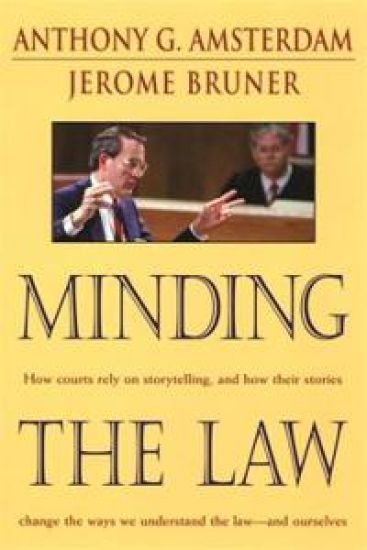
Minding the Law

Minding the Law

Anthony G. Amsterdam; Jerome Bruner

Harvard University Press
2002
nidottu
In this remarkable collaboration, one of the nation's leading civil rights lawyers joins forces with one of the world's foremost cultural psychologists to put American constitutional law into an American cultural context. By close readings of key Supreme Court opinions, they show how storytelling tactics and deeply rooted mythic structures shape the Court's decisions about race, family law, and the death penalty.Minding the Law explores crucial psychological processes involved in the work of lawyers and judges: deciding whether particular cases fit within a legal rule ("categorizing"), telling stories to justify one's claims or undercut those of an adversary ("narrative"), and tailoring one's language to be persuasive without appearing partisan ("rhetorics"). Because these processes are not unique to the law, courts' decisions cannot rest solely upon legal logic but must also depend vitally upon the underlying culture's storehouse of familiar tales of heroes and villains.But a culture's stock of stories is not changeless. Amsterdam and Bruner argue that culture itself is a dialectic constantly in progress, a conflict between the established canon and newly imagined "possible worlds." They illustrate the swings of this dialectic by a masterly analysis of the Supreme Court's race-discrimination decisions during the past century.A passionate plea for heightened consciousness about the way law is practiced and made, Minding the Law will be welcomed by a new generation concerned with renewing law's commitment to a humane justice.
Constructing Panic

Constructing Panic

Lisa Capps; Elinor Ochs; Jerome Bruner

Harvard University Press
1997
nidottu
Meg Logan has not been farther than two miles from home in six years. She has agoraphobia, a debilitating anxiety disorder that entraps its sufferers in the fear of leaving safe havens such as home. Paradoxically, while at this safe haven, agoraphobics spend much of their time ruminating over past panic experiences and imagining similar hypothetical situations. In doing so, they create a narrative that both describes their experience and locks them into it.Constructing Panic offers an unprecedented analysis of one patient's experience of agoraphobia. In this novel interdisciplinary collaboration between a clinical psychologist and a linguist, the authors probe Meg's stories for constructions of emotions, actions, and events. They illustrate how Meg uses grammar and narrative structure to create and recreate emotional experiences that maintain her agoraphobic identity.In this work Capps and Ochs propose a startling new view of agoraphobia as a communicative disorder. Constructing Panic opens up the largely overlooked potential for linguistic and narrative analysis by revealing the roots of panic and by offering a unique framework for therapeutic intervention. Readers will find in these pages hope for managing panic through careful attention to how we tell the story of our lives.
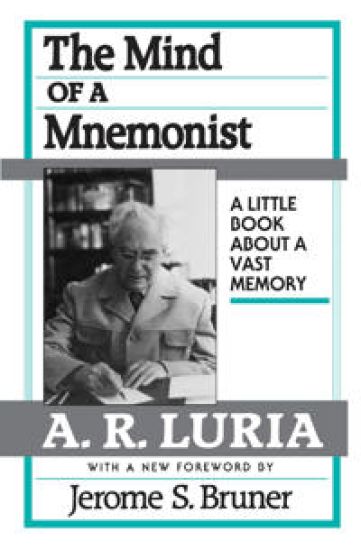
The Mind of a Mnemonist

The Mind of a Mnemonist

A. R. Luria; Jerome Bruner

Harvard University Press
1987
nidottu
This study explores the inner world of a rare human phenomenon—a man who was endowed with virtually limitless powers of memory. From his intimate knowledge of S., the mnemonist, gained from conversations and testing over a period of almost thirty years, A. R. Luria is able to reveal in rich detail not only the obvious strengths of S.’s astonishing memory but also his surprising weaknesses: his crippling inability to forget, his pattern of reacting passively to life, and his uniquely handicapped personality.