Kirjojen hintavertailu. Mukana 11 342 296 kirjaa ja 12 kauppaa.

Kirjahaku

Etsi kirjoja tekijän nimen, kirjan nimen tai ISBN:n perusteella.

3 kirjaa tekijältä Jerrold M. Sadock

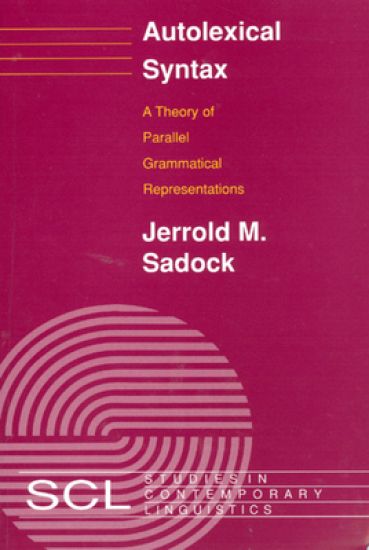
Autolexical Syntax

Autolexical Syntax

Jerrold M. Sadock

University of Chicago Press
1990
sidottu
In Autolexical Syntax, Jerrold M. Sadock argues for a radical departure from the derivational model of grammar that has prevailed in linguistics for thirty years. He offers an alternative theory in which the various components of grammar—in particular syntax, semantics, and morphology—are viewed as fully autonomous descriptive devices for various parallel dimensions of linguistic representation. The lexicon in this theory forges the connection between autonomous representations in that a typical lexeme plays a role in all three of the major components of the grammar. Sadock's principal innovation is the postulation of a uniform set of interface conditions that require the several orthogonal representations of a single natural language expression to match up in certain ways. Through a detailed application of his theory to the twin morphosyntactic problems of cliticization and incorporation, Sadock shows that very straightforward accounts are made possible by the nonderivational model. He demonstrates the empirical success of these accounts by examining more than two dozen morphosyntactic problems in almost as many languages. Autolexical Syntax will be of interest to those in the fields of theoretical grammar, particularly concerned with the problems of morphology and syntax, as well as philosophers of language, logicians, lexicographers, psychologists of language, and computer scientists.
Autolexical Syntax

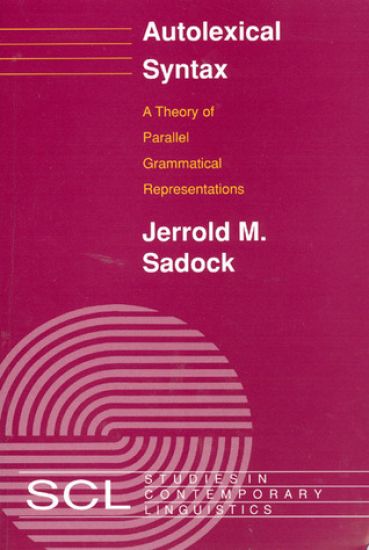
Autolexical Syntax

Jerrold M. Sadock

University of Chicago Press
1990
nidottu
In Autolexical Syntax, Jerrold M. Sadock argues for a radical departure from the derivational model of grammar that has prevailed in linguistics for thirty years. He offers an alternative theory in which the various components of grammar—in particular syntax, semantics, and morphology—are viewed as fully autonomous descriptive devices for various parallel dimensions of linguistic representation. The lexicon in this theory forges the connection between autonomous representations in that a typical lexeme plays a role in all three of the major components of the grammar. Sadock's principal innovation is the postulation of a uniform set of interface conditions that require the several orthogonal representations of a single natural language expression to match up in certain ways. Through a detailed application of his theory to the twin morphosyntactic problems of cliticization and incorporation, Sadock shows that very straightforward accounts are made possible by the nonderivational model. He demonstrates the empirical success of these accounts by examining more than two dozen morphosyntactic problems in almost as many languages. Autolexical Syntax will be of interest to those in the fields of theoretical grammar, particularly concerned with the problems of morphology and syntax, as well as philosophers of language, logicians, lexicographers, psychologists of language, and computer scientists.
The Modular Architecture of Grammar

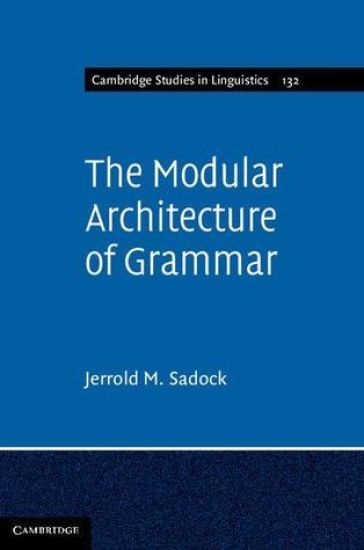
The Modular Architecture of Grammar

Jerrold M. Sadock

Cambridge University Press
2012
sidottu
Modular grammar postulates several autonomous generative systems interacting with one another as opposed to the prevailing theory of transformational grammar where there is a single generative component – the syntax – from which other representations are derived. In this book Jerrold Sadock develops his influential theory of grammar, formalizing several generative modules that independently characterize the levels of syntax, semantics, role structure, morphology and linear order, as well as an interface system that connects them. Multi-modular grammar provides simpler, more intuitive analyses of grammatical phenomena and allows for greater empirical coverage than prevailing styles of grammar. The book illustrates this with a wide-ranging analysis of English grammatical phenomena, including raising, control, passive, inversion, do-support, auxiliary verbs and ellipsis. The modules are simple enough to be cast as phrase structure grammars and are presented in sufficient detail to make descriptions of grammatical phenomena more explicit than the approximate accounts offered in other studies.