Kirjojen hintavertailu. Mukana 11 244 527 kirjaa ja 12 kauppaa.

Kirjahaku

Etsi kirjoja tekijän nimen, kirjan nimen tai ISBN:n perusteella.

10 kirjaa tekijältä Jerry A. Fodor

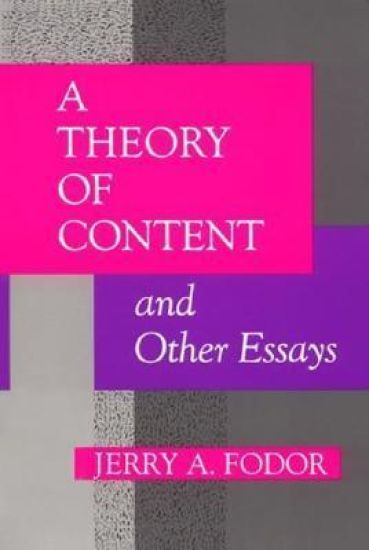
A Theory of Content and Other Essays

A Theory of Content and Other Essays

Jerry A. Fodor

Bradford Books
1992
pokkari
This collection of new and previously published essays reflects the major research and thought of one of today's preeminent philosophers of mind.This collection of new and previously published essays reflects the major research and thought of one of today's preeminent philosophers of mind. The first seven essays are philosophical pieces that focus on mental representation and the foundations of intentionality; these are followed by four psychological essays on cognitive architecture. In his eloquent introduction Fodor shows how the two areas are thematically united and epistemologically related, highlighting his concern in finding alternatives to holistic accounts of mental content. Fodor's philosophical essays develop an informational view of semantics that offers the possibility of atomism about meaning; his psychological essays present a modular view of cognitive architecture that offers the possibility of atomism about perception. These ideas, he points out, are joined in epistemology in way that the books last essay begins to explore. Taken together, the essays represent Fodor's lively attempt to knock the underpinnings from the currently popular relativism to show that the arguments for semantic and psychological holism are insubstantial and that important alternatives exist to be explored.
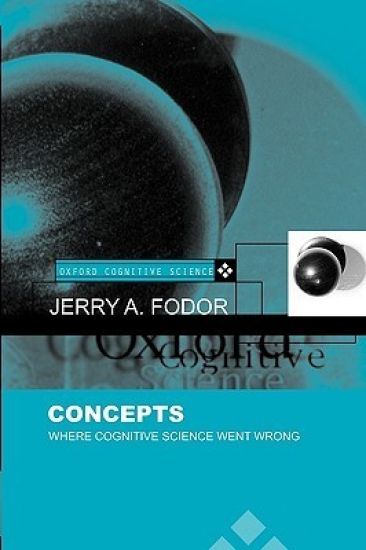
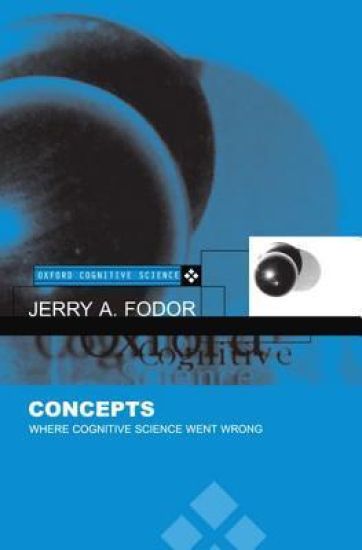
Concepts

Concepts

Jerry A. Fodor

Clarendon Press
1998
nidottu
Oxford Cognitive Science Series General Editors: Martin Davies, Wilde Reader in Mental Philosophy, University of Oxford, UK, James Higginbotham, Professor of General Linguistics, University of Oxford, UK, John O'Keefe, Professor of Cognitive Neuroscience, University College, London, UK, Christopher Peacocke, Waynflete Professor of Metaphysical Philosophy, University of Oxford, UK, and Kim Plunkett, University Lecturer in Psychology, University of Oxford, UK The Oxford Cognitive Science series is a forum for the best contemporary work in this flourishing field, where various disciplines--cognitive psychology, philosophy, linguistics, cognitive neuroscience, and computational theory--join forces in the investigation of thought, awareness, understanding, and associated workings of the mind. Each book will represent an original contribution to its subject, but will be accessible beyond the ranks of specialists, so as to reach a broad interdisciplinary readership. The series will be carefully shaped and steered by the general editors, with the aim of representing the most important developments in the field and bringing together its constituent disciplines. About this book The renowned philosopher Jerry Fodor, who has been a leading figure in the study of the mind for more than twenty years, presents a strikingly original theory of the basic constituents of thought. He suggests that the heart of a cognitive science is its theory of concepts, and that cognitive scientists have gone badly wrong in many areas because their assumptions about concepts have been seriously mistaken. Fodor argues compellingly for an atomistic theory of concepts, deals out witty and pugnacious demolitions of the rival theories that have prevailed in recent years, and suggests that future work on human cognition should build upon new foundations. This lively, conversational, and surprisingly accessible book is the first volume in the Oxford Cognitive Science Series, where the best original work in this field will be presented to a broad readership. Concepts will fascinate anyone interested in contemporary work on mind and language. Cognitive science will never be the same again.
Concepts

Concepts

Jerry A. Fodor

Clarendon Press
1998
sidottu
Oxford Cognitive Science Series General Editors: Martin Davies, Wilde Reader in Mental Philosophy, University of Oxford, UK, James Higginbotham , Professor of General Linguistics, University of Oxford, UK, John O'Keefe, Professor of Cognitive Neuroscience, University College, London, UK, Christopher Peacocke, Waynflete Professor of Metaphysical Philosophy, University of Oxford, UK, and Kim Plunkett, University Lecturer in Psychology, University of Oxford, UK The Oxford Cognitive Science series is a forum for the best contemporary work in this flourishing field, where various disciplines--cognitive psychology, philosophy, linguistics, cognitive neuroscience, and computational theory--join forces in the investigation of thought, awareness, understanding, and associated workings of the mind. Each book will represent an original contribution to its subject, but will be accessible beyond the ranks of specialists, so as to reach a broad interdisciplinary readership. The series will be carefully shaped and steered by the general editors, with the aim of representing the most important developments in the field and bringing together its constituent disciplines. About this book The renowned philosopher Jerry Fodor, who has been a leading figure in the study of the mind for more than twenty years, presents a strikingly original theory of the basic constituents of thought. He suggests that the heart of a cognitive science is its theory of concepts, and that cognitive scientists have gone badly wrong in many areas because their assumptions about concepts have been seriously mistaken. Fodor argues compellingly for an atomistic theory of concepts, deals out witty and pugnacious demolitions of the rival theories that have prevailed in recent years, and suggests that future work on human cognition should build upon new foundations. This lively, conversational, accessible book is the first volume in the Oxford Cognitive Science Series, where the best original work in this field will be presented to a broad readership. Concepts will fascinate anyone interested in contemporary work on mind and language. Cognitive science will never be the same again.
Hume Variations

Hume Variations

Jerry A. Fodor

Oxford University Press
2005
nidottu
Hume? Yes, David Hume, that's who Jerry Fodor looks to for help in advancing our understanding of the mind. Fodor claims his Treatise of Human Nature as the foundational document of cognitive science: it launched the project of constructing an empirical psychology on the basis of a representational theory of mind. Going back to this work after more than 250 years we find that Hume is remarkably perceptive about the components and structure that a theory of mind requires. Careful study of the Treatise helps us to see what's amiss with much twentieth-century philosophy of mind, and to get on the right track. Hume says in the Treatise that his main project is to construct a theory of human nature and, in particular, a theory of the mind. Hume Variations examines his account of cognition and how it is grounded in his 'theory of ideas'. Fodor discusses such key topics as the distinction between 'simple' and 'complex' ideas, the thesis that an idea is some kind of picture, and the roles that 'association' and 'imagination' play in cognitive processes. He argues that the theory of ideas, as Hume develops it, is both historically and ideologically continuous with the representational theory of mind as it is now widely endorsed by cognitive scientists. This view of Hume is explicitly opposed to recent discussions by critics who hold that the theory of ideas is the Achilles heel of his philosophy and that he would surely have abandoned it if only he had read Wittgenstein carefully. You don't have to know much about Hume to enjoy this inventively argued, provocative, and stimulating defence of the representational theory of mind--which is looking increasingly hard to resist. LINES OF THOUGHT Philosophy books don't need to be hundreds of pages long to make a substantial contribution to the subject. This new series presents original works by leading philosophers at an affordable price and a readable length. Series Editors Peter Ludlow (University of Michigan, Ann Arbor) Scott Sturgeon (Birkbeck College, London)
LOT 2

LOT 2

Jerry A. Fodor

Oxford University Press
2008
sidottu
Jerry A. Fodor presents a new development of his famous Language of Thought hypothesis, which has since the 1970s been at the centre of interdisciplinary debate about how the mind works. Fodor defends and extends the groundbreaking idea that thinking is couched in a symbolic system realized in the brain. This idea is central to the representational theory of mind which Fodor has established as a key reference point in modern philosophy, psychology, and cognitive science. The foundation stone of our present cognitive science is Turing's suggestion that cognitive processes are not associations but computations; and computation requires a language of thought. So the latest on the Language of Thought hypothesis, from its progenitor, promises to be a landmark in the study of the mind. LOT 2 offers a more cogent presentation and a fuller explication of Fodor's distinctive account of the mind, with various intriguing new features. The central role of compositionality in the representational theory of mind is revealed: most of what we know about concepts follows from the compositionality of thoughts. Fodor shows the necessity of a referentialist account of the content of intentional states, and of an atomistic account of the individuation of concepts. Not least among the new developments is Fodor's identification and persecution of pragmatism as the leading source of error in the study of the mind today. LOT 2 sees Fodor advance undaunted towards the ultimate goal of a theory of the cognitive mind, and in particular a theory of the intentionality of cognition. No one who works on the mind can ignore Fodor's views, expressed in the coruscating and provocative style which has delighted and disconcerted countless readers over the years.
LOT 2

LOT 2

Jerry A. Fodor

Oxford University Press
2010
nidottu
Jerry Fodor presents a new development of his famous Language of Thought hypothesis, which has since the 1970s been at the centre of interdisciplinary debate about how the mind works. Fodor defends and extends the groundbreaking idea that thinking is couched in a symbolic system realized in the brain. This idea is central to the representational theory of mind which Fodor has established as a key reference point in modern philosophy, psychology, and cognitive science. The foundation stone of our present cognitive science is Turing's suggestion that cognitive processes are not associations but computations; and computation requires a language of thought. So the latest on the Language of Thought hypothesis, from its progenitor, promises to be a landmark in the study of the mind. LOT 2 offers a more cogent presentation and a fuller explication of Fodor's distinctive account of the mind, with various intriguing new features. The central role of compositionality in the representational theory of mind is revealed: most of what we know about concepts follows from the compositionality of thoughts. Fodor shows the necessity of a referentialist account of the content of intentional states, and of an atomistic account of the individuation of concepts. Not least among the new developments is Fodor's identification and persecution of pragmatism as the leading source of error in the study of the mind today. LOT 2 sees Fodor advance undaunted towards the ultimate goal of a theory of the cognitive mind, and in particular a theory of the intentionality of cognition. No one who works on the mind can ignore Fodor's views, expressed in the coruscating and provocative style which has delighted and disconcerted countless readers over the years.
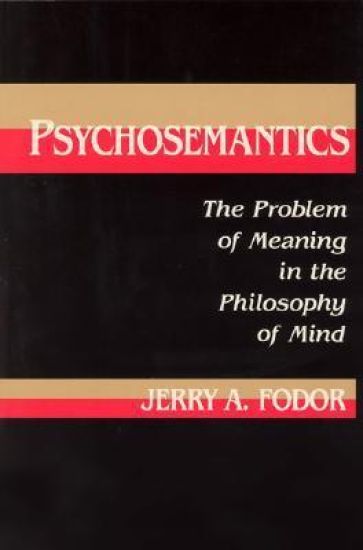
Psychosemantics

Psychosemantics

Jerry A. Fodor

Bradford Books
1989
pokkari
Psychosemantics explores the relation between commonsense psychological theories and problems that are central to semantics and the philosophy of language. Building on and extending Fodor's earlier work it puts folk psychology on firm theoretical ground and rebuts externalist, holist, and naturalist threats to its position.This book is included in the series Explorations in Cognitive Science, edited by Margaret A. Boden.A Bradford Book.
The Elm and the Expert

The Elm and the Expert

Jerry A. Fodor

Bradford Books
1995
pokkari
Written in a highly readable, irreverent style, The Elm and the Expert provides a lively discussion of semantic issues about mental representation, with special attention to issues raised by Frege's problem, Twin cases, and the putative indeterminacy of reference.Bound to be widely read and much discussed, The Elm and the Expert, written in Jerry Fodor's usual highly readable, irreverent style, provides a lively discussion of semantic issues about mental representation, with special attention to issues raised by Frege's problem, Twin cases, and the putative indeterminacy of reference. The book extends and revises a view of the relation between mind and meaning that the author has been developing since his 1975 book, The Language of Thought.There is a general consensus among philosophers that a referential semantics for mental representation cannot support a robust account of intentional explanation. Fodor has himself espoused this view in previous publications, and it is widespread (if tacit) throughout the cognitive science community. This book is largely a reconsideration of the arguments that are supposed to ground this consensus. Fodor concludes that these considerations are far less decisive than has been supposed. He offers a theory sketch in which psychological explanation is intentional, psychological processes are computational, and the semantic properties of mental representations are referential. Connections with the problem of "naturalizing" intentionality are also explored.The four lectures in The Elm and the Expert were originally delivered in Paris in the spring of 1993 to inaugurate the Jean Nicod Lecture series. The Jean Nicod Lectures are delivered annually by a leading philosopher of mind or philosophically oriented cognitive scientist. The 1993 lectures marked the centenary of the birth of the French philosopher and logician Jean Nicod (1893-1931). The lectures are sponsored by the Centre National de la Recherche Scientifique (CNRS) as part of its effort to develop the interdisciplinary field of cognitive science in France.Jean Nicod series
Language of Thought

Language of Thought

Jerry A. Fodor

Harvard University Press
1980
pokkari
In a compelling defense of the speculative approach to the philosophy of mind, Jerry Fodor argues that, while our best current theories of cognitive psychology view many higher processes as computational, computation itself presupposes an internal medium of representation. Fodor's prime concerns are to buttress the notion of internal representation from a philosophical viewpoint, and to determine those characteristics of this conceptual construct using the empirical data available from linguistics and cognitive psychology.