Kirjojen hintavertailu. Mukana 11 699 587 kirjaa ja 12 kauppaa.

Kirjahaku

Etsi kirjoja tekijän nimen, kirjan nimen tai ISBN:n perusteella.

21 kirjaa tekijältä Jerry White

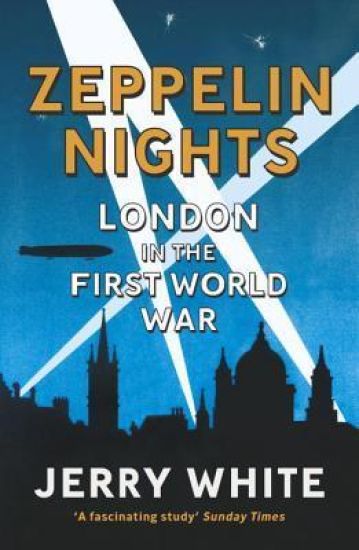
Zeppelin Nights

Zeppelin Nights

Jerry White

Vintage
2015
pokkari
‘Zeppelin Nights is social history at its best… White creates a vivid picture of a city changed forever by war’ The Times2018 marks the centenary of the end of the First World War. In those four decisive years, London was irrevocably changed. Soldiers passed through the capital on their way to the front and wounded men were brought back to be treated in London’s hospitals. At night, London plunged into darkness for fear of Zeppelins that raided the city. Meanwhile, women escaped the drudgery of domestic service to work as munitionettes. Full employment put money into the pockets of the poor for the first time. Self-appointed moral guardians seize the chance to clamp down on drink, frivolous entertainment and licentious behaviour. Even against a war-torn landscape, Londoners were determined to get on with their lives, firmly resolved not to let Germans or puritans spoil their enjoyment. Peopled with patriots and pacifists, clergymen and thieves, bluestockings and prostitutes, Jerry White’s magnificent panorama reveals a battle-scarred yet dynamic, flourishing city.‘Jerry White's name on a title page is a guarantee of a lively, compassionate book full of striking incidents and memorable images… This is a fast-paced social history that never stumbles… A well-orchestrated polyphony of voices that brings history alive’ Guardian
The Battle of London 1939-45

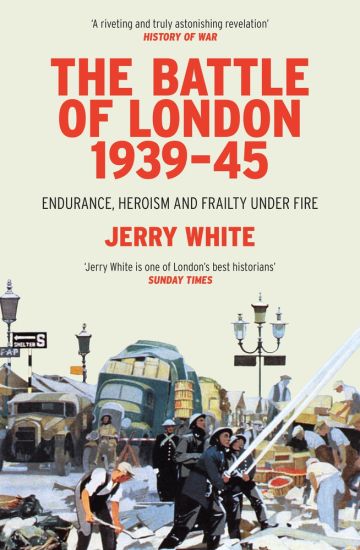
The Battle of London 1939-45

Jerry White

Vintage Publishing
2023
pokkari
'Endlessly fascinating. . . White is such a brilliant historian' Mail on SundayLasting for six long years, the Blitz transformed life in the capital beyond recognition, marking a time of almost constant anxiety, disruption, deprivation and sacrifice for Londoners. With the capital the nation's frontline during the Second World War, by its end, 30,000 inhabitants had lost their lives.While much has been written about 'the Myth of the Blitz', its riveting social history has often been overlooked. Unearthing what it was actually like for those living through those tempestuous years, Jerry White paints a fascinating portrait of the daily lives of ordinary Londoners, telling the story through their own voices.'As a history of the capital in wartime, it is probably unsurpassable' Sunday Telegraph'An impressive history of the capital at war. . . White, an accomplished chronicler of London's history, tells it with brio and a confident mastery of the sources' Literary Review
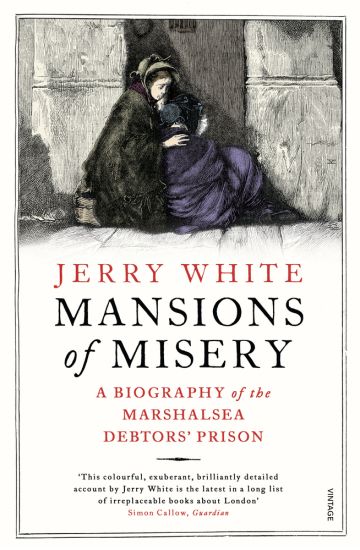
Mansions of Misery

Mansions of Misery

Jerry White

Vintage
2017
pokkari
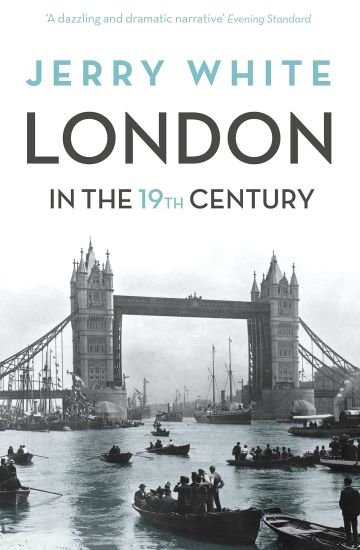
For Londoners of the eighteenth and nineteenth centuries, debt was a part of everyday life. But when your creditors lost their patience, you might be thrown into one of the capital’s most notorious jails: the Marshalsea Debtors’ Prison.In Mansions of Misery, acclaimed chronicler of the capital Jerry White introduces us to the Marshalsea’s unfortunate prisoners – rich and poor; men and women; spongers, fraudsters and innocents. We get to know the trumpeter John Grano who wined and dined with the prison governor and continued to compose music whilst other prisoners were tortured and starved to death. We meet the bare-knuckle fighter known as the Bold Smuggler, who fell on hard times after being beaten by the Chelsea Snob. And then there’s Joshua Reeve Lowe, who saved Queen Victoria from assassination in Hyde Park in 1820, but whose heroism couldn’t save him from the Marshalsea. Told through these extraordinary lives, Mansions of Misery gives us a fascinating and unforgettable cross-section of London life from the early 1700s to the 1840s.
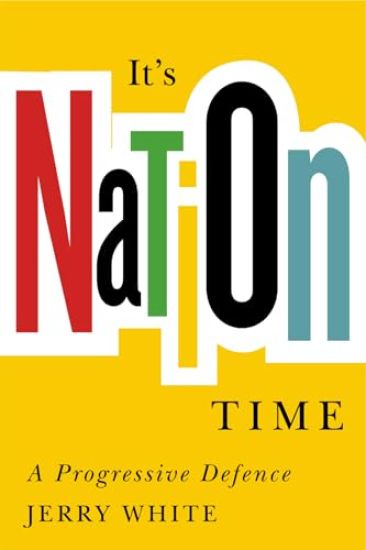
It’s Nation Time

It’s Nation Time

Jerry White

MCGILL-QUEEN'S UNIVERSITY PRESS
2024
sidottu
Speaking at the Congress of African People in September 1970, Amiri Baraka said, “In Newark, when we greet each other on the streets, we say, ‘what time is it?’ We always say, ‘It’s nation time!’ Nationalism is about land and nation, a way of life trying to free itself.” National identity and nationhood are too often easily dismissed as retrograde populism or racist exclusion. Instead, they need to be understood as a key part of a vision of globalization that holds the imperatives of diversity and solidarity in a delicate balance.Jerry White offers a defence of the nation based on the assumption that struggles for national identity have often unfolded in ways that should be familiar to those who defend the political standpoint of the progressive left. Having evolved into something that a wide variety of actors have sought to defend, nations can also serve as a defence against the homogenizing forces of globalization and as havens of diversity in opposition to more singularly minded forms of affiliation. It’s Nation Time is structured as a series of specific case studies that speak to theories of nation and their historical and cultural manifestations. It includes examples as varied as Black nationalism, Simone Weil’s hopes for a postwar France, the first independence period of Georgia, the Bollywood cinema of Nehru-era India, and small or stateless nations such as New Zealand, Quebec, Ireland, Catalonia, the Métis, the Mohawk, and the Inuit to argue that nationalism is a social form that has much potential and life in it.Broadly internationalist but also deeply insightful about the particular cultures and politics of small nations, It’s Nation Time defends an idea of nation, and a form of nationalism that are rooted in the potential for diversity, flexibility, and progressive politics.
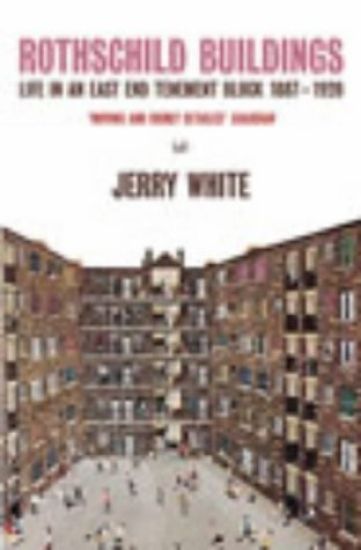
Rothschild Buildings

Rothschild Buildings

Jerry White

Pimlico
2003
pokkari
Winner of the Jewish Chronicle Harold H. Wingate Literary Award.Rothschild Buildings were typical of the 'model dwellings for the working classes' which were such an important part of the response to late-Victorian London's housing problem. They were built for poor but respectable Jewish immigrants from Eastern Europe, and the community which put down roots there was to be characteristic of the East End Jewish working class in its formative years. By talking to people who grew up in the Buildings in the 1890s and after, and using untapped documentary evidence from a wide range of public and private sources, the author re-creates the richly detailed life of that community and its relations with the economy and culture around it. The book shows how cramped and austere housing was made into homes; how the mechanism of class domination, of which the Buildings were part, was both accepted and fought against; how a close community was riven with constantly shifting tensions; and how that community co-existed in surprising ways with the East End casual poor of 'outcast London'. It provides unique and fascinating insights into immigrant and working-class life at the turn of the last century.
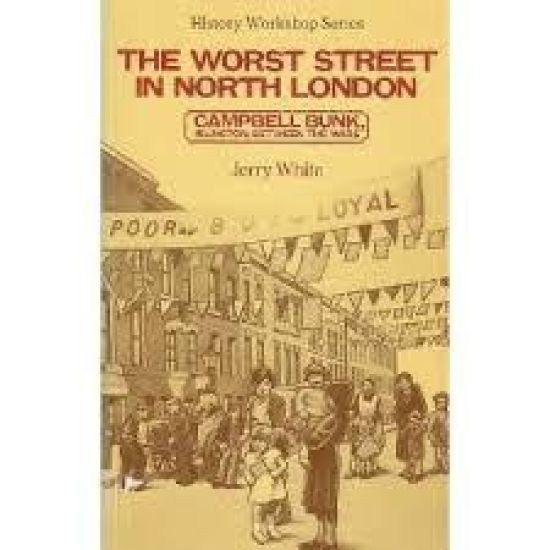
Campbell Bunk

Campbell Bunk

Jerry White

Vintage
2003
pokkari
From the 1880s to the Second World War, Campbell Road, Finsbury Park (known as Campbell Bunk), had a notorious reputation for violence, for breeding thieves and prostitutes, and for an enthusiastic disregard for law and order.
Of This Place and Elsewhere

Of This Place and Elsewhere

Jerry White

Toronto International Film Festival
2007
pokkari
A key figure in the Toronto New Wave of the 1980s, Peter Mettler is one of the most intriguing and audacious filmmakers in English Canada, known not only for his work as a director but also as a cinematographer and editor. His films are distinguished by an innovative approach to the medium, regardless of genre, bridging the gap between experimental, narrative, personal essay, and documentary. All of his work is visually stunning, particularly the two films he is best known for: Picture of Light and Gambling, Gods and LSD. Mettler is also an accomplished photographer and a pioneer in multimedia work. His live visual mixing performances are groundbreaking and legendary, and he has long been considered a leader in this field.In Peter Mettler, Jerry White focuses on Mettler's career as a director, emphasizing the global nature of his films. White also discusses Mettler's groundbreaking explorations in the field of visual mixing and his work as a still photographer and cinematographer. The book is richly illustrated with examples of Mettler's work.
Black Women Only

Black Women Only

Jerry White

Createspace Independent Publishing Platform
2018
nidottu
Travis Simmons is a serial killer that loves meth and has a lust for chocolate. His addictions has gotten him caught up in an international human trafficking ring ran by the self proclaimed King of Russia Isben Hussein, who has vowed to blow America off the map.
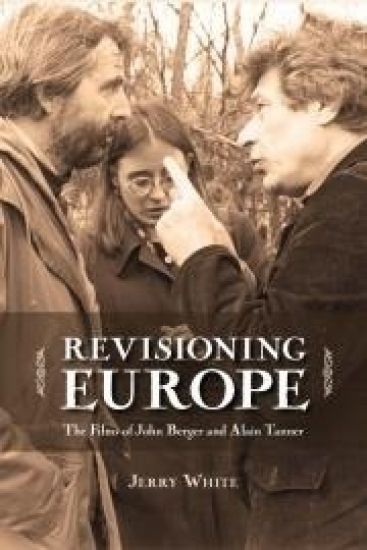
Revisioning Europe

Revisioning Europe

Jerry White

University of Calgary Press
2012
nidottu
Revisioning Europe is among the few existing English-language discussions of the films made by British novelist John Berger and Swiss film director Alain Tanner. It brings to light a political cinema that was unsentimental about the possibilities of revolutionary struggle and unsparing in its critique of the European left, and at the same time optimistic about the ability of radicalism - and radical art - to transform the world.Jerry White argues that Berger and Tanner's work is preoccupied with ideas that were both central to the Enlightenment and at the same time characteristically Swiss. Translations of previously unpublished essays by both John Berger and Alain Tanner are included as appendices.
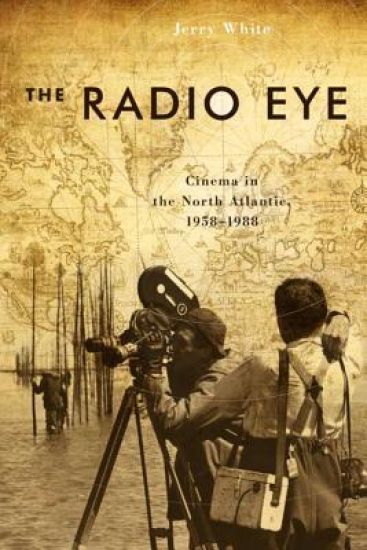
The Radio Eye

The Radio Eye

Jerry White

Wilfrid Laurier University Press
2009
sidottu
The Radio Eye: Cinema in the North Atlantic, 1958-1988, examines the way in which media experiments in Quebec, Newfoundland, the Faroe Islands, and the Irish-Gaelic-speaking communities of Ireland use film, video, and television to advocate for marginalized communities and often for ""smaller languages."" The Radio Eye is not, however, a set of isolated case studies. Author Jerry White illustrates the degree to which these experiments are interconnected, sometimes implicitly but more often quite explicitly. Media makers in the North Atlantic during the period 1958-1988 were very aware of each other's cultures and aspirations, and, by structuring the book in two interlocking parts, White illustrates the degree to which a common project emerged during those three decades. The book is bound together by White's belief that these experiments are following in the idealism of Soviet silent filmmaker Dziga Vertov, who wrote about his notion of ""the Radio Eye."" White also puts these experiments in the context of work by the Cuban filmmaker and theorist Julio García Espinosa and his notion of ""imperfect cinema,"" Jürgen Habermas and his notions of the ""public sphere,"" and Édourard Glissant's ideas about ""créolité"" as the defining aspect of modern culture. This is a genuinely internationalist moment, and these experiments are in conversation with a wide array of thought across a number of languages.
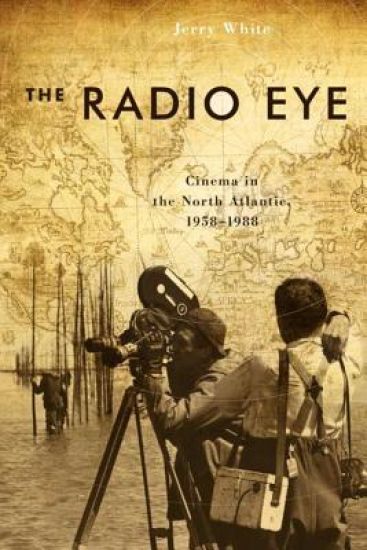
The Radio Eye

The Radio Eye

Jerry White

Wilfrid Laurier University Press
2018
nidottu
The Radio Eye: Cinema in the North Atlantic, 1958-1988, examines the way in which media experiments in Quebec, Newfoundland, the Faroe Islands, and the Irish-Gaelic-speaking communities of Ireland use film, video, and television to advocate for marginalized communities and often for ""smaller languages."" The Radio Eye is not, however, a set of isolated case studies. Author Jerry White illustrates the degree to which these experiments are interconnected, sometimes implicitly but more often quite explicitly. Media makers in the North Atlantic during the period 1958-1988 were very aware of each other's cultures and aspirations, and, by structuring the book in two interlocking parts, White illustrates the degree to which a common project emerged during those three decades. The book is bound together by White's belief that these experiments are following in the idealism of Soviet silent filmmaker Dziga Vertov, who wrote about his notion of ""the Radio Eye."" White also puts these experiments in the context of work by the Cuban filmmaker and theorist Julio García Espinosa and his notion of ""imperfect cinema,"" Jürgen Habermas and his notions of the ""public sphere,"" and Édourard Glissant's ideas about ""créolité"" as the defining aspect of modern culture. This is a genuinely internationalist moment, and these experiments are in conversation with a wide array of thought across a number of languages.
Two Bicycles

Two Bicycles

Jerry White

Wilfrid Laurier University Press
2013
nidottu
Jean-Luc Godard and Anne-Marie Miéville are among the most important postwar filmmakers; they have worked across forms, across media, and across countries. This book, the first to be devoted specifically to the work they did together, examines the way they expanded the possibilities of cinema by using cutting-edge video equipment in a constant search for a new kind of filmmaking. Two Bicycles examines all of the films, videos, and television works that the two did together, and moves slowly across France and Switzerland, with detours in Quebec, Mozambique, and Palestine. Their amazingly varied body of work includes a twelve-hour television series, some experimental videos, an acclaimed feature film with Isabelle Huppert, a cigarette commercial, and much else. Overall the book shows the degree to which this work departs radically from the legacy of the French New Wave, and in many ways shows signs of having been formed by the distinct culture of Switzerland, to which Godard and Miéville returned in the 1970s to set up their ""atelier,"" Sonimage. Two Bicycles offers a chance to explore a body of work that is as unique and demanding as it is rich and revelatory. Godard and Miéville have worked together for four decades but have never seemed more relevant.
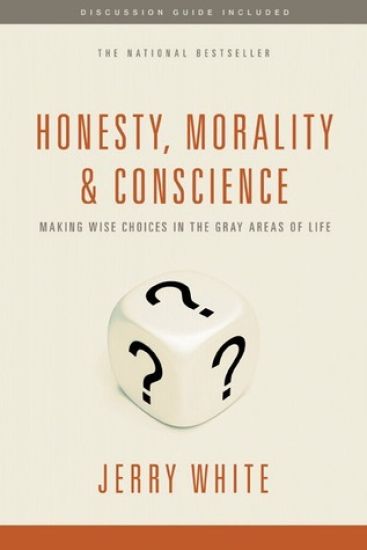
Honesty, Morality, and Conscience

Honesty, Morality, and Conscience

Jerry White

NavPress Publishing Group
2007
nidottu
In Honesty, Morality, and Conscience, Navigator author Jerry White takes a hard look at some of life's gray areas. Examining the origin and depth of our conscience, our moral compass, and truthful living, he explains how God has given us everything we need to face the ethical questions of today in all areas of our lives. Explore issues of identity, integrity, and accountability as you look at your sources for discernment and wisdom. This great leadership and character-building tool includes discussion questions.
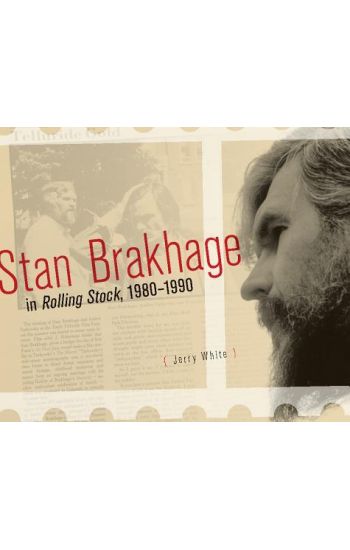
Stan Brakhage in Rolling Stock, 1980-1990

Stan Brakhage in Rolling Stock, 1980-1990

Jerry White

Wilfrid Laurier University Press
2018
sidottu
This is a collection of writings by the giant of experimental cinema, Stan Brakhage, that shows him in a completely new light, as part of world cinema. For the duration of the 1980s, Brakhage contributed to the Boulder literary magazine Rolling Stock, mostly publishing reports from the Telluride Film Festival. These reports show that Brakhage was keenly interested in world cinema, anxious to meet and dialogue with filmmakers of many different stripes.The book also contains substantial discussion of Brakhage's work in light of the filmmakers he encountered at Telluride and discussed in Rolling Stock. Long chapters are given over to Soviet filmmakers such as Andrei Tarkovsky, Larissa Shepitko, and Sergei Parajanov, as well as the German filmmaker Hans-Jürgen Syberberg. Brakhage was a keen viewer of these filmmakers and their contemporaries, both at Telluride and in his role as teacher at the University of Colorado, and Stan Brakhage and Rolling Stock attempts to place his work alongside theirs and thus reclaim him for world cinema.The book's appendices reprint letters Brakhage wrote to Stella Pence (Telluride's co-founder and managing director), as well as summaries of his work for Telluride and a brace of difficult-to-find reviews.
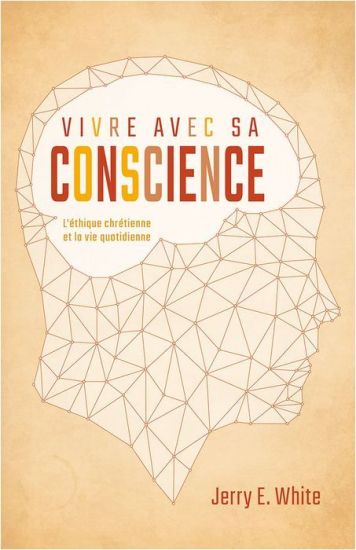
Vivre Avec Sa Conscience (Honesty, Morality, and Conscience): L'
Au palmar s des notions floues et difficiles, la conscience figure sans doute en bonne place. Elle est source de bien des erreurs, de la culpabilisation abusive la licence sans bornes. Bien r elle et pourtant impalpable, elle est changeante selon les moments et les individus. Pourtant, elle est mentionn e dans la Bible comme l'un des moyens par lequel Dieu nous parle et peut nous guider si nous la d veloppons de la bonne mani re. Il ne s'agit pas d'un livre de morale, ni d'une approche th ologique du sujet. Bas sur l'enseignement des critures et sur l'exp rience v cue de l'auteur, cet ouvrage aborde de fa on aussi pragmatique que possible des sujets comme: - l'honn tet et l' thique au travail; - le probl me de la pression du groupe; - l'honn tet au foyer; - l'honn tet avec soi-m me; - la moralit sexuelle; - d velopper ses convictions sur une base biblique.
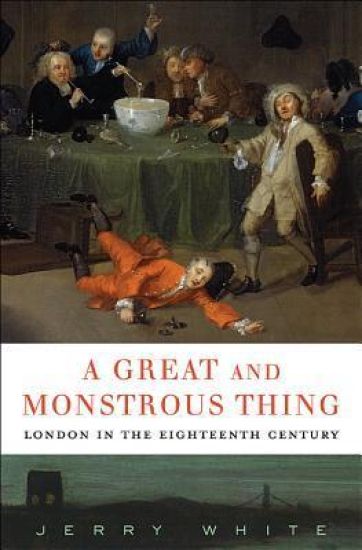
A Great and Monstrous Thing: London in the Eighteenth Century
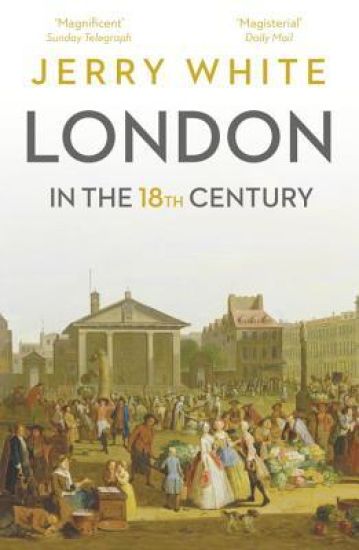
London in the eighteenth century was a new city, risen from the ashes of the Great Fire of 1666 that had destroyed half its homes and great public buildings. The century that followed was an era of vigorous expansion and large-scale projects, of rapidly changing culture and commerce, as huge numbers of people arrived in the shining city, drawn by its immense wealth and power and its many diversions. Borrowing a phrase from Daniel Defoe, Jerry White calls London "this great and monstrous thing," the grandeur of its new buildings and the glitter of its high life shadowed by poverty and squalor. A Great and Monstrous Thing offers a street-level view of the city: its public gardens and prisons, its banks and brothels, its workshops and warehouses--and its bustling, jostling crowds. White introduces us to shopkeepers and prostitutes, men and women of fashion and genius, street-robbers and thief-takers, as they play out the astonishing drama of life in eighteenth-century London. What emerges is a picture of a society fractured by geography, politics, religion, history--and especially by class, for the divide between rich and poor in London was never greater or more destructive in the modern era than in these years. Despite this gulf, Jerry White shows us Londoners going about their business as bankers or beggars, reveling in an enlarging world of public pleasures, indulging in crimes both great and small--amidst the tightening sinews of power and regulation, and the hesitant beginnings of London democracy.