Kirjojen hintavertailu. Mukana 12 042 993 kirjaa ja 12 kauppaa.

Kirjahaku

Etsi kirjoja tekijän nimen, kirjan nimen tai ISBN:n perusteella.

6 kirjaa tekijältä Jim Samson

The Music of Chopin

The Music of Chopin

Jim Samson

Clarendon Press
1994
nidottu
A critical study of Chopin's music which provides a detailed analysis of its style and structure, in the light of Chopin scholarship and recent analytical methods. It also explores the creative process itself, which is central to the lives of all composers.
Black Sea Sketches

Black Sea Sketches

Jim Samson

Routledge
2021
sidottu
Black Sea Sketches is a portrait of some of the diverse musical cultures surrounding the Black Sea and in its hinterlands. Its six separate chapters follow a very broad trajectory from close-ups of traditional music (chapters 1-4) towards wide-angle studies of art music (chapters 5-6), and each of them opens windows to big, border-crossing themes about music and place. A wide variety of repertoires is discussed: ancient layers of polyphonic music, bardic songs, traditional music from the coasts and mountains, the sacred music of Islam and Orthodox Christianity, the art music of Europe and West Asia, and present-day popular music ‘scenes’. The usual practice is for each chapter to begin with a Black Sea coastal location before reaching out into the hinterlands. The result is a collection of six relatively discrete essays on different locations and topics, but with underlying thematic continuities, and offering a wide-ranging commentary on cultural difference. Firmly grounded in ethnographic and documentary research, this is an important study for scholars and researchers of Ethnomusicology, as also of Caucasian and Russian/East European Studies.
Black Sea Sketches

Black Sea Sketches

Jim Samson

TAYLOR FRANCIS LTD
2022
nidottu
Black Sea Sketches is a portrait of some of the diverse musical cultures surrounding the Black Sea and in its hinterlands. Its six separate chapters follow a very broad trajectory from close-ups of traditional music (chapters 1-4) towards wide-angle studies of art music (chapters 5-6), and each of them opens windows to big, border-crossing themes about music and place. A wide variety of repertoires is discussed: ancient layers of polyphonic music, bardic songs, traditional music from the coasts and mountains, the sacred music of Islam and Orthodox Christianity, the art music of Europe and West Asia, and present-day popular music ‘scenes’. The usual practice is for each chapter to begin with a Black Sea coastal location before reaching out into the hinterlands. The result is a collection of six relatively discrete essays on different locations and topics, but with underlying thematic continuities, and offering a wide-ranging commentary on cultural difference. Firmly grounded in ethnographic and documentary research, this is an important study for scholars and researchers of Ethnomusicology, as also of Caucasian and Russian/East European Studies.

Virtuosity and the Musical Work

Virtuosity and the Musical Work

Jim Samson

Cambridge University Press
2007
nidottu
This book is about three sets of etudes by Liszt: the Etude en douze exercices (1826), its reworking as Douzes grandes etudes (1837), and their reworking as Douzes etudes d'execution transcendante (1851). At the same time it is a book about nineteenth-century instrumental music in general, in that the three works invite the exploration of features characteristic of the early Romantic era in music. These include: a composer-performer culture, the concept of virtuosity, the significance of recomposition, music and the poetic, and the consolidation of a musical work-concept. A central concern is to illuminate the relationship between the work-concept and a performance- and genre-orientated musical culture. At the same time the book reflects on how we might make judgements of the 'Transcendentals', of the Symphonic Poem Mazeppa (based on the fourth etude), and of Liszt's music in general.
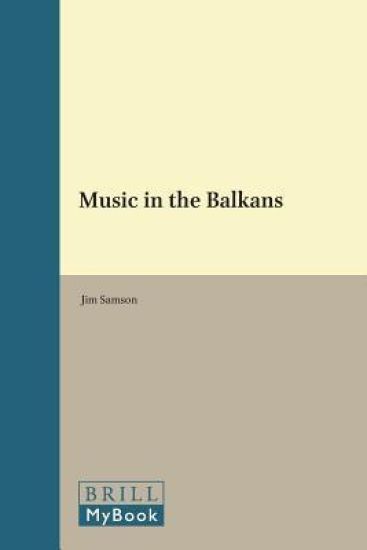
Music in the Balkans

Music in the Balkans

Jim Samson

Brill
2013
sidottu
This book asks how a study of many different musics in South East Europe can help us understand the construction of cultural traditions, East and West. It crosses boundaries of many kinds, political, cultural, repertorial and disciplinary. Above all, it seeks to elucidate the relationship between politics and musical practice in a region whose art music has been all but written out of the European story and whose traditional music has been subject to appropriation by one ideology after another. South East Europe, with its mix of ethnicities and religions, presents an exceptionally rich field of study in this respect. The book will be of value to anyone interested in intersections between pre-modern and modern cultures, between empires and nations and between culture and politics.