Kirjojen hintavertailu. Mukana 11 627 220 kirjaa ja 12 kauppaa.

Kirjahaku

Etsi kirjoja tekijän nimen, kirjan nimen tai ISBN:n perusteella.

5 kirjaa tekijältä Joe B. Fulton

The Reconstruction of Mark Twain

The Reconstruction of Mark Twain

Joe B. Fulton

Louisiana State University Press
2011
sidottu
When Confederate forces fired on Fort Sumter in April 1861, thousands of patriotic southerners rushed to enlist for the Confederate cause. Samuel Langhorne Clemens, who grew up in the border state of Missouri in a slave-holding family, was among them. Clemens, who later achieved fame as the writer Mark Twain, served as second lieutenant in a Confederate militia, but only for two weeks, leading many to describe his loyalty to the Confederate cause as halfhearted at best. After all, Mark Twain's novel The Adventures of Huckleberry Finn (1885) and his numerous speeches celebrating Abraham Lincoln, with their trenchant call for racial justice, inspired his crowning as ""the Lincoln of our Literature."" In The Reconstruction of Mark Twain, Joe B. Fulton challenges these long-held assumptions about Twain's advocacy of the Union cause, arguing that Clemens traveled a long and arduous path, moving from pro-slavery, secession, and the Confederacy to pro-union, and racially enlightened. Scattered and long-neglected texts written by Clemens before, during, and immediately after the Civil War, Fulton shows, tout pro-southern sentiments critical of abolitionists, free blacks, and the North for failing to enforce the Fugitive Slave Act. These obscure works reveal the dynamic process that reconstructed Twain in parallel with and response to events on American battlefields and in American politics. Beginning with Clemens's youth in Missouri, Fulton tracks the writer's transformation through the turbulent Civil War years as a southern-leaning reporter in Nevada and San Francisco to his raucous burlesques written while he worked as a Washington correspondent during the impeachment crises of 1867--1868. Fulton concludes with the writer's emergence as the country's satirist-in-chief in the postwar era. By explaining the relationship between the author's early pro-southern writings and his later stance as a champion for racial justice throughout the world, Fulton provides a new perspective on Twain's views and on his deep involvement with Civil War politics.A deft blend of biography, history, and literary studies, The Reconstruction of Mark Twain offers a bold new assessment of the work of one of America's most celebrated writers.
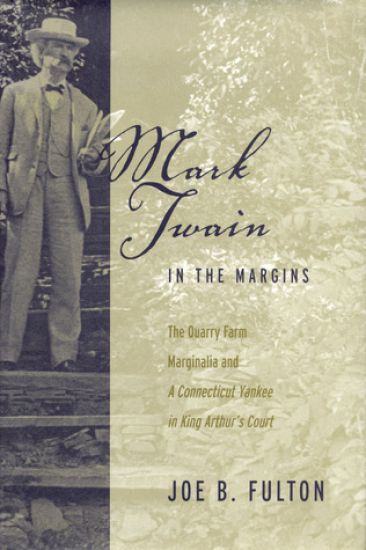
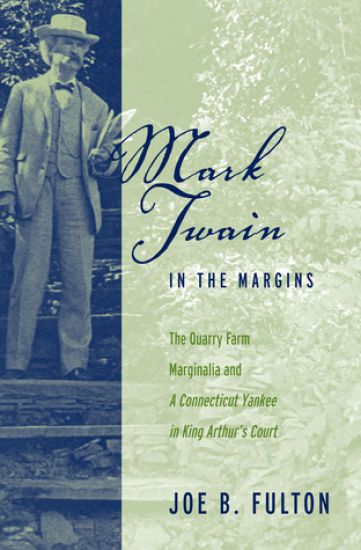
Mark Twain in the Margins

Mark Twain in the Margins

Joe B. Fulton

The University of Alabama Press
2000
nidottu
The common characterization of Mark Twain as an uneducated and improvizational writer took hold largely because of the novelist's own claims about his writing practices. This book argues that Twain approached his work with careful research and calculated design.
Mark Twain in the Margins

Mark Twain in the Margins

Joe B. Fulton

The University of Alabama Press
2007
nidottu
The common characterization of Mark Twain as an uneducated and improvisational writer took hold largely because of the novelist's own frequent claims about his writing practices. But using recently discovered evidence--Twain's marginal notes in books he consulted as he worked on A Connecticut Yankee in King Arthur's Court--Joe Fulton argues for a reconsideration of scholarly views about Twain's writing process, showing that this great American author crafted his novels with careful research and calculated design. Fulton analyzes Twain's voluminous marginalia in the copies of Macaulay's History of England, Carlyle's History of the French Revolution, and Lecky's History of the Rise of Rationalism and England in the Eighteenth Century available to Twain in the library of Quarry Farm, the New York farm where the novelist and his family routinely spent their summers. Comparing these marginal notes to entries in Twain's writing journal, the manuscript of Connecticut Yankee, and the book as published in 1889, Fulton establishes that Twain's research decisively influenced the novel. Fulton reveals Twain to be both the writer from experience he claimed to be and the careful craftsman that he attempted to downplay. By redefining Twain's aesthetic, Fulton reinvigorates current debates about what constitutes literary realism. Fulton's transcriptions of the marginalia appear in an appendix; together with his analysis, they provide a valuable new resource for Twain scholars.
Lost Liberty: Recovering Historical Definitions of America's Most Important Word

Lost Liberty: Recovering Historical Definitions of America's Most Important Word

Joe B. Fulton

Createspace Independent Publishing Platform
2014
nidottu
What is the defining expression of the American way? In a word, it is liberty. From liberty's famed appearance in the United States Declaration of Independence through its role in emancipation, no other word has so embraced and shaped the country's distinct ethos. So what does it mean that the word inhabits less real estate in American dictionaries and American rhetoric? Lost Liberty: Recovering Historical Definitions of America's Most Important Word charts the substantial usage of the word in America, drawing from primary sources such as dictionaries and books to examine how it emerged, and why it has steadily receded. From the pens of colonists fleeing religious persecution through the framers of the Constitution, no single string of letters garnered as much cultural currency or has spawned as many phrases incorporating it. "Natural liberty," "religious liberty," "civil liberty," and "liberty of the press" were mainstays, but we forged other phrases, too: "celestial liberty," "federal liberty," "wild liberty," and "savage liberty," among many others. To paraphrase founding father Thomas Jefferson, new circumstances call for new words. The singular circumstance that forged this nation elevated the word liberty to such prominence in the country's collective consciousness that entries in American dictionaries exponentially surpassed British counterparts of the same era. So why did its usage decline so dramatically?
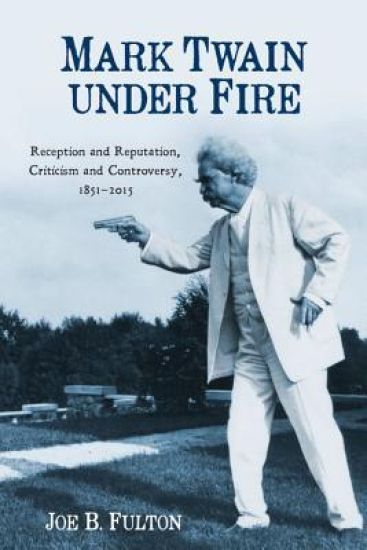
Mark Twain under Fire

Mark Twain under Fire

Joe B. Fulton

Camden House Inc
2018
pokkari
Tracks the genesis and evolution of Twain's reputation as a writer, revealing how and why the writer has been "under fire" since the advent of his career. Threatened by a rival editor brandishing a double-barreled shotgun, young Samuel Clemens had his first taste of literary criticism. Clemens began his long writing career penning satirical articles for his brother's newspaper in Hannibal, Missouri. His humor delighted everyone except his targets, and it would not be the last time his writing provoked threats of "dissection, tomahawking, libel, and getting his head shot off." Clemens adopted the name Mark Twain while living in the Nevada Territory, where his caustic comedy led to angry confrontations, a challenge to a duel, and a subsequent flight. Nursing his wounded ego in California, Twain vowed to develop a reputation that would"stand fire" and in the process became the classic American writer. Mark Twain under Fire tracks the genesis and evolution of Twain's reputation as a writer: his reception as a humorist, his "return fire" on genteel critics, and the development of academic criticism. As a history of Twain criticism, the book draws on English and foreign-language scholarship. Fulton discusses the forces and ideas that have influenced criticism, revealinghow and why Mark Twain has been "under fire" from the advent of his career to the present day, when his masterpiece Huckleberry Finn remains one of America's most frequently banned books. Joe B. Fulton is Professor of English at Baylor University in Waco, Texas. He has published four previous books on Mark Twain.