Kirjojen hintavertailu. Mukana 12 078 004 kirjaa ja 12 kauppaa.

Kirjahaku

Etsi kirjoja tekijän nimen, kirjan nimen tai ISBN:n perusteella.

6 kirjaa tekijältä John Bew

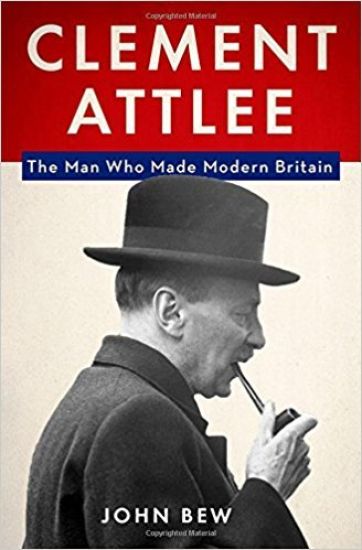
Clement Attlee: The Man Who Made Modern Britain

Clement Attlee: The Man Who Made Modern Britain

John Bew

Oxford University Press
2017
sidottu
Throughout the first half of the twentieth century, Winston Churchill's wartime heroics and larger-than-life personality propelled him to the center of the world stage. To most, he remains Great Britain's greatest Prime Minister, his fame and charisma overshadowing those who followed in his footsteps. Yet while he presided over his country's finest hour, he was not its most consequential leader. In this definitive new biography, John Bew reveals how that designation belongs to Clement Attlee, Churchill's successor, who launched a new era of political, economic, and social reform that would forever change Great Britain. Bew's thorough and keen examination of Attlee, the former leader of the Labour Party, illuminates how his progressive beliefs shaped his influential domestic and international policy. Alternatively criticized for being "too socialist" or "not radical enough," Attlee's quiet tenacity was intrinsic to the success of his party and highly pertinent to British identity overall. In 1948, he established the National Health Service as part of his "British New Deal"-a comprehensive, universal system of insurance, welfare, and family allowances to be enjoyed by all British citizens. Attlee also initiated key advancements in international relations by supporting the development of both the United Nations and the North Atlantic Treaty Organization, and by granting independence to India, Burma, and Ceylon. More controversially, he sanctioned the building of Britain's nuclear deterrent in response to the rise of the Soviet Union and the threat of atomic bombs. Clement Attlee: The Man Who Made Modern Britain explores his tenure in the years after the war, as he presided over a radical new government in an age of austerity and imperial decline. Bew mines contemporary memoirs, diaries, and press excerpts to present readers with an illuminating and intimate look into Attlee's life and career. Attentive to both the man and the political landscape, this comprehensive biography provides new insight into the soul of a leader who transformed his country and by extension the vast empire over which it once ruled.
Realpolitik

Realpolitik

John Bew

Oxford University Press Inc
2018
nidottu
Since its coinage in mid-19th century Germany, Realpolitik has proven both elusive and protean. To some, it represents the best approach to meaningful change and political stability in a world buffeted by uncertainty and rapid transformation. To others, it encapsulates an attitude of cynicism and cold calculation, a transparently self-justifying policy exercised by dominant nations over weaker. Remolded across generations and presupposed to its political and ideological moment, Realpolitik remains a touchstone for discussion about statecraft and diplomacy. It is a freighted concept. Historian John Bew explores the genesis of Realpolitik, tracing its longstanding and enduring relevance in political and foreign policy debates. Bew's book uncovers the context that gave birth to Realpolitik--that of the fervor of radical change in 1848 in Europe. He explains its application in the conduct of foreign policy from the days of Bismarck onward. Lastly, he illuminates its translation from German into English, one that reveals the uniquely Anglo-American version of realpolitik--small "r"--being practiced today, a modern iteration that attempts to reconcile idealism with the pursuit of national interests. Lively, encyclopedic, and utterly original, Realpolitik: A History illuminates the life and times of a term that has shaped and will continue to shape international relations.
Realpolitik

Realpolitik

John Bew

Oxford University Press Inc
2016
sidottu
Realpolitik is approaching its 160th birthday, though it has existed as a form of statecraft for centuries and is arguably as old as the conduct of foreign affairs itself. Associated with great thinkers from Machiavelli to Kissinger, it is deeply rooted in the history of diplomacy yet also remains strikingly relevant to debates on contemporary foreign policy in the Obama administration today. Despite the fact that Realpolitik has had something of a renaissance in recent years, however, it remains a surprisingly elusive notion, defying easy categorization. In this concise book, John Bew aims to address this gap, offering a history of the concept of Realpolitik in the English-speaking world: its origins as an idea; its practical application to statecraft in the recent past; and its relevance to the foreign policy challenges facing the United States and its allies in the future. Now most often associated with the conduct of foreign policy, Realpolitik has traditionally had pejorative connotations in the English-speaking world and sits uneasily alongside notions of "enlightenment," "morality" and "virtue." But it has also had its defenders, admirers and exponents, who regard it as the best tool for the successful wielding of political power and the preservation of global order. As such, Realpolitik has both successes and failures to its name, as Bew's comprehensive and even-handed overview displays. Bew begins by charting the evolution of the idea through the work of important thinkers or statesmen from Machiavelli, Cardinal de Richelieu, and Thomas Hobbes up through Carl Schmitt, Kissinger, and Dennis Ross. He then examines how Realpolitik has been evoked and operationalized in US and UK foreign policy during specific episodes in the twentieth century, looking at such cases as the overthrow of Iranian Prime Minister Mohammad Mosaddegh in 1953, and President Nixon's visit to the People's Republic of China in 1972 - often taken as the archetypal instance of Realpolitik in action. Bew then uses this historical platform to look forward to emerging foreign policy challenges in a changing, multi-polar, geo-political scene - in which Realpolitik and agile statecraft seems as important as ever. Suggesting that there is a uniquely Anglo-American version of Realpolitik, which reflects an attempt (not always a successful one) to reconcile Western ideological and moral norms with purely utilitarian conceptions of the national interest, Bew argues that a more accurate and sustainable version of Anglo-American Realpolitik is one that recognizes the draw Enlightenment values and ideas. Directed at a broader audience of current policy-makers, legislators and commentators with an interest in foreign affairs, this is a brilliant introduction to an important topic from one of the field's rising stars.
Castlereagh

Castlereagh

John Bew

riverrun
2014
pokkari
The best political biography of the year' Jonathan Sumption, Spectator'Wonderful . . . A Life so nearly complete it need never be written again' Ferdinand Mount, Times Literary SupplementBy the author of the Orwell Prize-winning Citizen ClemDamned in coruscating verse by Shelley and Byron, his coffin hissed at during his funeral, Lord Castlereagh has one of the blackest reputations in British history. But as John Bew shows, this is but a half-drawn portrait. His gripping biography reveals a shy, inarticulate but passionate man; a towering political figure of implacable principles who redrew the map of Europe, fought a duel with a cabinet colleague and would tragically take his own life amid rumours of scandal and madness.
Citizen Clem

Citizen Clem

John Bew

riverrun
2017
pokkari
**WINNER OF THE ORWELL PRIZE FOR POLITICAL WRITING****WINNER OF THE ELIZABETH LONGFORD PRIZE FOR HISTORICAL BIOGRAPHY***Book of the year: The Times, Sunday Times, New Statesman, Spectator, Evening Standard*'Outstanding . . . We still live in the society that was shaped by Clement Attlee' Robert Harris, Sunday Times'The best book in the field of British politics' Philip Collins, The Times'Easily the best single-volume, cradle-to-grave life of Clement Attlee yet written' Andrew RobertsClement Attlee was the Labour prime minister who presided over Britain's radical postwar government, delivering the end of the Empire in India, the foundation of the NHS and Britain's place in NATO. Called 'a sheep in sheep's clothing', his reputation has long been that of an unassuming character in the shadow of Churchill. But as John Bew's revelatory biography shows, Attlee was not only a hero of his age, but an emblem of it; and his life tells the story of how Britain changed over the twentieth century. Here, Bew pierces Attlee's reticence to examine the intellect and beliefs of Britain's greatest - and least appreciated - peacetime prime minister. This edition includes a new preface by the author in response to the 2017 general election.