Kirjojen hintavertailu. Mukana 11 627 220 kirjaa ja 12 kauppaa.

Kirjahaku

Etsi kirjoja tekijän nimen, kirjan nimen tai ISBN:n perusteella.

6 kirjaa tekijältä John C. Weaver

Adam Smith’s Islands

Adam Smith’s Islands

John C. Weaver

MCGILL-QUEEN'S UNIVERSITY PRESS
2025
nidottu
Many developed countries restructured relations between state and economy from the late 1970s into the 1990s. Among them, New Zealand went far, fast, and left a clear trail, making it possible to study economic restructuring as it occurred, with all the debates, uncertainty, surprises, mistakes, and accomplishments this entailed. Adam Smith’s Islands reveals the inside life of a government determined to revolutionize its nation’s politics and economy.While the 1980s economic restructuring of members of the Organisation for Economic Co-operation and Development and former Warsaw Pact countries can seem like a foregone conclusion from the vantage point of the twenty-first century, John Weaver examines how local and global institutions had to come together to implement social adjustments in New Zealand. Mounting evidence that the state had not functioned as an effective manager split the business community and primary producers between defenders of subsidization and free-market insurgents. Reforms undertaken by the governing Labour Party included abandoning currency controls, privatizing state-run businesses, ending a multitude of open and disguised subsidies, tightening fiscal responsibility, and reforming taxation. Adam Smith’s Islands focuses on the verifiable: direct primary sources from dozens of state collections and deposits of personal papers. The archival cornucopia informing this history supports a narrative that has little in common with intellectual histories of neoliberalism. To understand how the relationship between the economy and the state changed, we need to grasp how and why core institutions, practices, and cultural beliefs shed some of their once potent legitimacy.Through the lens of New Zealand, Adam Smith’s Islands examines larger questions about policy dilemmas, the global flow of capital, and the sustainability of social adjustments in economic restructuring. In so doing, it casts new light on the formation and history of what is casually labelled today as the neoliberal state.
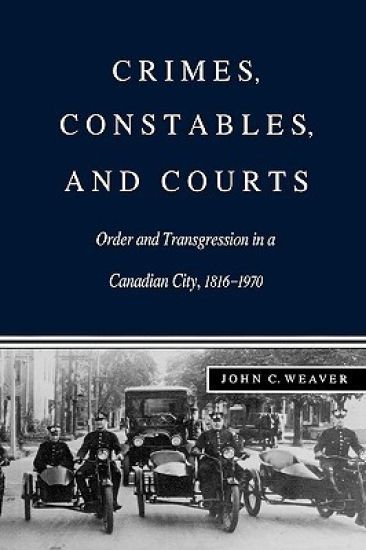
Crimes, Constables, and Courts

Crimes, Constables, and Courts

John C. Weaver

McGill-Queen's University Press
1995
sidottu
Using Hamilton, Ontario, as his model, Weaver makes extensive use of newspaper accounts and police, court, and jail records in a revealing exploration of individual crime cases and overall trends in crime. Tracing the origin and evolution of courts, juries, police, and punishments, Weaver takes into account various social and cultural issues. For example, he shows how increasing centralization and professionalization of the criminal justice system and police have deprived communities of input, and how the legal system continues to be male dominated and biased against newcomers, strangers, and marginalized social groups. Often critical of the "state," Weaver paints a sympathetic view of police constables, who play an ambiguous role in the community while being saddled with an expanding array of onerous duties. Crimes, Constables, and Courts is history at its best - informative, entertaining, and accessible with a lively human element woven throughout. "Truly outstanding." Rod C. Macleod, Department of History, University of Alberta.
Crimes, Constables, and Courts

Crimes, Constables, and Courts

John C. Weaver

McGill-Queen's University Press
1995
nidottu
Using Hamilton, Ontario, as his model, Weaver makes extensive use of newspaper accounts and police, court, and jail records in a revealing exploration of individual crime cases and overall trends in crime. Tracing the origin and evolution of courts, juries, police, and punishments, Weaver takes into account various social and cultural issues. For example, he shows how increasing centralization and professionalization of the criminal justice system and police have deprived communities of input, and how the legal system continues to be male dominated and biased against newcomers, strangers, and marginalized social groups. Often critical of the "state," Weaver paints a sympathetic view of police constables, who play an ambiguous role in the community while being saddled with an expanding array of onerous duties. Crimes, Constables, and Courts is history at its best - informative, entertaining, and accessible with a lively human element woven throughout. "Truly outstanding." Rod C. Macleod, Department of History, University of Alberta.
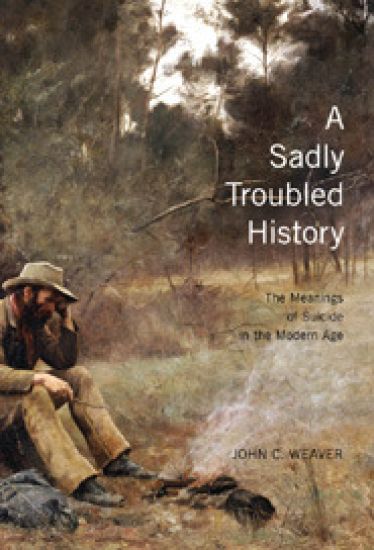
A Sadly Troubled History

A Sadly Troubled History

John C. Weaver

McGill-Queen's University Press
2009
sidottu
More people die by suicide each year than by homicide, wars, and terrorist attacks combined. Witnesses and survivors are left perplexed and troubled. Doctors, clinical psychologists, and social workers try to deal with it through their professional routines; sociologists and psychiatrists attempt to provide theoretical explanations of it. In a study of nearly 7000 suicides from 1900 to 1950 in New Zealand and Queensland, Australia, John Weaver documents the challenges that ordinary people experienced during turbulent times and, using witnesses' testimony, death bed statements, and suicide notes, reconstructs individuals' thoughts as they decide whether to endure their suffering. Bridging social and medical history, Weaver presents an intellectual and political history of suicide studies, a revealing construction and deconstruction of suicide rates, a discussion of gender, life stages, and socio-economic circumstances in relation to suicide patterns, reflections on reasoning processes and intent, and society's reactions to suicide, including medical intervention. A Sadly Troubled History marshals thousands of suicide inquests, replete with observations on the anxieties of unemployment, the heartbreak of romantic disappointment, the pain of domestic turmoil, and the torments of mental illness, to demonstrate that history - although, like biochemistry, sociology, psychology, and psychiatry, reliant on remarkable yet imperfect information - can contribute to a better understanding of the suicidal act and its motives.
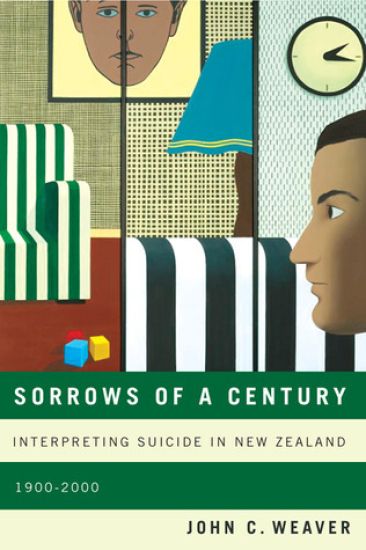
Sorrows of a Century

Sorrows of a Century

John C. Weaver

McGill-Queen's University Press
2014
sidottu
In Sorrows of a Century, John Weaver describes how personal relationships, work, poverty, war, illness, and legal troubles have driven thousands to despair. His study is set in twentieth-century New Zealand where - in spite of high standards of living and a commitment to social welfare - citizens have experienced the profound losses and stresses of the human condition. Focusing on New Zealand because it has the most comprehensive and accessible coroners' records, Weaver analyzes a staggering amount of information to determine the social and cultural factors that contribute to suicide rates. He examines the country's investigations into sudden deaths, places them within the context of major events and societal changes, and turns to witnesses' statements, suicide notes, and medical records to remark on prevention strategies. His extensive survey of twelve thousand cases also provides an insightful assessment of psychiatry and psychology in the last century. In reviewing the motives and methods of suicide, Weaver points out the complications facing deterrence. Moving beyond the timeless present of the social sciences and the irrationality emphasized in psychology, Sorrows of a Century marshals testimony to highlight the historical context and rational conduct behind suicide.