Kirjahaku
Etsi kirjoja tekijän nimen, kirjan nimen tai ISBN:n perusteella.
14 kirjaa tekijältä John Cage
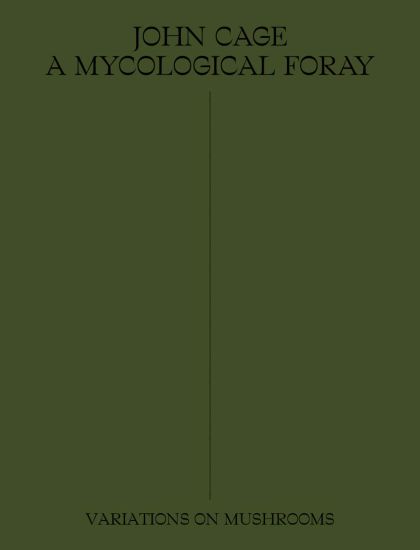
Foraging for mushrooms with John Cage: writing, art, photography and ephemera from an idiosyncratic chapter in the composer's life Imagined as an extended mushroom-foraging expedition, John Cage: A Mycological Foray gathers together Cage’s mushroom-themed compositions, photographs, illustrations and ephemera. Indeterminacy Stories and other writings by Cage are interwoven throughout the first volume within a central essay examining Cage’s enduring relationship with mycology. Also included is a transcript of Cage’s 1983 performance, MUSHROOMS et Variationes. The second volume is the inaugural reproduction of Cage’s 1972 portfolio, Mushroom Book, authored in collaboration with illustrator Lois Long and botanist Alexander H. Smith. Readers are thus drawn through the landscape of Cage’s mycologically centred oeuvre and interests, discovering assorted works, images, compositions, philosophies and ephemera, as one might encounter assorted fungi and flora while foraging. John Cage: A Mycological Foray constitutes a new, idiosyncratic chapter in Cage’s oeuvre, a departure from the composer’s more established narrative. American composer and music theorist John Cage (1912–92) was a pioneer of indeterminacy in music, electroacoustic music and a leading figure of the postwar avant-garde. His influence extended to the realms of dance, poetry, performance and visual art.

Now available in an expanded paperback edition, Diary registers Cage's assessment of the times in which he lived as well as his often uncanny portents about the world we live in now. With a great sense of play as well as purpose, Cage traverses vast territory, from the domestic minutiae of everyday life to ideas about how to feed the world. He used chance operations to determine not only the word count and the application of various typefaces but also the number of letters per line, the patterns of indentation, and in the case of Part Three, originally published by Something Else Press color. The unusual visual variances on the page become almost musical as language takes on a physical and aural presence.While Cage used chance operations to expand the possibilities of creating and shaping his work beyond the limitations of individual taste, Diary nonetheless accumulates into a complex reflection of Cage's sensibilities as a thinker and citizen of the world, illuminating his social and political awareness, as well as his idealism and sense of humor: it becomes an oblique but indelible portrait of one the most influential figures of the 20th-century American avant-garde.Collecting all eight parts into a single volume, co-editors Joe Biel and Richard Kraft also used chance operations to render the entire text in various combinations of the red and blue (used by Dick Higgins and Alison Knowles for Part Three) as well as to apply a single set of 18 fonts to the entire work. In the editors' note, Kraft and Biel elucidate the procedure of chance operations and demonstrate its application, giving readers a rare opportunity to see how the text is transformed.This expanded paperback edition reproduces the 2015 hardback edition, with a new essay by mycologist and Cage aficionado David Rose and, most important, with a significant addendum that includes many facsimile pages of Cage's handwritten notebook of a ninth part in progress, bringing the reader into compelling proximity to Cage's process and the raw material from which Diary was made.
Without doubt the most influential American composer of the last half century, John Cage has had an enormous impact not only on music but on art, literature, the performing arts, and aesthetic thought in general. His insistent exploration of “nonintention” and his fruitful merging of Western and Eastern traditions have made him a powerful force in the world of the avant-garde.There have never been lectures like these: delivered at Harvard in 1988–89 as the Charles Eliot Norton Lectures, they were more like performances, as the audience heard them. Cage calls them “mesostics,” a literary form generated by chance (in this case computerized I-Ching chance) operations. Using the computer as an oracle in conjunction with a large source text, he happens upon ideas, which produce more ideas. Chance, and not Cage, makes the choices and central decisions. Such a form is rooted, Cage tells us in his introduction, in the belief that “all answers answer all questions.”Acting as a kind of counterpoint to the six texts here are transcripts (edited by Cage) of the provocative question-and-answer seminars that followed each presentation. Included with the book are two audiocassettes, one of Cage reading a mesostic (IV), allowing the listener to experience it as it was delivered, and one with a lively selection from the question-and-answer seminars that conveys the flavor of the event. The illustrations consist of fifteen different chance-determined prints from a single negative by Robert Mahon of the first autograph page of Cage’s Sixteen Dances (1951).I–VI is, in short, an experience of John Cage, where silences become words and words become silences, in arrangements that will disconcert and exercise our minds.

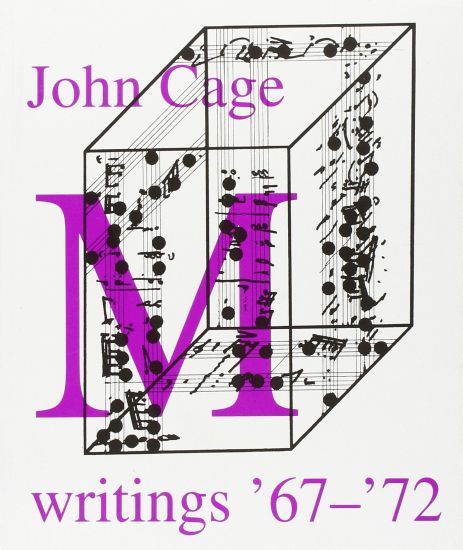

Cage voices his concerns on the nature and future of music, they ways of dancers, the West's interpretation of Eastern ideas in this thought provoking collection of anecdotes and epigrams.
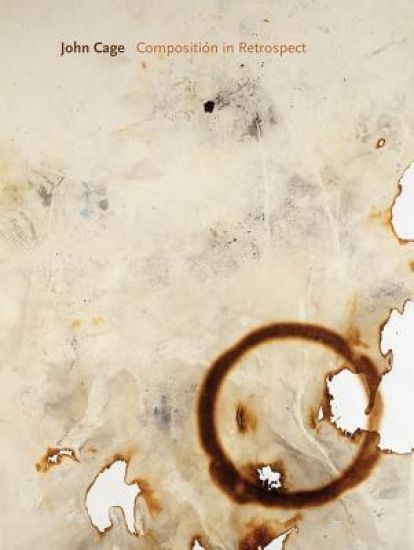
A superb introduction to the work of John Cage, celebrated minimalist composer, who died in 1992, aged 79 years. Printed in the style requested by the author, this book summarises his major works in one volume.
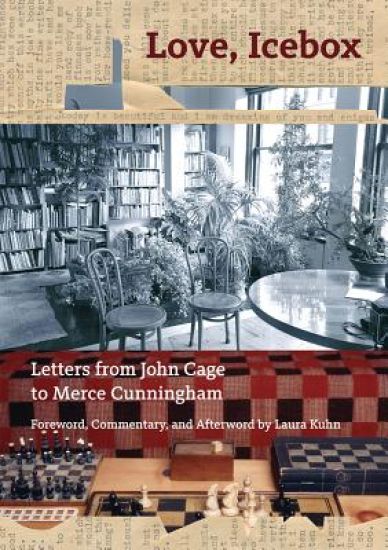
These early letters from John Cage to Merce Cunningham will be revelatory for many. While the two are widely known as a dynamic, collaborative duo, the story of how and when they came together has never been fully told. In the 39 letters of this collection, spanning 1942 46, Cage shows himself to be a man falling deeply in love. When they first met at the Cornish School in Seattle in the 1930s, Cage was 26 to Cunningham's 19, their relationship was purely that of teacher and student, and Cage was also very much married.It was in Chicago that their romantic relationship would begin. Cage was teaching at Moholy-Nagy's School of Design when Cunningham passed through town as a dancer with the Martha Graham Company on March 14, 1942. The letters begin in January, but a week after Cunningham's performance, the essential correspondence begins. Cage's letters to Cunningham are passionate, distraught, romantic and confused, occasionally containing snippets of poetry and song. They are also more than love letters, with intimations that resonate with our experience of the later John Cage.Love, Icebox takes its shape from these letters transcribed, chronologically ordered and in some instances reproduced in facsimile. Laura Kuhn, Cage's assistant from 1986 to 1992 and now longtime director of the John Cage Trust, adds an introduction, postscript and running commentary. Photographic illustrations of their final 18th St loft, as well as personal and household objects left behind, remind us of the substance and rituals of a long-shared life.