
Kirjojen hintavertailu. Mukana 12 016 292 kirjaa ja 12 kauppaa.

Kirjahaku

Etsi kirjoja tekijän nimen, kirjan nimen tai ISBN:n perusteella.

2 kirjaa tekijältä John Edward Terrell

A Talent for Friendship

A Talent for Friendship

John Edward Terrell

Oxford University Press Inc
2015
sidottu
This book frames our biological and psychological capacity to make friends as an evolved ability, comparing friendship to other evolved traits of human beings such as walking upright on two legs, having opposable thumbs and a prominent chin, and possessing the capacity for speech and complex abstract reasoning. Professor John Terrell investigates how the human brain has evolved to perform two functions essential to friendship that, at first glance, appear to be at odds with one another: remaking the outside world to suit our collective needs, and escaping into our own inner thoughts and imagining how things might and ought to be. We must all deal with our species' hereditary legacy--that we are social animals who need to include others in our lives for our biological and psychological survival. Yet we are also able to exercise the cognitive freedom to detach from the adaptive realities and demands of life. These thought patterns have important consequences for how we understand aggression and cooperation. Terrell claims that conflict is best understood in terms of friendship--as challenges that emerge when we are forced to reconcile the inner, private worlds of our imaginations with the experienced realities of our daily lives and each other.
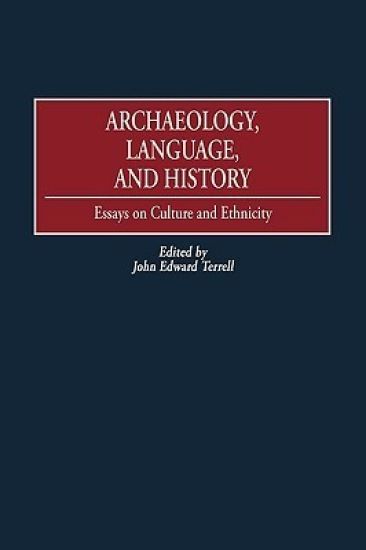
Archaeology, Language, and History

Archaeology, Language, and History

John Edward Terrell

Praeger Publishers Inc
2001
sidottu
Ever since Darwin, the world has been struggling with the mystery of human diversity. As the historian Peter Bowler has written, an evolutionary interpretation of the history of life on the earth must inevitably extend itself to include the origins of the human race. But this has proved to be a difficult and controversial task. Understanding human origins means accounting not only for the obvious differences between people and cultures around the world, but also for the unity of Homo sapiens as a single biological species. As Stephen Jay Gould has said, flexibility is the hallmark of human evolution. Because so much of who we are is learned rather than genetically predetermined, a satisfactory understanding of human evolution--to use old parlance--must account both for the human body and the human soul.At any single moment of time, it is always possible to find instances where people seem to live in their own world, speak in their own distinctive ways, and have their own exclusive cultural traits and practices. Over the course of time, however, it is not so easy to find places where these dimensions of our diversity stay together. The essays in this collection show why we must stop thinking that race, language, and culture go together, and why we should be wary of the commonsense beliefs that human races exist and that people who speak different languages come from fundamentally different biological lineages.