Kirjojen hintavertailu. Mukana 12 016 292 kirjaa ja 12 kauppaa.

Kirjahaku

Etsi kirjoja tekijän nimen, kirjan nimen tai ISBN:n perusteella.

12 kirjaa tekijältä John F. Copper

Taiwan's Mid-1990s Elections

Taiwan's Mid-1990s Elections

John F. Copper

Praeger Publishers Inc
1998
sidottu
An assessment of the recent unprecedented Taiwanese democratic elections, which, despite threats from Beijing, set the stage for genuine democracy in Taiwan. A firsthand account of three crucial elections in the 1990s, two of which were unprecedented: the 1994 election of the first governor of Taiwan and the 1996 presidential election. The latter marked the first direct election of a chief executive in Taiwan or any Chinese nation in 5,000 years of Chinese history. This study considers the political environment in which these elections were held, particular political issues, party strategies and campaigns, and election results.Taiwan is now in the final stage of democracy, and its impressive political modernization is one proof of its new status. The 1995 legislative election and the 1996 presidential election were held amidst Beijing's intimidation in the form of missile tests close to Taiwan's shores, massive military excercises, and verbal threats. Such posturing forced the United States to send aircraft carriers to the area in response. Taiwan's remarkable progress has begun to draw the attention of the leaders of developing countries who have come to see Taiwan's political modernization as a model for their own nations.
Playing with Fire

Playing with Fire

John F. Copper

Praeger Publishers Inc
2006
sidottu
One of the most pressing issues for China—and the world at large—is the continuing presence of an independence-minded Taiwan off China's southern coast. Recent modernization efforts within the Chinese military and tough remarks by Chinese officials have alarmed many in Washington, and caused others to question America's commitments in the region.Copper details events of recent decades to give the reader a complete picture of potential flash points concerning Taiwan. An expert who has studied the region for more than thirty years, he saw firsthand the turmoil that followed the recent Taiwanese elections. Drawing upon his interdisciplinary research on the political, economic, and military issues surrounding the U.S.-Taiwan-China triangle, he assesses the various aspects of this complex relationship and comments on what may come from playing with fire.Daily headlines and news stories remark upon the growing economic might of China. Analysts note that this increasing economic influence will undoubtedly lead to increasing political engagement on a global level. It is clear that the United States can no longer ignore what Napoleon called the sleeping giant.One of the most pressing issues for China—and the world at large—is the continuing presence of an independence-minded Taiwan off China's southern coast. Recent modernization efforts within the Chinese military and tough remarks by Chinese officials have alarmed many in Washington, and caused others to question America's commitments in the region.Copper details events of recent decades to give the reader a complete picture of potential flash points concerning Taiwan. An expert who has studied the region for more than thirty years, he saw firsthand the turmoil that followed the recent Taiwanese elections. Drawing upon his interdisciplinary research on the political, economic, and military issues surrounding the U.S.-Taiwan-China triangle, he assesses the various aspects of this complex relationship and comments on what may come from playing with fire.
China Diplomacy

China Diplomacy

John F. Copper

Routledge
2019
sidottu
This book, examining the process that created the Taiwan Relations Act (TRA), endeavors to assess the TRA in terms of its role in guiding or determining U.S. China policy, in preserving the sovereignty of Taiwan, in promoting democracy there, and in resolving the "Taiwan issue."
China Diplomacy

China Diplomacy

John F. Copper

Routledge
2020
nidottu
This book, examining the process that created the Taiwan Relations Act (TRA), endeavors to assess the TRA in terms of its role in guiding or determining U.S. China policy, in preserving the sovereignty of Taiwan, in promoting democracy there, and in resolving the "Taiwan issue."
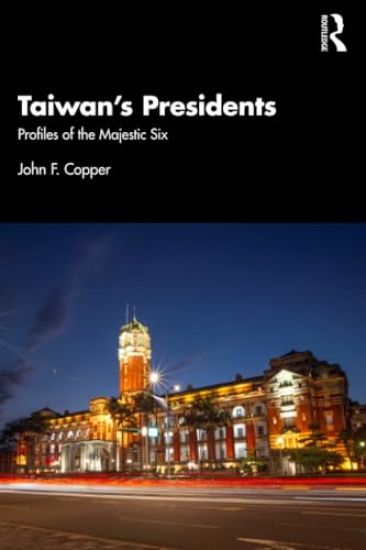
Taiwan's Presidents

Taiwan's Presidents

John F. Copper

TAYLOR FRANCIS LTD
2024
nidottu
This book profiles Taiwan’s six key presidents—Chiang Kai-shek, Chiang Ching-kuo, Lee Teng-hui, Chen Shui-bian, Ma Ying-jeou, and Tsai Ing-wen—focusing on politics, economics, elections, successes and failures in office, popularity, and democratization.By analyzing criteria of the six presidents’ leadership, such as management of crises, advancing democracy, stewardship of the economy, charisma, corruption, and handling of foreign relations, especially with China and the U.S., John F. Copper goes on to rank the presidents and predicts trends and difficulties that future presidents will face. Special attention is paid to relations with the U.S., acknowledging the U.S. as Taiwan’s political and economic model as well as its being Taiwan’s protector in the context of China’s claim to Taiwan.As an assessment of these six political leaders as well as a study of Taiwan’s political system, this book will appeal to students and scholars of Taiwan, political science, and international relations.
Taiwan's Presidents

Taiwan's Presidents

John F. Copper

TAYLOR FRANCIS LTD
2024
sidottu
This book profiles Taiwan’s six key presidents—Chiang Kai-shek, Chiang Ching-kuo, Lee Teng-hui, Chen Shui-bian, Ma Ying-jeou, and Tsai Ing-wen—focusing on politics, economics, elections, successes and failures in office, popularity, and democratization.By analyzing criteria of the six presidents’ leadership, such as management of crises, advancing democracy, stewardship of the economy, charisma, corruption, and handling of foreign relations, especially with China and the U.S., John F. Copper goes on to rank the presidents and predicts trends and difficulties that future presidents will face. Special attention is paid to relations with the U.S., acknowledging the U.S. as Taiwan’s political and economic model as well as its being Taiwan’s protector in the context of China’s claim to Taiwan.As an assessment of these six political leaders as well as a study of Taiwan’s political system, this book will appeal to students and scholars of Taiwan, political science, and international relations.
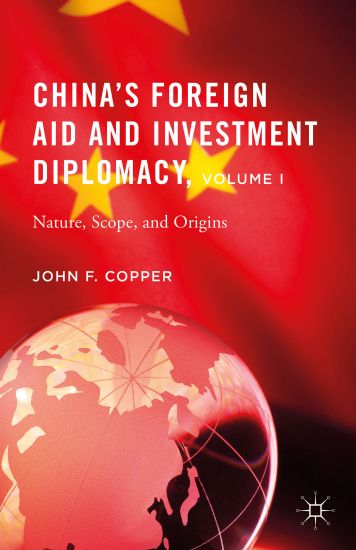
China’s Foreign Aid and Investment Diplomacy, Volume I
Today, by many accounts, China is the world's foremost purveyor of foreign aid and foreign investment to developing countries. This is the product of China's miracle economic growth over a period of more than three decades, together with China's drive to become a major player in world affairs and accomplish this through economic rather than military means. This three-volume work is the first comprehensive study of China's aid and investment strategy to trace how it has evolved since Beijing launched its foreign aid diplomacy at the time of the founding of the People's Republic of China in 1949.Volume I examines the definitions, origins, nature, and scope of foreign aid and investment by other countries. Using that background, John F. Copper then traces China's financial assistance to developing countries from the Mao period - when China gave meaningful foreign aid despite its own economic struggles - through the beginning of China's post-1978 economic boom and during subsequentdecades of rapid economic growth. Copper shows that China has a more salient history in giving foreign assistance than any other country in the world; while China's objectives in giving foreign assistance have changed markedly over time, China has always been driven by efforts to realize its foreign policy objectives and expand China's external influence.
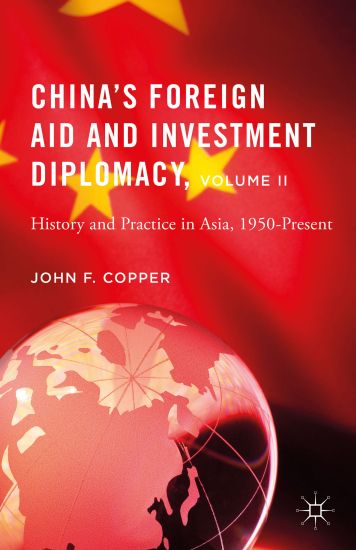
China’s Foreign Aid and Investment Diplomacy, Volume II
Today, by many accounts, China is the world's foremost purveyor of foreign aid and foreign investment to developing countries. This is the product of China's miracle economic growth over a period of more than three decades, together with China's drive to become a major player in world affairs and accomplish this through economic rather than military means. This three-volume work is the first comprehensive study of China's aid and investment strategy to trace how it has evolved since Beijing launched its foreign aid diplomacy at the time of the founding of the People's Republic of China in 1949. Volume II provides an analysis of China's foreign aid and investment to countries and regional organizations on the Asian continent, covering all of its major sub-regions, during the period from 1950 to the present day. Copper considers motivating factors such as the Korean War, the Vietnam War, and China's desire to challenge the West and later the Soviet Union. Also important to Chinaand driving its aid and investment was China's pursuit of Communist Bloc solidarity, a search for secure borders, and competition with India for influence in the Third World. Securing its imports of energy and raw materials and markets for is products came later. Marginalizing Taiwan and defeating it diplomatically constituted another goal of China's foreign aid and foreign investment analyzed here.
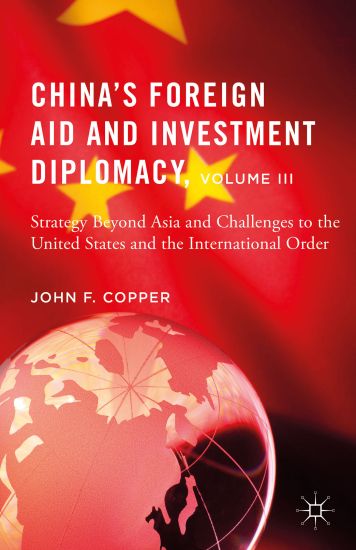
China’s Foreign Aid and Investment Diplomacy, Volume III
Today, by many accounts, China is the world's foremost purveyor of foreign aid and foreign investment to developing countries. This is the product of China's miracle economic growth over a period of more than three decades, together with China's drive to become a major player in world affairs and accomplish this through economic rather than military means. This three-volume work is the first comprehensive study of China's aid and investment strategy to trace how it has evolved since Beijing launched its foreign aid diplomacy at the time of the founding of the People's Republic of China in 1949.Volume III offers an analysis of China's foreign aid and investment to countries outside of Asia: in Africa, Europe, the Middle East, Latin America, and Oceania. Africa was and is the most important of these regions and it is given special treatment. In the concluding chapter, Copper reviews the findings of previous the volumes, delineates China's most important victories and setbacks, and notes opposition to and criticism of China's aid and investment diplomacy. Copper gives evidence that will be shocking to some of the reality that China's financial help to developing countries is one of the most salient trends in international politics and constitutes a formidable challenge to the United States, Japan, and Europe, as well as international financial institutions.
Historical Dictionary of Taiwan (Republic of China)
Taiwan is an island located off the east coast of southern China. It is the largest piece of territory under the jurisdiction of the “nation” known officially as the Republic of China. Taiwan is a place of contradictions. Its successful economic and political modernization have stimulated the imaginations of most observers. Still its nation-state status has been constricted and weakened. It covets and pursues peace; yet it is a vortex actor in global strategic/military competition. It is small; yet its importance far exceeds its size. It has long occupied a critical place in history; even though it has not sought this it appears inevitable that it will continue to be so. This fourth edition of Historical Dictionary of the Taiwan (Republic of China) covers its history through a chronology, an introductory essay, appendixes, and an extensive bibliography. The dictionary section has over 600 cross-referenced entries on important personalities, politics, economy, foreign relations, religion, and culture. This book is an excellent access point for students, researchers, and anyone wanting to know more about the Taiwan.
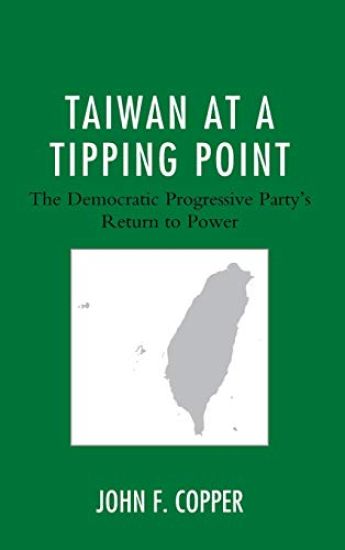
Taiwan at a Tipping Point

Taiwan at a Tipping Point

John F. Copper

Lexington Books
2017
sidottu
Taiwan at a Tipping Point assesses issues relating to Taiwan’s new political, economic, diplomatic and military/strategic state-of-affairs following the January 2016 national election that brought the then opposition Democratic Progressive Party (DPP) to power. This was a momentous event. The DPP won major presidential and legislative victories giving it an easy mandate to govern. Tsai Ing-wen became president. But ruling did not turn out to be easy. Tsai and the DPP had little experience managing the economy and their growth strategies did not work well. Their stances on Taiwan’s independence alienated Taiwan’s biggest trading partner and a nation that claims Taiwan is its territory, China. Beijing took revenge. Taiwan’s only ally, the United States, was confused and distracted in trying to formulate a new policy toward Taiwan. Promises President Tsai and the DPP made during the campaign, especially on reform and Taiwan’s national status, were hard to fulfill and for the most part were not. Post-election euphoria turned into dismay. Thus the question arose whether the president and the DPP would remain in power or whether the next elections would see the Nationalist Party or Kuomintang (KMT) return—though it remaining in the doldrums made this seem unlikely. Thus uncertainty characterized Taiwan post-election. Taiwan was at a turning point.
Historical Dictionary of Taiwan (Republic of China)
Taiwan is a place of contradictions. Its successful economic and political modernization has stimulated the imaginations of most observers. Still, its nation-state status has been constricted and weakened. It covets and pursues peace, yet it is a vortex actor in global strategic/military competition. It is small, yet its importance far exceeds its size. It has long occupied a crucial place in history even though it has not sought this status, yet it appears inevitable that it will continue to do so.Historical Dictionary of Taiwan (Republic of China), Fifth Edition contains a chronology, an introduction, and an extensive bibliography. The dictionary section has more than 600 cross-referenced entries on important personalities as well as aspects of the country’s politics, economy, foreign relations, religion, and culture. This book is an excellent resource for students, researchers, and anyone wanting to know more about Taiwan.