Kirjojen hintavertailu. Mukana 12 016 292 kirjaa ja 12 kauppaa.

Kirjahaku

Etsi kirjoja tekijän nimen, kirjan nimen tai ISBN:n perusteella.

4 kirjaa tekijältä John F. Hoffecker

Modern Humans

Modern Humans

John F. Hoffecker

Columbia University Press
2017
sidottu
Modern Humans is about the most recent-and perhaps the most important-phase of human evolution: the appearance of anatomically modern people (Homo sapiens) in Africa less than a quarter of a million years ago and their subsequent spread throughout the world. Most of the features that render living human beings unique among all forms of life evolved or developed with Homo sapiens, and in Modern Humans, John F. Hoffecker argues that humans represent a "major transition" in evolution with respect to the storage, transmission, and translation of information, as well as a quantum leap in living-system complexity. Modern Humans synthesizes data from genetics (including the rapidly growing body of ancient DNA), the human fossil record, and archaeology relating to the African origins and global dispersal of anatomically modern people. The book begins by placing humans into the broad context of the evolution of life, emphasizing the fundamental role of genetic and nongenetic forms of information in living systems, and how changes in information are tied to "major transitions" in evolution. For more than a hundred thousand years, a diverse "near modern" human population, characterized by the retention of some archaic skeletal traits and possibly lacking the full suite of cognitive faculties found in living people, occupied the African continent and expanded briefly into the adjoining Arabian Peninsula and Levant. The immediate ancestors of all living maternal and paternal lineages possibly emerged from within this population, spreading initially throughout Africa before beginning a second-and ultimately global-dispersal no later than 60,000 years ago. The later chapters of this book recount their rapid expansion into southern Asia and Australia, northern Eurasia and Beringia, and throughout the Americas.

Desolate Landscapes

Desolate Landscapes

John F. Hoffecker

Rutgers University Press
2002
nidottu
Ice-Age Eastern Europe was an inhospitable place, isolated from the moderating influence of oceans. Unlike Western Europe, which was settled over half a million years ago, Eastern Europe remained largely unoccupied until the appearance of the cold-adapted Neanderthals. When modern humans arrived from southern latitudes, they were anatomically less suited to colder climates, but successfully colonized Eastern Europe with the aid of innovative technologies that their Neanderthal predecessors lacked. John F. Hoffecker provides an overview of Pleistocene or Ice-Age settlement in Eastern Europe with a heavy focus on the adaptations of Neanderthals and modern humans to this harsh environmental setting. Hoffecker argues that the Eastern European record reveals a stark contrast between Neanderthals and modern humans with respect to technology and social organization, both of which are tied to the development of language and the use of symbols. Desolate Landscapes will bring readers up to date with the rich archaeological record in this significant region and its contribution to our understanding of one of our most important events in human evolution - the rise of modern humans and the extinction of the Neanderthals. The book is divided into seven chapters. The first discusses general anthropological principles and theories pertaining to human adaptation and development in cold environments. The second outlines the environmental conditions of the specific area under study in the book. The next two chapters focus on Neanderthal finds in the area. The following two chapters discuss the replacement of the local Neanderthal population by the Cro-magnons, and the development of their way of life in the cold Loess Steppe environment. The final chapter summarizes the discussion and is followed by an extremely valuable and extensive bibliography, more than half of which consists of non-English (primarily Russian) sources.
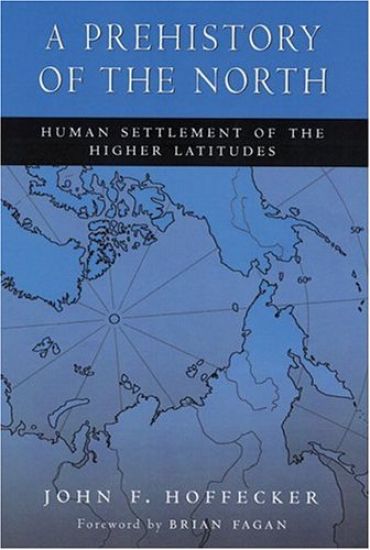
A Prehistory of the North

A Prehistory of the North

John F. Hoffecker

Rutgers University Press
2004
nidottu
Early humans did not simply drift northward from their African origins as their abilities to cope with cooler climates evolved. The initial settlement of places like Europe and northern Asia, as well as the later movement into the Arctic and the Americas, actually occurred in relatively rapid bursts of expansion. A Prehistory of the North is the first full-length study to tell the complex story, spanning almost two million years, of how humans inhabited some of the coldest places on earth.In an account rich with illustrations, John Hoffecker traces the history of anatomical adaptations, diet modifications, and technological developments, such as clothing and shelter, which allowed humans the continued ability to push the boundaries of their habitation. The book concludes by showing how in the last few thousand years, peoples living in the circumpolar zone—with the exception of western and central Siberia—developed a thriving maritime economy.Written in nontechnical language, A Prehistory of the North provides compelling new insights and valuable information for professionals and students.