Kirjojen hintavertailu. Mukana 11 244 527 kirjaa ja 12 kauppaa.

Kirjahaku

Etsi kirjoja tekijän nimen, kirjan nimen tai ISBN:n perusteella.

40 kirjaa tekijältä John Gordon

Researching Interpretive Talk Around Literary Narrative Texts
Drawing on a multidisciplinary approach integrating insights from conversation analysis, narrative analysis, and narratology, this book theorizes teaching around narrative prose in each level of education, with a focus on a new framework of Pedagogic Literary Narration which emphasizes the practice of shared novel reading and the importance of the role of the teacher in mediating this practice. // With insights taken from a comprehensive set of transcripts taken from actual classrooms, the volume focuses on the convention in native-tongue literary study in which teachers and students read a novel shared over lessons, combining periods of reading aloud with those of questioning and discussion. In so doing, Gordon seeks to extend existing methodologies from literary and social science research toward informing teaching practice in literary pedagogy and address the need for a theorization of literary pedagogy which considers the interrelationship between text-in-print and text-through-talk. Transcripts are supported with comprehensive analyses to help further explicate the research methodology and provide guidance on implementing it in the classroom. // This book is a valuable resource for scholars in language and education, literary studies, narrative inquiry, and education research.
Researching Interpretive Talk Around Literary Narrative Texts
Drawing on a multidisciplinary approach integrating insights from conversation analysis, narrative analysis, and narratology, this book theorizes teaching around narrative prose in each level of education, with a focus on a new framework of Pedagogic Literary Narration which emphasizes the practice of shared novel reading and the importance of the role of the teacher in mediating this practice. // With insights taken from a comprehensive set of transcripts taken from actual classrooms, the volume focuses on the convention in native-tongue literary study in which teachers and students read a novel shared over lessons, combining periods of reading aloud with those of questioning and discussion. In so doing, Gordon seeks to extend existing methodologies from literary and social science research toward informing teaching practice in literary pedagogy and address the need for a theorization of literary pedagogy which considers the interrelationship between text-in-print and text-through-talk. Transcripts are supported with comprehensive analyses to help further explicate the research methodology and provide guidance on implementing it in the classroom. // This book is a valuable resource for scholars in language and education, literary studies, narrative inquiry, and education research.
Sensational Joyce

Sensational Joyce

John Gordon

University Press of Florida
2025
sidottu
Exploring how Ulysses imitates the human mindat work, connecting close readings to psychological theories of Joyce's time In this book, JohnGordon uses historically oriented close readings to demonstrate that Ulyssesis a book that mimics the workings of the human mind. Gordon highlights James Joyce'sexceptional ability to capture and represent lived experiences, showing how Joyce'swritings display the ways specific minds interact with their environments. Ulyssesis portrayed here as having its own evolving consciousness. Sensational Joyce is the first bookon Joyce's psychology to engage deeply with theorists beyond Freud, Jung, orLacan. Gordon explains how Joyce used other psychological theories, likeWilliam James's ideas on stimulus and response, Gestalt psychology, JohnWatson's behaviorism, and trauma research. The book also includes discussionsof phenomena considered experimental at the time, such as telepathy, telekinesis, precognition, and spiritualism. Gordon examines the characters ofsensitive intellectual Stephen Dedalus and advertising professional Leopold Bloom, following the book's centers of consciousness into the visionary, hallucinatory, and prophetic final chapters. Gordon highlightshow Joyce's unique writing style transforms sensations and stimuli intothoughts and responses. As Ulysses progresses, the sensational--meaningsensory data--becomes sensationalistic. In tracing the contemporary theories ofpsychology evidenced in the novel, Sensational Joyce presents many newand original interpretations that can be applied to other works by Joyce, especially Finnegans Wake. A volume in the Florida James Joyce Series, edited by Sam Slote
Finnegans Wake

Finnegans Wake

John Gordon

Syracuse University Press
1986
pokkari
This is the only full-length study of Finnegans Wake to outline and catalog the immense amount of naturalistic detail from which Joyce built the book.The opening chapters describe the physical setting, time, and main characters out of which the book is constructed. John Gordon argues that behind this detail is an essentially autobiographical story involving Joyce's history and, in particular, his feelings toward his father, wife, daughter and the older brother who died in infancy.Many of the author's findings are new and likely to be controversial because recent criticism has tended to the belief that what he attempts to do cannot be done.This new study of Finnegans Wake represents a radically conservative approach and is intended to function both as a guide to the newcomer seeking a chapter-by-chapter plot summary and as an original contribution to Joyce criticism.
Joyce and Reality

Joyce and Reality

John Gordon

Syracuse University Press
2004
sidottu
Joyce was a realist, but his reality was not ours, writes John Gordon in his new book. Here, he maintains that the shifting styles and techniques of Joyce's works is a function of two interacting realities - the external reality of a particular time and place and the internal reality of a character's mental state. In making this case Gordon offers up a number of new readings: how Stephen Dedalus conceives and composes his villanelle; why the Dubliners story about Little Chandler is titled ""A Little Cloud""; why MacDowell suddenly appears and disappears; what is happening when Leopold Bloom looks for two minutes at a beer bottle's label; why the triangle etched at the center of Finnegans Wake doubles itself and grows a pair of circles; why the next to last chapter of Ulysses has, by far, the book's highest incidence of the letter C; and who is the man in the macintosh. Gordon, whose authoritative Finnegans Wake: A Plot Summary received critical acclaim and is considered one of the standard references, revises - and challenges - the received version of that reality. For instance, Joyce features ghost visitations, telepathy, and other para-normal phenomena not as ""flights into fantasy"" but because he believed in the real possibility of such occurrences.
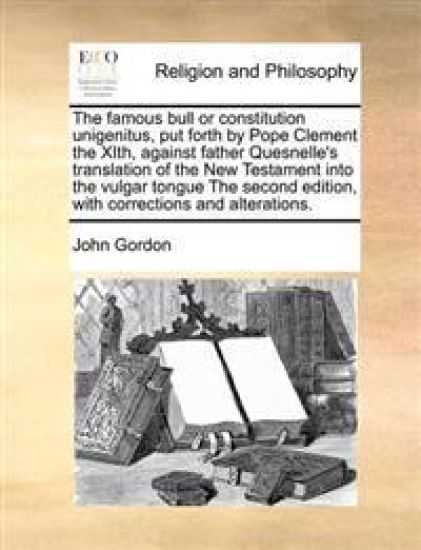
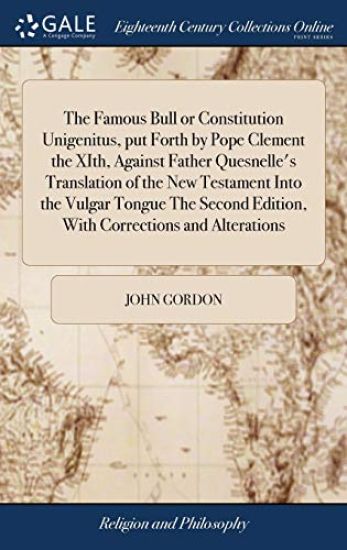
The Famous Bull or Constitution Unigenitus, put Forth by Pope Clement the XIth, Against Father Quesnelle's Translation of the New Testament Into the Vulgar Tongue The Second Edition, With Corrections and Alterations
The 18th century was a wealth of knowledge, exploration and rapidly growing technology and expanding record-keeping made possible by advances in the printing press. In its determination to preserve the century of revolution, Gale initiated a revolution of its own: digitization of epic proportions to preserve these invaluable works in the largest archive of its kind. Now for the first time these high-quality digital copies of original 18th century manuscripts are available in print, making them highly accessible to libraries, undergraduate students, and independent scholars.The Age of Enlightenment profoundly enriched religious and philosophical understanding and continues to influence present-day thinking. Works collected here include masterpieces by David Hume, Immanuel Kant, and Jean-Jacques Rousseau, as well as religious sermons and moral debates on the issues of the day, such as the slave trade. The Age of Reason saw conflict between Protestantism and Catholicism transformed into one between faith and logic -- a debate that continues in the twenty-first century.++++The below data was compiled from various identification fields in the bibliographic record of this title. This data is provided as an additional tool in helping to insure edition identification: ++++British LibraryT126850'A second part of the memoirs of the life of John Gordon, .. Containing, I. A refutation of the supremacy of the Roman Church. II. An exact chronological history of all the popes .. III. The popish doctrine of indulgences.' has a separate titlepage dated London: printed for John Oswald, 1734?]. viii,108;iv,83, 1]p., plates; 12
Teaching English in Secondary Schools

Teaching English in Secondary Schools

John Gordon

SAGE Publications Ltd
2015
sidottu
This book is an indispensable guide for anyone training to become a secondary English teacher. It provides an overview of the main topics taught in schools, informed by good teaching practice drawn from the classroom and supported by research and theory, and engages with the requirements of the 2014 National Curriculum for England. Each chapter is based around a ‘lesson feedback’ case study informed by real classroom observations combined with research findings to explore and analyse what underpins high quality English teaching. Coverage includes: · Encouraging a love of reading in your classroom · How to teach effective writing for pleasure and for information · Developing students’ grammar, vocabulary and spoken English · Inspiring teaching using drama, poetry and Shakespeare · Intelligent use of media and new literacies in teaching This is essential reading on all secondary English initial teacher education courses, including school-based (SCITT, School Direct, Teach First), university-based (PGCE) and employment-based routes into teaching.
Teaching English in Secondary Schools

Teaching English in Secondary Schools

John Gordon

SAGE Publications Ltd
2015
nidottu
This book is an indispensable guide for anyone training to become a secondary English teacher. It provides an overview of the main topics taught in schools, informed by good teaching practice drawn from the classroom and supported by research and theory, and engages with the requirements of the 2014 National Curriculum for England. Each chapter is based around a ‘lesson feedback’ case study informed by real classroom observations combined with research findings to explore and analyse what underpins high quality English teaching. Coverage includes: · Encouraging a love of reading in your classroom · How to teach effective writing for pleasure and for information · Developing students’ grammar, vocabulary and spoken English · Inspiring teaching using drama, poetry and Shakespeare · Intelligent use of media and new literacies in teaching This is essential reading on all secondary English initial teacher education courses, including school-based (SCITT, School Direct, Teach First), university-based (PGCE) and employment-based routes into teaching.