Kirjojen hintavertailu. Mukana 11 244 527 kirjaa ja 12 kauppaa.

Kirjahaku

Etsi kirjoja tekijän nimen, kirjan nimen tai ISBN:n perusteella.

7 kirjaa tekijältä John Haffenden

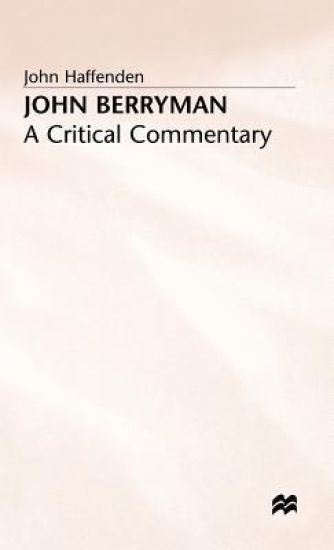
John Berryman

John Berryman

John Haffenden

Palgrave Macmillan
1980
sidottu
The poetry of John Berryman occupies an incomparable place in modern American literature. This study traces the composition of the major poems, and interprets Berryman's characteristic trials and his imaginative triumphs. In Homage to Mistress Bradstreet , which Edmund Wilson called ' the most distinguished long poem by an American since The Waste Land ', Berryman set himself enormous problems of theme and form, and overcame them with the vigorous and exciting craft that is described in this book. He transformed his personal concerns and historical interests into a fully achieved artistic unity, a poem which succeeds both as lyric and as drama. Similarly, in forging the thirteen-year 'epic' of The Dream Songs , 'the tragical history of Henry', as the poet himself called it, Berryman resolutely confronted chosen models such as Don Quixote and The Iliad , and eventually realised his own design and a unique poetic voice. 'I set up the 'Bradstreet' poem as an attack on 'The WasteLand' ' Berryman said in his National Book Award Acceptance Speech; 'I set up ' The Dream Songs ' as hostile to every visible tendency in both American and English poetry...The aim was the same in both poems: the reproduction or invention of the motions of a human personality, free and determined, in one case feminine, in the other masculine.' A chief feature of this study is the remarkably extensive use John Haffenden has made of primary research materials - manuscript drafts, notes, marginalia, diary entries and letters, all of which are printed here for the first time - to illuminate and explain the poems. This book is both a critical analysis of Berryman's mature works and an internal narrative of the poet's struggles and success. It includes comprehensive notes and commentary on 'The Dream Songs' and on 'Delusions, Etc.' , as well as an authoritative discussion and assesment of 'Love & Fame'.
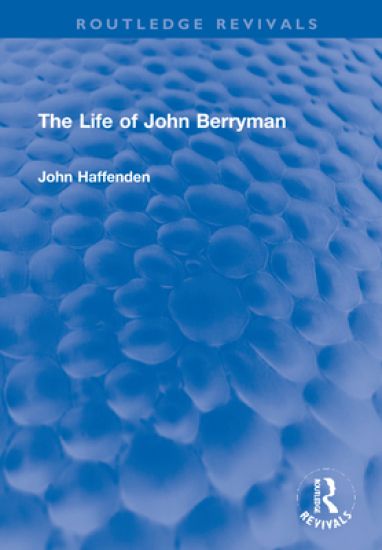
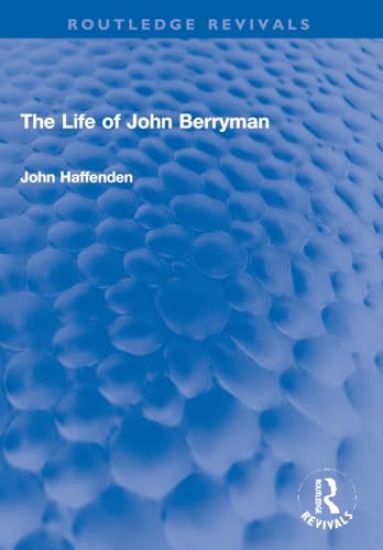
The Life of John Berryman

The Life of John Berryman

John Haffenden

TAYLOR FRANCIS LTD
2022
sidottu
First published in 1982, The Life of John Berryman draws on extensive research in the USA and on an enormous collection of hitherto unpublished materials – journals, letters, stories and poetry –to build a biography that recounts in absorbing detail the public and private stages of John Berry man’s career. It also offers an intimate portrait of a creative artist: his compulsive self-presentation and self-reproach, his moral and artistic dilemmas, his dedication and his accomplishments.John Berryman occupies a central place among the outstanding poets of recent times. The course of his life ran between the extremes of personal degradation and artistic ecstasy. He suffered the early suicide of his father, the dominance of his mother, poverty and professional setbacks, psychiatric treatment, alcoholism, and sexual and spiritual vexation. He became an electrifying, fearful teacher and a loving, jealous friend. His mentors and close associates included Mark Van Doren, Richard Blackmur, Allen Tate, Robert Lowell and Saul Bellow. The years brought him spells of deep personal joy and artistic fulfilment, but all too heavy a hand of terrible suffering. The book will be an extremely interesting read for students of literature.
The Life of John Berryman

The Life of John Berryman

John Haffenden

TAYLOR FRANCIS LTD
2024
nidottu
First published in 1982, The Life of John Berryman draws on extensive research in the USA and on an enormous collection of hitherto unpublished materials – journals, letters, stories and poetry –to build a biography that recounts in absorbing detail the public and private stages of John Berry man’s career. It also offers an intimate portrait of a creative artist: his compulsive self-presentation and self-reproach, his moral and artistic dilemmas, his dedication and his accomplishments.John Berryman occupies a central place among the outstanding poets of recent times. The course of his life ran between the extremes of personal degradation and artistic ecstasy. He suffered the early suicide of his father, the dominance of his mother, poverty and professional setbacks, psychiatric treatment, alcoholism, and sexual and spiritual vexation. He became an electrifying, fearful teacher and a loving, jealous friend. His mentors and close associates included Mark Van Doren, Richard Blackmur, Allen Tate, Robert Lowell and Saul Bellow. The years brought him spells of deep personal joy and artistic fulfilment, but all too heavy a hand of terrible suffering. The book will be an extremely interesting read for students of literature.
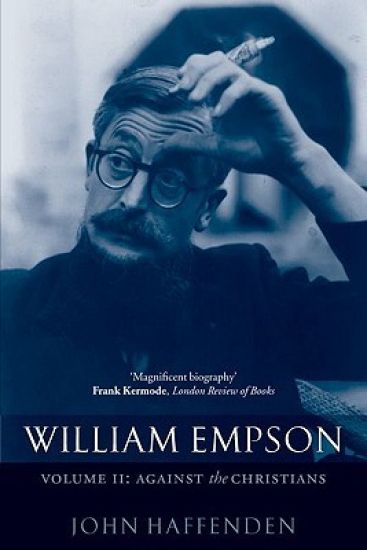
William Empson, Volume II

William Empson, Volume II

John Haffenden

Oxford University Press
2006
sidottu
Following the acclaimed first volume, Among the Mandarins, this is the second and concluding volume of the authorized biography of William Empson, one of the foremost poets and literary critics of the twentieth century. Against the Christians begins during the Second World War and follows Empson's turbulent years of writing wartime propaganda for the BBC. As Chinese Editor, he organised broadcasts to China and propaganda programmes for the Home Service, during which time his friends and colleagues included the prickly George Orwell. The effectiveness of Empson's work for the BBC provoked the Nazi propagandist Hans Fritzsche to call him a 'curly-headed Jew' -- a charge which gave him enormous satisfaction. In 1947 he returned to China, where he was caught up in the Communist siege of the Peking and witnessed Mao Tse-tung's triumphant entry. 'I was there for the honeymoon between the universities and the communists; we were being kept up to the mark rather firmly.' He saw 'the dragooning of independent thought and the hysteria of the confession meetings'. In the late 1940s he also taught in the USA, where he relished the irony of his situation. 'My position here really seems to me very dramatic; there can be few other people in the world who are receiving pay simultaneously and without secrecy from the Chinese Communists, the British Socialists, and the capitalist Rockefeller machine.' From 1953 to 1971 he held the Chair of English Literature at Sheffield, where he engaged more vigorously than ever before in public controversy, being driven by a desire to correct the wrong-headed orthodoxies of modern literary criticism -- most notably 'neo-Christianity'. He acquired massive publicity for his views on the wickedness of Christianity when he published Milton's God in 1961: 'The poem is wonderful because it is an awful warning. The effort of reconsidering Milton's God, who makes the poem so good just because he is so sickeningly bad, is a basic one for the European mind.' Haffenden presents a full account of the work on Milton, along with analyses of Empson's many other writings on subjects including Marlowe, Donne, Marvell, and Coleridge, and The Structure of Complex Words (1951). In a full and candid study of the public and private Empson, John Haffenden enables the reader to understand one of the most gifted, eccentric, witty, and controversial figures of our age -- a giant of modern literature and criticism.
William Empson, Volume II

William Empson, Volume II

John Haffenden

Oxford University Press
2009
nidottu
Following the acclaimed first volume, Among the Mandarins , this is the second and concluding volume of the authorized biography of William Empson, one of the foremost poets and literary critics of the twentieth century. Against the Christians begins during the Second World War and follows Empson's turbulent years of writing wartime propaganda for the BBC. As Chinese Editor, he organised broadcasts to China and propaganda programmes for the Home Service, during which time his friends and colleagues included the prickly George Orwell. The effectiveness of Empson's work for the BBC provoked the Nazi propagandist Hans Fritzsche to call him a 'curly-headed Jew' -- a charge which gave him enormous satisfaction. In 1947 he returned to China, where he was caught up in the Communist siege of the Peking and witnessed Mao Tse-tung's triumphant entry. 'I was there for the honeymoon between the universities and the communists; we were being kept up to the mark rather firmly.' He saw 'the dragooning of independent thought and the hysteria of the confession meetings'. In the late 1940s he also taught in the USA, where he relished the irony of his situation. 'My position here really seems to me very dramatic; there can be few other people in the world who are receiving pay simultaneously and without secrecy from the Chinese Communists, the British Socialists, and the capitalist Rockefeller machine.' From 1953 to 1971 he held the Chair of English Literature at Sheffield, where he engaged more vigorously than ever before in public controversy, being driven by a desire to correct the wrong-headed orthodoxies of modern literary criticism -- most notably 'neo-Christianity'. He acquired massive publicity for his views on the wickedness of Christianity when he published Milton's God in 1961: 'The poem is wonderful because it is an awful warning. The effort of reconsidering Milton's God, who makes the poem so good just because he is so sickeningly bad, is a basic one for the European mind.' Haffenden presents a full account of the work on Milton, along with analyses of Empson's many other writings on subjects including Marlowe, Donne, Marvell, and Coleridge, and The Structure of Complex Words (1951). In a full and candid study of the public and private Empson, John Haffenden enables the reader to understand one of the most gifted, eccentric, witty, and controversial figures of our age -- a giant of modern literature and criticism.
Novelists in Interview

Novelists in Interview

John Haffenden

Routledge
2019
sidottu
Originally published in 1985, fourteen foremost writers of fiction give detailed accounts of their writings in this absorbing collection by John Haffenden, whom The Sunday Times has applauded for having ‘perfected’ the art of the literary interview. Bringing together discussions with a wide range of authors in Britain at the time, the volume contains interviews with Martin Amis, Malcolm Bradbury, Anita Brookner, Angela Carter, William Golding, Russell Hoban, David Lodge, Ian McEwan, Iris Murdoch, V.S. Pritchett, Salman Rushdie, David Storey, Emma Tennant and Fay Weldon.John Haffenden questions them about the creative process, about specific works – including Golding’s Rites of Passage, Hoban’s Riddley Walker, Murdoch’s The Philosopher’s Pupil and Rushdie’s Midnight’s Children and Shame – and about the ideas and visions which inform those works. The writers provide lively, fascinating and often definitive responses which offer many insights into the value and function of fiction. The volume also includes discussions of cultural context and of narrative techniques and kinds – realist, postmodernist, fabulous – offering immediate material for critical debate. For all who are interested in twentieth century fiction it is essential reading.
Novelists in Interview

Novelists in Interview

John Haffenden

Routledge
2021
nidottu
Originally published in 1985, fourteen foremost writers of fiction give detailed accounts of their writings in this absorbing collection by John Haffenden, whom The Sunday Times has applauded for having ‘perfected’ the art of the literary interview. Bringing together discussions with a wide range of authors in Britain at the time, the volume contains interviews with Martin Amis, Malcolm Bradbury, Anita Brookner, Angela Carter, William Golding, Russell Hoban, David Lodge, Ian McEwan, Iris Murdoch, V.S. Pritchett, Salman Rushdie, David Storey, Emma Tennant and Fay Weldon.John Haffenden questions them about the creative process, about specific works – including Golding’s Rites of Passage, Hoban’s Riddley Walker, Murdoch’s The Philosopher’s Pupil and Rushdie’s Midnight’s Children and Shame – and about the ideas and visions which inform those works. The writers provide lively, fascinating and often definitive responses which offer many insights into the value and function of fiction. The volume also includes discussions of cultural context and of narrative techniques and kinds – realist, postmodernist, fabulous – offering immediate material for critical debate. For all who are interested in twentieth century fiction it is essential reading.