Kirjojen hintavertailu. Mukana 12 294 893 kirjaa ja 12 kauppaa.

Kirjahaku

Etsi kirjoja tekijän nimen, kirjan nimen tai ISBN:n perusteella.

4 kirjaa tekijältä John L. Locke

Eavesdropping

Eavesdropping

John L. Locke

Oxford University Press
2010
sidottu
Why we can't resist listening in on our neighbours Eavesdropping has a bad name. It is a form of human communication in which the information gained is stolen, and where such words as cheating and spying come into play. But eavesdropping may also be an attempt to understand what goes on in the lives of others so as to know better how to live one's own. John Locke's entertaining and disturbing account explores everything from sixteenth-century voyeurism to Hitchcock's 'Rear Window'; from chimpanzee behaviour to Parisian café society; from private eyes to Facebook and Twitter. He uncovers the biological drive behind the behaviour, and its consequences across history and cultures. In the age of CCTV, phone tapping, and computer hacking, this is uncomfortably important reading.

Duels and Duets

Duels and Duets

John L. Locke

Cambridge University Press
2011
sidottu
Why do men and women talk so differently? And how do these differences interfere with communication between the sexes? In search of an answer to these and other questions, John Locke takes the reader on a fascinating journey, from human evolution through ancient history to the present, revealing why men speak as they do when attempting to impress or seduce women, and why women adopt a very different way of talking when bonding with each other, or discussing rivals. When men talk to men, Locke argues, they frequently engage in a type of 'dueling', locking verbal horns with their rivals in a way that enables them to compete for the things they need, mainly status and sex. By contrast, much of women's talk sounds more like a verbal 'duet', a harmonious way of achieving their goals by sharing intimate thoughts and feelings in private.
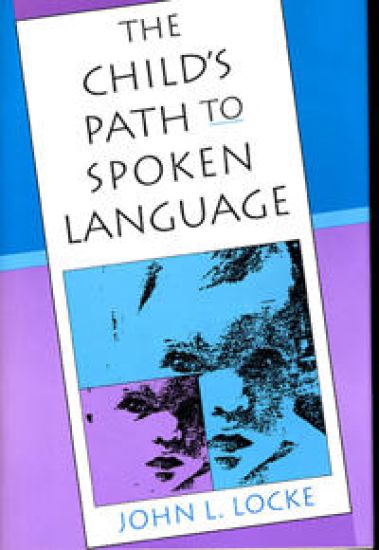
The Child’s Path to Spoken Language

The Child’s Path to Spoken Language

John L. Locke

Harvard University Press
1995
nidottu
Progressing gradually from babbling to meaningful sentences is something most babies do naturally. But why do they? John L. Locke’s answer constitutes a fascinating journey along the path of language development, a tour that takes in all the stops—neurological and perceptual, social and linguistic—that mark the way to intelligible speech. A major synthesis of the latest research on early language acquisition, this volume revises the way we understand ourselves and our approach to speech.
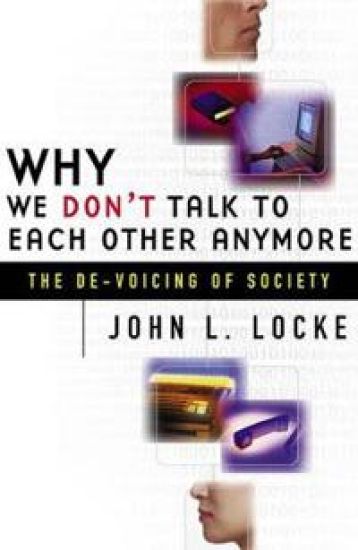
Why We Don't Talk to Each Other Anymore
We Have Arrived at the Information Age -- But Not in Person E-mail, voice mail, fax machines, beepers. Technology is overwhelming us with information, driving out the sound of human voices. We have gained the advantage of nearly constant interaction with others but make only partial connections; in the process, we are losing something precious. In this witty and intelligent book, prominent psycholinguist John Locke takes a hard look at what we are really missing as intimate forms of self-expression vanish. Talking is the way we build and maintain relationships. Talking is the way that we learn to trust one another. But we now spend our days exchanging electronic factoids, leaving us little time to "just talk." Without intimate conversation, we can't really know others well enough to trust them or work with them harmoniously. We even lose track of our own selves -- our sense of humor, our own particular way of looking at things. We become lonely. Keenly perceptive and though-provoking, "Why We Don't Talk to Each Other Anymore" is a provocative look at how we live with -- and without -- one another.